
India will count caste in 2027 for the first time since 1931. The enumerator has been told to write down whatever the respondent says, with no list to choose from. That instruction decides what the count can be used for, and the rules for turning the answers into usable categories have not been published.
When I worked on the caste tables for the Oxfam India Inequality Report 2022, every table had four boxes: Scheduled Castes, Scheduled Tribes, Other Backward Classes, and everyone else. Everything we could say about caste had to fit into those four boxes, because the surveys we drew on recorded nothing finer. Years before that, during land reform fieldwork in Bardhaman, I had learned how little four boxes hold. A household’s caste name changed with the person asking. The surveyor heard one name, the village another, and a neighbour a third.
That gap between what people say and what a form can hold is now a matter of national policy. Census 2027 will record caste for every household in the country, and it will do so with a single open column. A respondent who is not Scheduled Caste or Scheduled Tribe will say a word, and the enumerator will type it in. I have been trying to work out what that decision does to the data. This essay is about what the open column makes possible, what it makes harder, and what the Registrar General would have to publish for the numbers to be usable in a courtroom or a budget.
What the 2027 schedule asks
The Registrar General notified the population enumeration schedule on 14 August 2026. It has 40 questions. The Union government had decided in April 2025 to include caste, and the PIB’s April 2026 explainer says the comprehensive caste enumeration will happen in the population enumeration phase.
Question 10 is the caste question. According to the petition the Supreme Court later disposed of, the column offers Scheduled Caste and Scheduled Tribe, and for everyone else it provides an open text field in which the person describes their caste in their own words. SC and ST answers attach to the codes in the notified lists. Every other answer is a string of characters. Outlook reports that the enumerator records the caste or sub-caste as declared.
The open format was tried first in a pre-test. It ran from 1 to 20 July 2026 in 16 states and Union Territories, with the self-enumeration portal open for the first five days and enumerator visits from 6 July. The Wire reported the open column method when the pre-test began.
The calendar has moved since the schedule was first announced. The national window is now fixed by a notification of 30 October: optional self-enumeration from 10 to 24 January 2027, house-to-house enumeration from 25 January to 28 February, and a reference date of 1 March 2027. Four states with assembly elections due early next year were moved ahead. A September notification advanced Goa, Uttar Pradesh, Punjab and the non-snow-bound parts of Uttarakhand, and self-enumeration there opened on 16 November. It runs to 30 November, and house-to-house counting follows from 1 December to 4 January.
So the caste column is already live. Households in Uttar Pradesh, Punjab, Goa and parts of Uttarakhand are answering Question 10 this month.
Forty-six lakh names
India has run an open caste column before. The Socio-Economic and Caste Census of 2011 recorded what respondents said, and the result is the best evidence we have on what that produces.
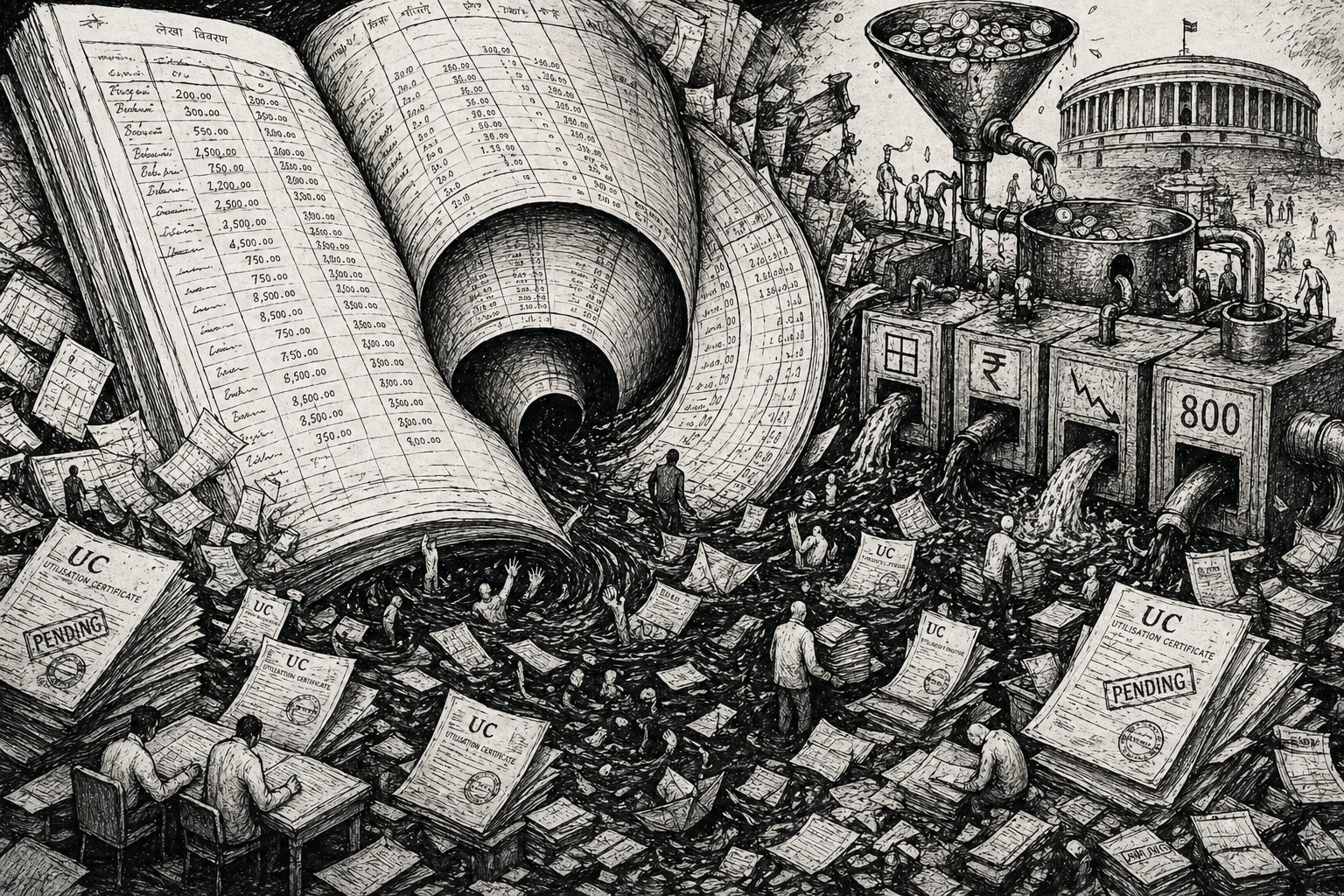
On 28 July 2015 the Home Ministry said that 46,73,034 distinct caste names had been returned. The release listed what the names included: caste and sub-caste names, synonyms, surnames, clan and gotra names, and phonetic variations. The same day the government said it had found more than 8.19 crore errors in the data, of which 1.45 crore still stood. The Cabinet had approved an expert group under Arvind Panagariya to classify the names. It never produced a classification. The Union’s later affidavit to the Supreme Court says no other members were appointed, as reported on inkl, which also records that the 1931 census counted 4,147 castes.
The numbers kept coming back in court. On 10 March 2021 the Minister of State for Home Affairs, Nityanand Rai, told the Rajya Sabha in answer to Unstarred Question 1795 from Manoj Kumar Jha that the government had no plan to enumerate caste data in the census other than for SCs and STs; the PIB release carries the same reply and the Tribune reported it. In September 2021 the Union filed an affidavit in the Maharashtra government’s writ petition. According to the same report, it said that 99 per cent of the castes enumerated had a population below 100, and that Maharashtra alone had returned 4.28 lakh caste names against 494 entries in the central SC and ST lists and the state OBC list.
On 15 December 2021 the Supreme Court dismissed Maharashtra’s plea for the raw data after the Centre’s lawyers called it unreliable. Maharashtra’s 27 per cent OBC quota in local body seats was opened up to the general category for want of data.
The affidavit also contains a sentence that the government’s own critics now quote. Paragraph 12(d), as quoted by The Pioneer, begins with the observation that there was “no registry of caste prepared prior to the conduct of the 2011 Census.” It goes on to say, in the paraphrase of that report, that a drop-down menu for selecting castes would have been ideal because it could have produced consistent data. Jairam Ramesh of the Congress made exactly this point on 18 August 2026, when he asked why the 2027 schedule lacks the menu the government recommended in 2021.

Figure 1 puts the four counts side by side. The 1931 figure and the two state figures come from lists or code books. The SECC figure comes from respondents’ own words. The SECC returned about 1,100 times as many names as the 1931 count.
The census already knows how to code free text
The open column is not a new technical problem for the Census Organisation. It has coded free text at scale before, in the mother tongue question.
In Census 2011 respondents named their mother tongue and the enumerator wrote it down. The India Forum reports 19,569 raw returns. After linguistic scrutiny they were rationalised to 1,369 mother tongues, of which 270 had more than 10,000 speakers, and then grouped into 121 languages. Gulf News reported the same totals, with 22 scheduled languages and 99 others. A further 1,474 returns were left unclassified under “other”.
The data came out in 2018, about seven years after the count. That summary of the release also reports that the returns set aside as not matching a language represented nearly 60 lakh people. I have not seen that figure in a primary source, so I treat it as indicative.

Two lessons follow from Figure 2. Coding open responses at national scale is possible, and the Census has done it. It is also slow, it loses people at the margins, and the rules used were set by experts after the count rather than published before it.
For languages that cost is tolerable. Nobody uses a language table to decide who gets a government job. Caste tables will be used that way, and this changes what a coding rule has to be.
What the data has to do in court
A caste count is only worth its cost if a government or a court can use it. The Supreme Court has said repeatedly what it needs, and the pattern in the judgments is consistent.
In Indra Sawhney (1992) the Court upheld the 27 per cent OBC quota and set the 50 per cent ceiling. The Mandal Commission whose recommendation it upheld had estimated the OBC population at 52 per cent, working from the 1931 census because nothing newer existed.
In Ram Singh v Union of India on 17 March 2015, a bench of Justices Ranjan Gogoi and Rohinton Nariman quashed the notification of 4 March 2014 that had put Jats on the central OBC list in several states. The Court held that outdated statistics cannot measure backwardness and that caste is a prominent factor in backwardness but cannot be the only one. The judgment itself shows the Union overriding the National Commission for Backward Classes.
In M. Nagaraj (2006) a five-judge bench allowed quotas in promotions only on quantifiable data on backwardness, inadequacy of representation and administrative efficiency. Jarnail Singh in September 2018 dropped the backwardness requirement for SCs and STs but kept the data on inadequate representation. The 2022 clarification held that states must devise their own yardstick and that the unit for the data is the cadre.
In Jaishri Laxmanrao Patil on 5 May 2021 a five-judge bench struck down the Maratha quota, finding that the Gaikwad Commission’s data did not show the extraordinary circumstances needed to go beyond the ceiling. Reservations, the judgment says in the words of the Court Observer’s summary, must rest on contemporaneous data.
For local bodies the Court has a three-part test, laid down in K. Krishna Murthy (2010) and applied in Vikas Kishanrao Gawali on 4 March 2021. A dedicated commission must conduct an empirical inquiry into backwardness in the local body. The proportion of seats must be fixed body by body. And the total of SC, ST and OBC seats must stay under 50 per cent. Maharashtra’s quota was stayed on 6 December 2021 for failing the first limb.
Most recently, on 1 August 2024, a seven-judge bench in State of Punjab v Davinder Singh held by 6 to 1 that states may sub-classify Scheduled Castes. The Court required that sub-classification rest on quantifiable, demonstrable data showing that the favoured sub-group is more disadvantaged and inadequately represented in state services.
Every one of these tests joins two things. One is a count of the people in a named caste or group. The other is data on what that group holds in jobs, seats or promotions. The second half has to be assembled from departmental records. The first half is the one the 2027 census is supposed to supply.
The Rohini Commission shows the difficulty. The central OBC list has 2,633 entries, and many of those entries bundle several communities, which the Commission counted as between 5,000 and 6,000 separately named castes. Its analysis of central jobs and admissions found that 97 per cent of the benefits had gone to 25 per cent of sub-castes, that 983 communities (37 per cent of the entries) had no representation at all, that 994 castes together had used only 2.68 per cent, and that ten OBC communities had taken about 25 per cent. The Commission submitted its report in July 2023.
Those are shares of seats. A seat share tells you who holds posts. It cannot tell you whether a community is over- or under-represented, because that needs the community’s share of the population as the comparison. For most OBC communities that denominator has never existed. If the 2027 returns cannot be matched reliably to the entries in the central and state lists, the denominator will still be missing after the census, and the open column will have produced a very large file that courts cannot use.
Two states that wrote a list
Bihar and Telangana made the opposite choice, and the contrast is instructive.
Bihar’s enumerators worked from a list of 214 castes, each with a code, and anyone outside the list got a separate code. The booklet enumerators carried had 215 codes, and teachers doing the work described cross-checking the book repeatedly. The state set aside ₹500 crore from its contingency fund, and the cabinet approved the outlay on 2 June 2022. The first phase of household listing ran from 7 to 31 January 2023. The Patna High Court paused the second phase on 4 May and cleared it on 1 August. The state published its findings on 2 October 2023, putting Extremely Backward Classes at 36.01 per cent and Other Backward Classes at 27.13 per cent, with Scheduled Castes at 19.65, the unreserved category at 15.52 and Scheduled Tribes at 1.68. A few outlets round the Backward Classes share to 27.12.
Telangana’s survey ran in November and December 2024 and listed 242 castes. Its questionnaire had 57 points covering about 75 data points and included categories for no caste and no religion. The Chief Minister presented the results to the Assembly on 4 February 2025. Backward Classes were 56.33 per cent of the population, made up of 46.25 per cent non-Muslim Backward Classes and 10.08 per cent Muslim Backward Classes, with Scheduled Castes at 17.43 per cent, Scheduled Tribes at 10.45 per cent and other castes at 15.79 per cent.
Because the list was coded, Telangana could then do something the Census cannot yet do. In April 2026 the state reported a backwardness index by caste and found that 135 of the 242 castes scored as more backward than the average. That is a table a commission under Davinder Singh could use.

A list does not settle the politics. Bihar’s response to its survey was a law raising the quota ceiling to 65 per cent. The Patna High Court struck the law down on 20 June 2024, and on 29 July 2024 the Supreme Court declined to stay that order, admitted the state’s appeal and listed it for hearing. The 65 per cent figure shows that coded data gets used immediately, by the people who commissioned it and by the people who challenge it.
Karnataka’s experience is a warning in a different direction. Its first survey, done in 2015 under the H. Kantharaj Commission, was shelved. According to The News Minute, the report was set aside as outdated after Vokkaliga and Lingayat leaders demanded a fresh scientific survey. The second survey began in September 2025, cost ₹635 crore, asked 54 questions and covered nearly 5.9 crore of the state’s estimated 6.26 crore people. The Backward Classes Commission handed the report to the Chief Minister on 27 May 2026. A survey that nobody trusts is as unusable as one that nobody published, and a list or a column does not settle who trusts it.
The case for the open column
The strongest defence of Question 10 deserves a fair statement, since the reasoning behind it is sound on its own terms.
A list fixes boundaries. Bernard Cohn’s essays on the colonial census argued that counting caste hardened fluid social relations into objects that could be ranked, and Nicholas Dirks, in Castes of Mind (2001), argued that colonial rule made caste into India’s master category. A drop-down that offers 214 or 242 names also tells a respondent which names count. A household whose group is missing from the state list, or listed under a name it does not use, has to pick something wrong or choose “other.” An open column records how people describe themselves, including those the lists forgot.
There is a practical case too. A central list for the whole country would have to reconcile state OBC lists that disagree on who is in them. A group can be OBC in one state and not in the next. The Registrar General can reasonably say that building one master list before the enumeration would be its own source of dispute.
The Supreme Court treated the choice as a policy question. On 28 October 2026 a bench led by Chief Justice Surya Kant disposed of the OBC Federation of India’s writ petition (Writ Petition (Civil) No. 1286 of 2026), which had asked for the recognised OBC list to be pre-loaded as a drop-down for Column 10. The Court said the issue essentially pertains to a policy decision, gave no view on the merits, and let the petitioner approach the Registrar General, with the petition to be treated as a representation. Telangana Today carried the PTI report the same day. Verdictum dates the order 31 October; the other two outlets date it 28 October, and I have followed them.
On the other side, the Congress has argued that the missing menu will make the data worse. Ramesh pointed in August to the 2021 affidavit and to the menus used in Bihar and Telangana. A letter dated 20 August from Congress president Mallikarjun Kharge and the Leader of Opposition, Rahul Gandhi, raised the same objections, and on 10 September Ramesh called the exercise “totally perverted”. Kharge’s suggestion of a drop-down goes back to a letter of 5 May 2025. These are the Opposition’s claims, and the government has not accepted them.
The government’s own answer is short. Outlook reports that the Centre has said Census 2027 will have a Code Directory and validation checks. The report names no official and gives no detail of either. I could find no published specification of the Code Directory, no coding protocol, and no tabulation plan. Coverage of the enumeration schedule and the Supreme Court order gives no official reason for choosing the open column over a list.
The portal already suggests names
A small episode in the first week of live enumeration shows that the Census has the tools for a middle path.
When the self-enumeration portal opened on 16 November, the religion question carried a list of 287 “other” religions, including ISKCON, Sarna, Shia, Sunni and Pentecostal. It was pulled within hours of going live. A government official told The Hindu that the entries had been built as predictive text, so that a respondent who typed ISKCON would be recorded without spelling variation. How the entries came to appear as a selectable list is under inquiry.
The episode went badly, and it also shows that the Census can suggest standard names to a respondent who is typing free text. The coverage I read does not say how the caste field behaves in the portal, and I would not assume it matches the religion field. But a type-ahead for caste, drawing on a state-wise list and leaving the typed text intact when nothing matches, would keep the open column and shrink the spelling problem.
What it would take
The open column can still produce usable data. The conditions are specific, and the Registrar General can meet most of them before the national window opens on 10 January 2027.
First, publish the Code Directory. A coding rule that maps spellings, gotras, surnames and synonyms to castes, and maps castes to the state and central OBC lists, is a public document. Researchers, state governments and litigants will all depend on it. Languages were coded under rules set after the fact, and I see no reason to repeat that for a question that decides quotas.
Second, add suggestions at the point of entry. The portal and the enumerator’s app can offer standard names as the person types, state by state, and keep the raw text when the person declines the suggestion. This costs a software change, and the 2027 count is digital throughout.
Third, ask a follow-up. If a respondent gives a surname, a gotra or a sub-caste name, a second prompt can ask for the caste or category the household is listed under. That lets the free text carry the household’s own description while the follow-up carries the link to a list entry.
Fourth, publish a tabulation plan before the data is released. This should say which tables will exist, for which geographies, at what threshold for small groups, and on what date. The mother tongue tables took seven years, and quota litigation cannot wait that long.
Fifth, use Parliament. A starred question asking the Home Ministry to table the Code Directory and the validation rules is cheap and answerable. The 2021 question put the Minister of State on record about the SECC data. The same device can put the Home Ministry on record about the coding rules.
There is one asymmetry to keep in view. Civils Daily’s analysis of the questionnaire points out that SC and ST returns will be clean because they come from coded lists, while OBC and general-category returns will carry the noise of free text. The OBC count is the one courts have asked for since Ram Singh, so the weakest part of the data sits where the legal need is greatest.
The last count
The last complete caste count in India was in 1931. It covered about 353 million people across British India and the princely states, and the Union’s affidavit says it recorded 4,147 castes. The volumes are in the Registrar General’s digital library, including the Imperial Tables with the caste tabulations.
Nearly a century of quota law has been argued over numbers derived from that count, such as the Mandal estimate of 52 per cent. The 2027 census will replace the 1931 number with a new one only if the returns can be matched to categories that a court, a commission or a finance department recognises.
Households in four states have until 30 November to fill in Question 10 online. Everyone else gets their turn from 10 January.
Further reading
The 2027 questionnaire and schedule
Census 2027 questionnaire notified with 40 questions (Civils Daily)
Census 2027: India’s first digital enumeration exercise (PIB, 25 April 2026)
The open column and the drop-down dispute
SECC 2011 and what went wrong
Errors and 46 lakh caste names (Business Standard, government release)
Supreme Court on Maharashtra’s plea for SECC data (Supreme Court Observer)
Reservation law and the data it demands
Jaishri Laxmanrao Patil, judgment (Supreme Court of India, 5 May 2021)
State of Punjab v Davinder Singh, case page (Supreme Court Observer)
Sub-categorisation and the Rohini Commission
State surveys
Counting and classification
Varna is a development economist and writes at policygrounds.press.



Write a comment ...