
The Tamil Nadu impasse is not an aberration. It is the predictable output of a fragmented mandate, a tribunal designed to fail, and a politics of charismatic capture that has been producing and repeating itself in the state since 1948.
From a Delhi flat, the news from Mamallapuram this week arrives in a visual grammar already familiar from Karnataka in 2018, Madhya Pradesh in 2020, and Maharashtra in 2022. Aerial drone footage of a beachside hotel. Police vans at the entrance. A morning convoy of buses with tinted windows. Television commentators count "numbers" while the men they are counting remain offscreen. The seventeenth Tamil Nadu legislative assembly, voted in barely a fortnight ago, has not yet met. Its single largest party, Tamilaga Vettri Kazhagam, is short of a majority by 5 MLAs. Those MLAs have been moved to Four Points by Sheraton at Poonjeri, on the OMR road south of Chennai, behind a police cordon thick enough to be visible from the air.
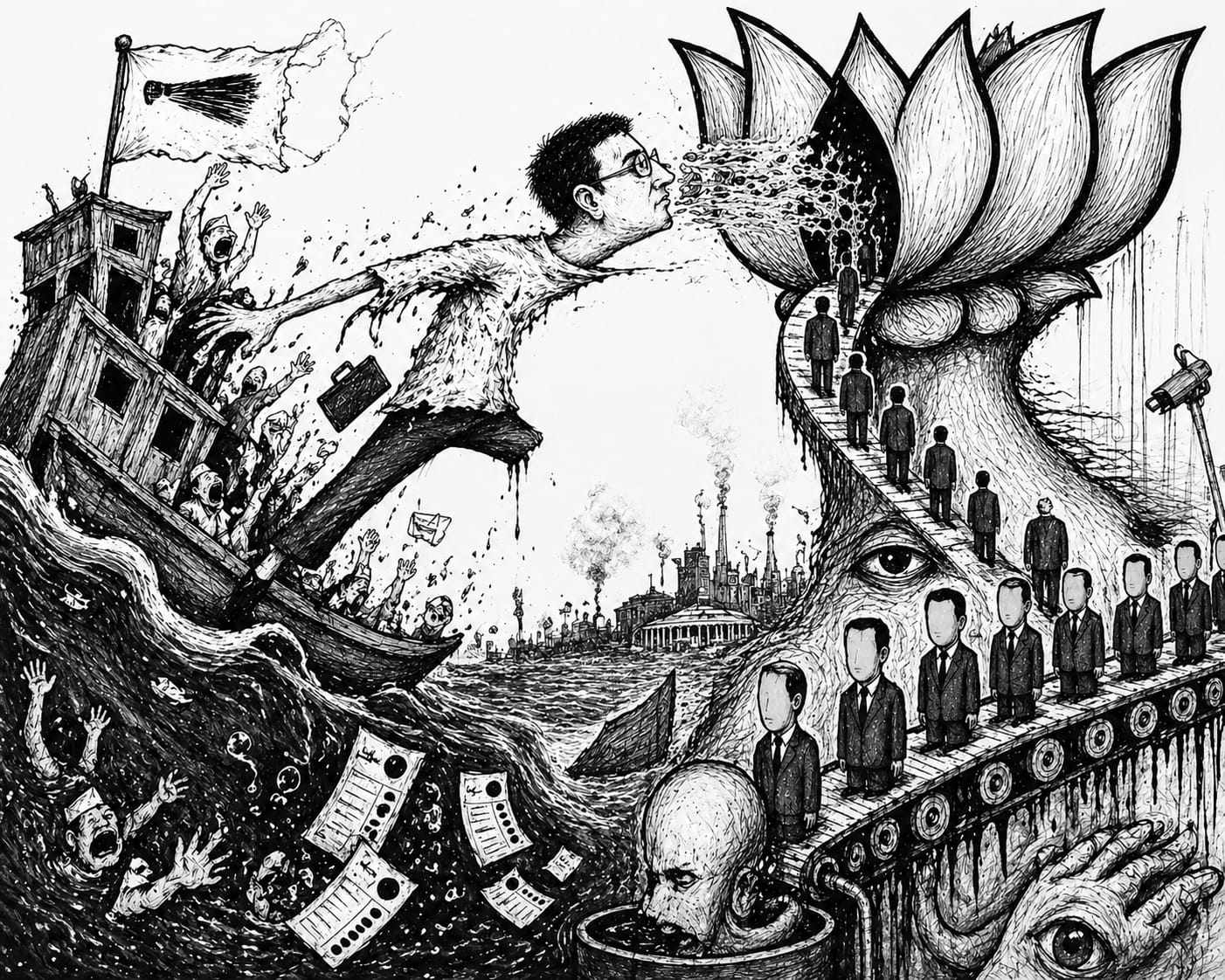
The choreography is clean enough now to have an English name. Resort politics. The party that wins fewer than half the seats but more than any other moves its members to a luxury hotel, sometimes a state guest house, occasionally a private estate, and waits. It waits for a Governor's invitation, for a friendly Speaker's order, for two or three or eight rebels from a rival party to cross over. The arithmetic is settled by sequestration. The voters who produced the assembly do not feature again until a by-election some months later, if at all. India has now done this enough times that the spectacle has become procedural rather than scandalous.
The development economics stake is not in the photographs. It is in what they signal. India is a lower-middle-income country whose structural transformation has reversed direction, whose state capacity is unevenly distributed across its constituent units, and whose welfare delivery, fiscal credibility and capital formation each depend on continuous administrative attention from elected governments. The empirical literature on political instability and economic growth is large and consistent. Alesina, Ozler, Roubini and Swagel (1996), in the foundational cross-country study, found that economies with high instability have post-per-capita GDP growth roughly one percentage point lower per year than stable counterparts, with the channel running through investment and discount rates. In India specifically, Iyer and Mani (2012) document that political turnover at the state level produces a sharp increase in transfers of district-level bureaucrats, particularly around the arrival of a new chief minister. The cost of resort politics is the policy continuity it interrupts and the institutional credibility it erodes.
This essay is about why this equilibrium is stable, why the Tenth Schedule of the Constitution, drafted in 1985 to end exactly this practice, has presided over more resort weeks than the decades preceding it, and why Tamil Nadu's particular history illuminates the wider Indian pattern. I have argued in an earlier piece on the Chadha defection that the Tenth Schedule was built less to prevent defection than to permit it through orderly channels, and that the Speaker's central role in adjudication is the design choice that makes this so. The present essay extends that argument into the development of economics: what it costs a state economy when an electoral mandate is converted, in the weeks between counting and the floor test, into a market in MLA loyalty.
Tamil Nadu's specific history is the story of a Dravidian movement which splintered twice over questions of personal succession and personal money before producing the DMK and the AIADMK, and which has now produced a third claimant in Vijay's TVK. The argument runs in four parts. First, what the numbers from this election do and do not mean. Second, the long arc from Periyar's marriage in 1948 through MGR's expulsion as DMK treasurer in 1972 to TVK's emergence in 2024, read as a sequence of charismatic-capture episodes that Indian electoral law has consistently failed to manage. Third, the resort tactic from 1967 to this week, with data on what the equilibrium produces and what it costs in foregone development. Fourth, the development economics of defection: rent, exit, voice, growth, and why electing a defector is sometimes rational at the constituency level even as it degrades the system as a whole.
What the verdict actually says
The numbers warrant a stocktake. Of the 234 seats in the Tamil Nadu assembly, TVK won 108 at its first attempt, on a vote share of 34.92 per cent. The DMK, which had ridden in on 159 seats in 2021 under M. K. Stalin, was reduced to 59. The AIADMK, in opposition for five years, ended at 47. The Indian National Congress took 5, the PMK 4, the CPI, CPI(M), VCK and IUML 2 each, the BJP, DMDK and AMMK one each. Stalin himself lost Kolathur, a seat he had won three times consecutively. Edappadi K. Palaniswami, by contrast, retained his constituency by the widest margin in the state.
Three features of the verdict deserve to be recorded before the resort overtakes the electoral analysis.
First, turnout. The Election Commission reported 84.69 per cent, eleven points above 2021 and the highest in the state's history. This was the first general election in Tamil Nadu after the Special Intensive Revision, which raised the eligible electorate from 56.7 million in February 2026 to a final 57.3 million. The SIR's role in shaping the eligible electorate is a separate question that I have engaged with in Census 2027 and the Politics of Not Knowing; for present purposes, the verdict cannot be dismissed as anti-incumbency on a thin participatory base. It is one of the most participatory mandates the state has ever delivered. As evidence of voter behaviour, it is harder to argue with than the wave verdicts of 1977 or 2011.
Second, vote share. A 34.92 per cent share at the first contest, against two parties with a combined 59-year hold on the chief minister's chair, is unprecedented in Tamil Nadu. The DMK and AIADMK together took roughly 38 per cent. TVK is therefore the largest single block of voter preference in the state, even though the seat distribution under first-past-the-post leaves it short of a majority. This matters when reading the resort: the moral claim of a 35 per cent first-time vote share is not the moral claim of a defector wedge.
Third, the gap. The majority mark is 118. TVK has 108. The Indian National Congress, which walked out of Stalin's Secular Progressive Alliance and crossed to TVK on 6 May, brings 5. That is 113. The five-seat gap is the entire reason for Mamallapuram. Without that gap, there would be a swearing-in instead of a hostage tableau. The mathematics of the gap, and what is being done about it inside the resort, is the subject of the rest of this essay.

The development stake in this particular state warrants attention. Tamil Nadu is the empirical anchor of the social-democratic developmental state in India, with HDI, female literacy, infant mortality and per capita income better than the national average and improving steadily over four decades. The work of Kalaiyarasan and Vijayabaskar describes this as the Dravidian model: a synthesis of social mobilisation, industrial policy and welfare delivery that has been broadly sustained across DMK and AIADMK governments.
I have argued in Tamil Nadu's Welfare Gamble that the model is not without contradictions, including its recent turn to unconditional cash transfers as a substitute for service delivery. But it is precisely because Tamil Nadu has built and protected this model over four decades of two-party alternation that the question of who will govern the state next, and on what programme, carries development weight that the equivalent question in many other states does not. This is not a polity that can absorb six months of administrative paralysis without a measurable cost to welfare delivery, capital execution, and the ongoing 16th Finance Commission negotiations.
The arc of charismatic capture, 1948 to 2024
Tamil politics is unusual among Indian state politics in that both its dominant electoral parties were born from social-movement schisms triggered by personal events. The DMK was born when Periyar married. The AIADMK was founded when MGR was ousted as treasurer. Each schism produced a party whose internal organisation rested on the founder's personal authority, with consequences that compound in the present.
The original organisation, the Justice Party, had become the Dravidar Kazhagam in 1944 under E. V. Ramasamy "Periyar". On 9 July 1948, Periyar, then 70, married K. A. Maniammai, who was 32. He explained later that the marriage was a legal device to make her his heir under a Hindu Civil Code that did not allow a woman to be adopted by an unrelated man. C. N. Annadurai, his chief lieutenant and presumptive successor, treated the marriage and the property arrangement around it as a betrayal of public trust in the movement and as evidence that Periyar had, despite his rationalist stance, accepted the constraints of Hindu personal law to secure private inheritance. By September 1949, Annadurai had broken away with most of Periyar's electorally minded cadre to form the Dravida Munnetra Kazhagam. A line attributed to Annadurai in secondary accounts of the period is: "We respected Periyar as a father figure, but how can a father marry his own daughter?"
The proximate cause was the marriage. The deeper question was whether the movement should enter electoral politics at all, which Periyar opposed on principled grounds, arguing that participation in elections would dissipate the moral force of the Self-Respect Movement. Annadurai disagreed and proceeded to demonstrate that he was right by leading the DMK to power in 1967, ending two decades of Congress dominance in Madras State.
The DMK's first decade in power exhibited the same fragility. When Annadurai died in 1969, M. Karunanidhi inherited the chief ministership. M. G. Ramachandran, by then the most popular film actor in the state and the DMK's treasurer, began to test the boundaries of the leadership in 1971 with mass fan-club mobilisation. By October 1972, he was, in public meetings at Thirukazhukundram and Royapettah, demanding that the party publish its accounts and that ministers declare their assets, and criticising Karunanidhi for lifting prohibition. On 10 October 1972, the DMK executive, on the requisition of 26 of its 31 members, suspended him for "anti-party activities". Within a week, he had founded the Anna Dravida Munnetra Kazhagam, later renamed All India Anna Dravida Munnetra Kazhagam. By 1977, it was in power.
The pattern is striking. The DMK was born out of the question of who would inherit Periyar's movement and its associated property. The AIADMK was born from the question of how the DMK accounted for its money under Karunanidhi. In each case, the schism turned on a personal crisis with a financial subtext, and the new party was held together by the personal authority of one man.
That logic of personal authority cashed out, predictably, in succession crises. MGR's death in December 1987 produced the Janaki-Jayalalithaa contest, which was settled only by Jayalalithaa's eventual consolidation of party control by the late 1980s. Jayalalithaa's death in December 2016 produced a longer and uglier contest involving V. K. Sasikala, T. T. V. Dhinakaran, O. Panneerselvam and Edappadi K. Palaniswami. By 2017, the contest had shifted onto the floor of the assembly, where 18 AIADMK MLAs loyal to Dhinakaran were disqualified by Speaker P. Dhanapal under the Tenth Schedule, in a decision the Madras High Court eventually upheld. The Speaker's gazette notification was issued on 18 September 2017. Without it, EPS would have lost its majority. With it, he kept the chief ministership, and the AIADMK survived its succession crisis as a single party until the 2026 verdict reduced it to opposition again.
Vijay's Tamilaga Vettri Kazhagam, formally launched in 2024, sits on the same long arc. It is a party founded around the personal authority of a film actor, with no organisational history to speak of, contesting on a platform whose particulars, beyond a claim to "Tamil pride" and a stated antipathy to the BJP, have not been spelt out in legislative detail. Its 34.92 per cent vote share at the first contest is a real signal of voter discontent with the DMK after fifteen years and with the AIADMK after the post-Jayalalithaa decade. It is also a signal that Tamil voters continue to reward charisma. The decision to sequester 108 MLAs at Four Points within hours of the result, before any negotiation with potential allies had taken place, is not a reform of this politics. It is its continuation. The opening move of the new party, before the assembly has even met, is to demonstrate that its MLAs are assets to be protected from the market, not agents of a programme.
From Aaya Ram to Mamallapuram
The resort tactic has a longer history than any of its current practitioners acknowledge. The phrase "Aaya Ram, Gaya Ram" was coined in 1967 when a Haryana MLA, Gaya Lal, switched parties three times in a fortnight. Of the 16 states that went to the polls in 1967, Congress lost its majority in eight and failed to form a government in seven. Between 1967 and 1971, PRS counted 142 defections in Parliament and 1,969 in the state assemblies, with 32 governments collapsing and 212 defectors rewarded with ministerial positions. Bihar saw five chief ministers in three years. Presidential rule was imposed in five states in succession. The Congress responded with the Tenth Schedule in 1985, brought in by Rajiv Gandhi as the 52nd Amendment.

The Tenth Schedule disqualifies a legislator who voluntarily gives up the membership of the political party on whose ticket she was elected, or who votes against a party whip. It exempts splits and mergers, originally permitting a one-third split and a two-thirds merger to escape disqualification. The 91st Amendment in 2003, responding to mass defections in Goa, Maharashtra and elsewhere, removed the one-third split exemption and retained only the two-thirds merger exception. Disqualification was made automatic for a defector taking ministerial office until re-election. The decision-making power was vested in the Speaker, who under Kihoto Hollohan v. Zachillhu (1992) was held to act as a tribunal, with a final order subject to judicial review.
The Tenth Schedule has not stopped resort politics. It has, on the available evidence, increased the price of an individual defection, formalised the technique of mass merger, and shifted the locus of strategic delay to the Speaker's office. A short catalogue of the post-2003 cases gives the empirical texture.
In 2008, the BJP's Karnataka government used "Operation Lotus" to engineer the resignation of Congress and JD(S) MLAs, who then re-contested by-elections on BJP tickets. The Speaker disqualified them; the Karnataka High Court reversed; the Supreme Court eventually reinstated the disqualifications, by which time the assembly had completed its term. In 2016, in Uttarakhand, nine Congress MLAs were disqualified before a floor test that the Harish Rawat government narrowly won, after a sequence of Speaker, Governor, High Court, President's Rule and Supreme Court interventions within two months. In Karnataka in July 2019, 17 Congress and JD(S) MLAs resigned en bloc; the Speaker rejected the resignations and disqualified them, the Supreme Court upheld the disqualification but allowed them to contest by-elections, which most won on BJP tickets. The Yediyurappa government took office.
In November 2019, Maharashtra produced an overnight government, with Devendra Fadnavis sworn in as chief minister at 8 a.m. on 23 November and the NCP's Ajit Pawar as deputy, on the strength of an undisclosed letter of support; the arrangement collapsed within 80 hours and the Uddhav Thackeray-led MVA government took office. In March 2020, Jyotiraditya Scindia and 22 Congress MLAs resigned in Madhya Pradesh, the Kamal Nath government fell on 20 March, and Shivraj Singh Chouhan returned as chief minister; the resigned MLAs largely won the consequent by-elections on BJP tickets. In June 2022, Eknath Shinde left Mumbai with a section of Shiv Sena MLAs, held them in Surat and then Guwahati, returned to claim that he and his faction were the "real" Shiv Sena, and was sworn in as chief minister. The Maharashtra Speaker took until January 2024 to decide the disqualification petitions and decided them in Shinde's favour. Goa has seen serial defections, including the 2022 mass merger of ten Congress MLAs to the BJP under the merger exception. Manipur, Arunachal Pradesh, Meghalaya and Nagaland have each seen comparable episodes.
The Telangana case is the most recent illustration of the design failure. Between March and April 2024, ten BRS MLAs defected to the ruling Congress. Disqualification petitions were filed within days. The Speaker took no decision for over a year. In Padi Kaushik Reddy v. State of Telangana (July 2025), a bench led by Chief Justice B. R. Gavai held that the Speaker enjoys no constitutional immunity in discharging his Tenth Schedule functions and directed him to decide within three months. The Speaker missed the deadline, granted further extensions through November 2025 and February 2026, and, by March 2026, had dismissed all petitions on the ground of "no conclusive documentary or legally sustainable evidence". The defections had been in operation for two years by then. The defecting MLAs had voted on the Telangana state budget for two cycles. The High Court is now hearing the BRS challenge.
In April 2026, seven of the Aam Aadmi Party's ten Rajya Sabha MPs merged the AAP legislature party in the Upper House with the BJP, invoking the two-thirds merger exception of the 91st Amendment. AAP's challenge, that the merger of the original political party rather than the legislature party is required, is pending. Within three weeks, on 4 May 2026, Tamil Nadu produced its result, and the resort phase began.
The pattern across these episodes is consistent. The Speaker is asked to act as a neutral tribunal in a context where her own political survival depends on the outcome. Please invite the right party to form a government and set the date of the floor test. The judiciary is asked to police both, generally after the political fact has been established. The 91st Amendment closed the one-third loophole and opened a two-thirds loophole. The resignation strategy, in which an MLA resigns rather than votes against the whip and then contests a by-election on a new party ticket, was not anticipated in the original drafting and remains unaddressed.
The economics of the equilibrium
The persistence of this equilibrium is what needs explaining. The conventional answer is moral failure: politicians are venal, parties are unprincipled, voters are credulous. The development economics answer is more useful because it suggests where to intervene.
Begin with Albert Hirschman's exit-voice-loyalty schema, which dev econ has applied to settings from public services to firm governance. In a well-functioning party, an MLA who disagrees with the leadership has voice (internal contestation), and loyalty (continued participation despite disagreement) as her primary options; exit (defection) is a last resort whose costs are high. The Tenth Schedule was meant to raise the cost of exit by attaching a disqualification to it. In practice, the merger and resignation routes have lowered exit costs, while the absence of internal democracy in most Indian parties has eliminated voice. Loyalty, in this setting, is whatever the leadership pays for. The MLA's bargaining position is therefore strongest when the assembly is fragmented, because her single vote is decisive in forming a government.
Pranab Bardhan's work on rent-seeking equilibria in Indian politics provides the second piece. Where institutional rules are weakly enforced and discretionary power is high, political actors will invest in capturing rents from that discretion rather than in productive activity. The MLA at Mamallapuram is doing exactly this. Sequestered, she is unavailable to the rival party that might bid for her vote. Released into a successful coalition, she is in line for a ministry, a chairmanship, a constituency project. The cost of producing this rent is a few weeks at a hotel, paid for by the party, plus the political cost of being seen as sequestered. The expected return is significant for an individual MLA in a Vidhan Sabha where ministerial portfolios determine access to a state budget, which, in Tamil Nadu's case, is approximately Rs 4.39 lakh crore for 2025-26.
The growth dimension of this equilibrium is the part most often missed. Karan Makkar's 2023 paper in the European Journal of Political Economy uses a close-election regression discontinuity design on Indian state assembly results between 1974 and the present, with constituency-level GDP proxied by night-light growth. The estimate is that electing a defector from the governing party to a state assembly raises annual GDP growth in the constituency by 0.13 to 0.48 percentage points, equivalent to 2 to 7.5 per cent of the constituency growth rate. Defectors are 2 to 3 times more likely than non-defectors to become ministers. The mechanism is plausible: a defector who joins the ruling side gets ministerial resources, project allocations and bureaucratic attention for her constituency. The implication for institutional design is uncomfortable. From the constituent's point of view, electing a candidate likely to defect to power is a rational individual choice. The cost of defection is borne by the electoral mandate, a public good that the constituent cannot internalise.
This individual rationality is one-half of the development story. The aggregate cost is the other. Iyer and Mani's 2012 work in the Review of Economics and Statistics shows that political turnover in Indian states produces a sharp increase in bureaucratic transfers, with new chief ministers reassigning a significant share of district-level officers and higher-skilled bureaucrats facing fewer politically motivated transfers than less-skilled ones. The authors are careful to note that they do not find robust evidence of a direct negative impact of these transfers on district-level development outcomes; the documented effect is on the structure of bureaucratic incentives, particularly the implicit return to political loyalty over technical competence. The longer-run development implication, though not directly identified in their data, is that bureaucracies that expect frequent political churn invest less in the place-specific knowledge and continuity that complex programme delivery requires. Resort politics, by producing chief ministers whose mandate rests on a sequestered legislative arithmetic rather than a coherent programme, both raises the frequency of these transfers and amplifies the perception of churn.
Banerjee and Pande's "Parochial Politics" frames a related long-run consequence. Their argument, applied to ethnic voting in India, is that when voters select politicians based on group identity rather than policy quality, the average quality of elected representatives declines, with the effect more pronounced when one group dominates the electorate. The mechanism generalises to charismatic-capture politics: when voter selection runs through identification with a personality rather than evaluation of a programme, the filtering function that an organised party performs is bypassed, and the legislators selected on this basis face weaker accountability for their post-election conduct. The defection equilibrium is the late-stage symptom; weak ex ante candidate filtering is the early-stage cause. Asher and Novosad's 2017 paper in AEJ: Applied Economics, examining Indian state-level growth using close-election RD, finds that constituencies represented by the ruling party experience roughly 1.1 log points higher annual employment growth than constituencies represented by the opposition. This is the development outcome that the defector buys for her constituency with her switch, and it is also the structural feature that makes the switch rational at the local level even when it degrades the electoral system as a whole.
Persson and Tabellini's work on the economic effects of constitutional rules supplies the closing analytical brick. Different electoral and parliamentary rules produce different equilibria over the size and composition of public spending, the quality of governance and the long-run growth path. The Tenth Schedule is not a constitutional system in itself. It is one of the parameters in India's constitutional system. Changing it changes outcomes. The persistence of the resort tactic suggests that the parameter has been set in a way that yields a stable equilibrium among defectors, leaders, and the electorate, in which each adopts a locally rational strategy that yields a globally suboptimal outcome.
The standard development economics literature on limited access orders (North, Wallis, and Weingast) describes such systems as ones in which the rents from manipulating political access are large enough that elites will not voluntarily move to a more open order. India's 9.8 per cent MLA defection rate between 2016 and 2020, against the 0.3 per cent rate among American state legislators in the same period, is not a difference in political culture. It is a difference in the price of exit, the availability of voice, and the rents available from joining a winning side. The Tamil Nadu impasse is one realisation of that price differential.

Why the Tenth Schedule cannot solve the problem it was written for
The structural reason the Tenth Schedule fails is that it was drafted to address parliamentary defection in an era of relatively coherent national parties, and it has been deployed in an era of fragmented mandates and weakly institutionalised parties. Three specific design failures recur.
The Speaker is the first. As a presiding officer who is also a serving member of the ruling party, the Speaker is asked to adjudicate disqualification petitions whose outcomes directly affect her party's survival. The Tamil Nadu Speaker's 2017 decision, which sustained the EPS government against Dhinakaran, was made by a Speaker from the same party. The Maharashtra Speaker's decision in January 2024, which sustained the Shinde government, was made by a Speaker elected on the votes of the post-split ruling coalition.
The Telangana Speaker's decision in March 2026, which protected the defectors who had crossed to his own party, was made by a Speaker of that party. The pattern is not partisan. It is structural. The Supreme Court has repeatedly directed Speakers to decide within three months, and Speakers have repeatedly missed the deadline without consequence. The Sarkaria Commission, the Punchhi Commission and the National Commission to Review the Working of the Constitution have each recommended shifting this function to an independent tribunal. None of them has been acted on.
The merger exception is the second. The 91st Amendment retained a route by which two-thirds of a legislative party can merge with another party without triggering disqualification. The technical question of whether the original political party, or only the legislative party, must so merge has been litigated repeatedly without resolution. The April 2026 AAP Rajya Sabha case is the most recent test. The merger exception now functions as a price list: a party that can secure two-thirds of a rival's legislators can absorb them lawfully. A party that wants to engineer a smaller defection uses the resignation-and-by-election route instead, which is not covered by the Schedule at all.
The Governor is the third. Constitutional convention permits the Governor wide discretion in inviting a party to form government and in setting the floor test. The Karnataka 2018 case, the Maharashtra 2019 case and the Maharashtra 2022 case each turned on the Governor's choice of timing. The Supreme Court intervened in each, generally to require an immediate floor test, but the convention itself has not been codified. The judgement in Rameshwar Prasad v. Union of India (2006) and the discussion in S. R. Bommai v. Union of India (1994) provide the principles, but their application is case-by-case. In Tamil Nadu this week, the Governor's decision on whether and when to invite Vijay is the procedural hinge of the entire impasse.
These three design failures interact. A defector who is uncertain whether her Speaker will disqualify her can use the resignation route to reduce risk. A party uncertain of two-thirds support can use the resort route to find the missing legislators. A Governor uncertain of the political balance can delay the floor test until the resort phase produces a result. The Tenth Schedule does not address any of these problems because it was not written to address them.
The fiscal cost that nobody books
Resort politics is not free, and the costs are not borne by the parties that practise it. Three categories deserve at least a short accounting.
State budget execution is the first. A state without a confirmed government cannot table its annual budget on schedule, release the second instalment of central transfers under the Finance Commission's award, or complete the procedural steps required for the next year's plan. Tamil Nadu's budget for 2025-26 was presented in March 2025; the implementation reports for the closing quarter are pending the new government, as is the framing of the 2026-27 budget. The state's own tax revenue of approximately Rs 2.2 lakh crore is materially exposed to administrative continuity. Capital expenditure, which suffers most when administrative attention is diverted, falls disproportionately on infrastructure, health, and education. The Indian fiscal cycle is, in any case fragile: I have argued in The Budget That Parliament Voted On Has Already Expired that the gap between the budget Parliament authorises and the budget the government implements has widened to the point of routine, and in Reading the Centre's Books that the Union's fiscal opacity already leaves states with limited information on their own divisible-pool entitlements. State-level political instability compounds this opacity at the implementation end.
Federal transfers are the second. The 16th Finance Commission is currently finalising its award for the period from 1 April 2026. Tamil Nadu, as a high-contributor state with a long-standing position on the erosion of the divisible pool through cesses and surcharges, has a substantial stake in the conduct of these negotiations. A government formed through resort politics, with a chief minister whose Hindi is reportedly limited and whose political experience amounts to two years, is poorly placed to negotiate. The legislative balance in the Rajya Sabha has also shifted decisively against opposition states, as I have argued in The Last Dam Has Broken, meaning the central government's policy menu is now executable without state-level checks that previously slowed it. A weakened Tamil Nadu government enters this configuration at a moment of maximum federal asymmetry.
Policy continuity is the third. Tamil Nadu's flagship welfare schemes, including the Kalaignar Magalir Urimai Thogai cash transfer to women, which I have written on for BehanBox, depend on continuous administrative attention from the Secretariat. The breakfast scheme, the free bus pass for women, the urban employment guarantee and the medical insurance programme each have implementation pipelines that are interrupted when ministerial portfolios are uncertain. The work of Khemani on credibility constraints in welfare delivery shows that programmes whose continuity is in doubt receive less administrative effort even before they are formally suspended, because frontline staff anticipate the disruption. Voters who returned a 35 per cent vote share to a new party, in part on the strength of these schemes, will discover the cost of that vote in the months when those schemes are administered without political ownership.
A back-of-the-envelope estimate of the development cost of a hung-mandate transition is hard to construct from existing literature, precisely because the empirical work that documents the political-instability mechanism (Iyer-Mani on bureaucratic churn, Makkar on defector growth premiums) does not directly identify the welfare-delivery cost at the state level. What can be said is this: Tamil Nadu's annual programme expenditure on welfare and human development is in the range of Rs 1 lakh crore. Even a one per cent disruption in delivery efficiency over a single year, well within the range of plausible estimates extrapolated from the bureaucratic turnover literature, implies foregone welfare delivery of the order of Rs 1,000 crore. This is not a precise estimate. It is a lower bound on what is at stake. The more troubling implication is that the lack of precise estimates is itself a feature of the equilibrium: the cost is dispersed enough to be unrecorded in any single fiscal account, but real enough to show up in the longer-run divergence between TN's own welfare delivery and what its administrative capacity is in principle able to deliver.
What might be done
The reform menu is not new. It is the reluctance to enact it that is the question.
The Speaker's role in adjudicating disqualification should be removed and given to an independent body, either a tribunal under the Supreme Court or the Election Commission. This was the recommendation of the Dinesh Goswami Committee in 1990, the Law Commission's 170th Report, the Sarkaria Commission, the Punchhi Commission and the NCRWC. The legal change required is a constitutional amendment to Paragraph 6 of the Tenth Schedule. The political change required is rare: a moment when both Houses of Parliament are willing to disempower their own Speakers.
The merger exception should be closed. The original 1985 design exempted a one-third split; the 91st Amendment narrowed this to a two-thirds merger; the next amendment should remove the exception entirely. A defector should be a defector, regardless of whether she is one of two or one of twenty. The legitimate concerns about a party's right to split on principled grounds can be addressed by requiring a defector to resign and seek re-election, with disqualification applying to her current term, and by allowing her party to contest the by-election if it has her support.
The Governor's discretion in inviting the formation of a government should be codified. The convention is presently that the single largest party is invited first, then the largest pre-poll alliance, then the largest post-poll combination. The convention should be that the assembly itself, in its first sitting after the result is declared, votes for a leader of the house, with the Governor's role limited to calling that sitting within ten days of the declaration of results. This removes both the discretionary delay and the bargaining incentive that the resort tactic exploits. The same logic of binding constitutional discretion to clear timelines applies to the delimitation question I have addressed elsewhere: structural constitutional questions decided through executive discretion, rather than by legislative timetable, produce predictable patterns of capture.
The resignation strategy should be brought within the Tenth Schedule. An MLA who resigns from her seat within two years of election and then contests a by-election on the ticket of another party should be treated, for purposes of disqualification, as having defected. Her party of the original election should retain the right to issue a no-objection. Without such a no-objection, she should be barred from holding ministerial office in the new government for the remainder of the term.
None of these is a complete solution. Each addresses one of the three design failures of the Tenth Schedule. Together, they would not abolish defection. They would change the price.
The view from Mamallapuram
The men at Four Points by Sheraton this week are not the most powerful figures in Indian politics. They are temporarily powerful. Their power consists entirely of being unavailable to be counted on the floor of the assembly until their party's leadership has settled the terms of their availability. This is the precise inversion of the relationship that the Tenth Schedule was supposed to produce, in which an MLA's vote is owed to the voter and the manifesto, not held in trust against the highest bid.
Tamil Nadu's two big parties were each born from a refusal to accept this kind of capture. Annadurai broke with Periyar over a marriage that he read as private inheritance dressed as a movement business. MGR broke with Karunanidhi over party accounts that he could not get the leadership to publish. Each schism, in its own moment, claimed to be a return to first principles. Each produced a party that ended up reproducing exactly the personalist authority it had rebelled against. Vijay's TVK enters this sequence at the moment of its third repetition. The decision to begin with the resort, before negotiation, before the assembly has met, is not a break with the pattern. It is the pattern's most efficient form yet, freed of even the pretence of internal disagreement.
The 35 per cent vote share is real. The verdict against the DMK is real. The end of a 59-year duopoly is real. None of these justifies what is happening at Four Points. The institutional problem is not that voters chose the wrong party. The institutional problem is that the rules under which a chosen party forms a government allow the resort to settle questions that the ballot did not. Until those rules are changed, the next state to vote will produce another resort, with another five-seat gap, and another set of MLAs whose week at a hotel will be remembered as the moment their mandate went private.
Further Reading
On the Tenth Schedule and its case law
Tenth Schedule of the Constitution of India ([MEA text](https://www.mea.gov.in/Images/pdf1/S10.pdf)). Kihoto Hollohan v Zachillhu, AIR 1993 SC 412 ([Indian Kanoon](https://indiankanoon.org/doc/1686885/)). Subhash Desai v Principal Secretary, Governor of Maharashtra, 2023 INSC 516 ([Indian Kanoon](https://indiankanoon.org/doc/12168609/)). Padi Kaushik Reddy v State of Telangana, 2025 ([Supreme Court Observer](https://www.scobserver.in/journal/supreme-court-speaker-does-not-enjoy-constitutional-immunity/)). Vidhi Centre for Legal Policy, [Anatomy of India's Anti-Defection Law](https://vidhilegalpolicy.in/research/anatomy-of-indias-anti-defection-law/), 2023. PRS Legislative Research, [The Anti-Defection Law: Intent and Impact](https://prsindia.org/files/parliament/discussion_papers/The_Anti-Defection_Law.pdf).
On the development economics of political instability and defection
Karan Makkar, "Defector Politicians and Economic Growth: Evidence from India," European Journal of Political Economy, vol. 79, 2023 ([Elsevier](https://www.sciencedirect.com/science/article/abs/pii/S0176268023000861)). Lakshmi Iyer and Anandi Mani, "Traveling Agents: Political Change and Bureaucratic Turnover in India," Review of Economics and Statistics, vol. 94 no. 3, 2012, pp. 723–739 ([MIT Press](https://direct.mit.edu/rest/article/94/3/723/58005/Traveling-Agents-Political-Change-and-Bureaucratic)). Sam Asher and Paul Novosad, "Politics and Local Economic Growth: Evidence from India," American Economic Journal: Applied Economics, vol. 9 no. 1, 2017, pp. 229–273 ([AEA](https://www.aeaweb.org/articles?id=10.1257/app.20150512)). Alberto Alesina, Sule Ozler, Nouriel Roubini and Phillip Swagel, "Political Instability and Economic Growth," Journal of Economic Growth, vol. 1 no. 2, 1996, pp. 189–211 ([Springer](https://link.springer.com/article/10.1007/BF00138862)). Mala Lalvani, "Sounding the Alarm: Impact of Political Instability on Growth and Fiscal Health of the Indian Economy," Economics of Governance, vol. 4 no. 2, 2003, pp. 103–114 ([Springer](https://link.springer.com/article/10.1007/s101010200047)). Abhijit Banerjee and Rohini Pande, "Parochial Politics: Ethnic Preferences and Politician Corruption," CID Working Paper 147, Harvard University, 2007 ([CID page](https://www.hks.harvard.edu/centers/cid/publications/faculty-working-papers/cid-working-paper-no.-147)). Albert O. Hirschman, Exit, Voice, and Loyalty, Harvard University Press, 1970 ([HUP](https://www.hup.harvard.edu/books/9780674276604)). Pranab Bardhan, The Political Economy of Development in India, Oxford University Press, 1984. Torsten Persson and Guido Tabellini, The Economic Effects of Constitutions, MIT Press, 2003 ([MIT Press](https://mitpress.mit.edu/9780262661195/the-economic-effects-of-constitutions/)).
On Tamil Nadu's political genealogy and developmental model
A. Kalaiyarasan and M. Vijayabaskar, The Dravidian Model: Interpreting the Political Economy of Tamil Nadu, Cambridge University Press, 2021. "The September which split Dravidians: Periyar weds Maniyammai, DMK is born," The News Minute ([link](https://www.thenewsminute.com/article/september-which-split-dravidians-periyar-weds-maniyammai-dmk-born-49850)). "Maniammai: Beyond Periyar's wife, a fierce Dravidian leader and activist," The News Minute ([link](https://www.thenewsminute.com/tamil-nadu/maniammai-beyond-periyars-wife-a-fierce-dravidian-leader-and-activist)). "How and why MGR launched ADMK 50 years ago," Daily Mirror ([link](https://www.dailymirror.lk/opinion/How-and-why-MGR-launched-ADMK-50-years-ago/172-247286)).
On the institutional decay frame
Atul Kohli, Democracy and Discontent: India's Growing Crisis of Governability, Cambridge University Press, 1990. Devesh Kapur and Pratap Bhanu Mehta (eds), Public Institutions in India: Performance and Design, Oxford University Press, 2005.
Author's prior pieces relevant here
[Counters Without Outcomes: The Chadha Defection and What India's Anti-Defection Law Was Built to Permit](https://varna.stck.me/post/1858822/Counters-Without-Outcomes-The-Chadha-Defection-and-What-India-s-Anti-Defection-Law-Was-Built-to-Permit). [Women, Delimitation, and the Design of Representation Deferred](https://varna.stck.me/post/1844722/Women-Delimitation-and-the-Design-of-Representation-Deferred). [Reading the Centre's Books: What CAG Report No. 6 of 2026 Tells Us About Union Finances](https://varna.stck.me/post/1858964/Reading-the-Centre-s-Books-What-CAG-Report-No-6-of-2026-Tells-Us-About-Union-Finances). [The Last Dam Has Broken: BJP's Rajya Sabha Majority and the Legislative Flood That Follows](https://varna.stck.me/post/1776085/The-Last-Dam-Has-Broken-BJP-s-Rajya-Sabha-Majority-and-the-Legislative-Flood-That-Follows). [The Budget That Parliament Voted On Has Already Expired](https://varna.stck.me/post/1780735/The-Budget-That-Parliament-Voted-On-Has-Already-Expired). [Tamil Nadu's Welfare Gamble: The Thousand Rupees and What It Cannot Buy](https://varna.stck.me/post/1813820/Tamil-Nadu-s-Welfare-Gamble-The-Thousand-Rupees-and-What-It-Cannot-Buy). [Census 2027 and the Politics of Not Knowing](https://varna.stck.me/post/1823103/Census-2027-and-the-Politics-of-Not-Knowing). [The Unaccountable State](https://varna.stck.me/post/1794622/The-Unaccountable-State). [The Road That Runs Back: India's Reverse Structural Transformation](https://varna.stck.me/post/1882165/The-Road-That-Runs-Back-India-s-Reverse-Structural-Transformation).
Varna is a development economist and writes at [policygrounds.press](http://policygrounds.press).













Write a comment ...