
India's agricultural employment share has been rising since 2018-19, reversing the Lewis-Kuznets path of structural change. The manufacturing window closed before workers leaving farms could pass through it. The MGNREGA floor has been knocked out, and the women left behind are recorded as employed for unpaid family labour.
A few years ago, doing fieldwork on migration and seasonal hunger in Bangladesh, I spent time with young women working in the garment factories on the outskirts of Dhaka. Most were in their twenties, and most had grown up in villages in Mymensingh, Khulna, and Faridpur, where their mothers had worked rice fields without wages and where their grandmothers had done the same. They were stitching shirts and trousers for European retailers, sending earnings home, and, in the process, rewriting the demographic future of their districts. Bangladesh's female labour force participation has risen from roughly 24 per cent in 1990 to 44 per cent in 2024, according to World Bank- and ILO-modelled estimates. Its agricultural employment share has fallen, and its manufacturing employment share has risen accordingly.
This is what structural transformation looks like in textbooks: workers move from farms to factories, productivity rises with the move, wages follow productivity, and daughters end up doing different work from their mothers. The road runs from village to city, from low-productivity agriculture to higher-productivity manufacturing and services. It does not run back.
In India, the road runs back.
This essay is about why.
The Periodic Labour Force Survey 2023-24, India's official employment survey, recorded an empirical fact that economists had been remarking on in post-pandemic data for four years. The share of agriculture in total employment rose from 44.1% in 2017-18 to 46.1% in 2023-24. The share of manufacturing fell from 12.1% to 11.4%. The share of services fell from 31.1% to 29.7%. The Economic Survey 2024-25, drawing on the PLFS, reproduced these numbers with little commentary. The most recent PLFS annual report covering January to December 2025 records a marginal correction in the agricultural share back down to 43%, but the broader trajectory of the past six years is unmistakable. Indian workers, taken as a whole, have moved back towards agriculture even as the economy has grown.
This inverts what the foundational models of development economics predict and what the Indian state's own policy rhetoric assumes. It also tells us something about who has been bearing the cost of the past decade's policy choices.
What the textbooks expected India to do
The benchmark model is W. Arthur Lewis's 1954 paper on economic development with unlimited supplies of labour, which still organises how most economists think about poor countries getting richer. Lewis described a dual economy. The traditional sector, mostly agricultural, has low labour productivity and many workers who are essentially redundant; they could leave without farm output falling. The modern sector, mostly urban manufacturing and services, has higher productivity through better technology, organisation, and access to capital. Growth in the modern sector pulls workers out of the traditional sector. As more workers leave, the marginal product of the workers who remain in agriculture rises. Eventually, surplus rural labour is exhausted. Wages start rising broadly. The economy crossed what later economists called the Lewis turning point.
Simon Kuznets later showed that the share of agriculture in employment falls steadily as countries grow rich. Manufacturing's share rises and then plateaus. Services rise after that. Korea, Taiwan, Japan, and most of Europe followed this path; China followed it at unprecedented speed; Bangladesh and Vietnam are following it now. The exact mechanism varies, but the direction does not.
For three decades after 1991, India looked as if it were on the same road, just slowly. The agricultural employment share fell from 64.6% in 1993-94 to 48.9% in 2011-12 to roughly 42% by 2018-19. Workers were leaving the fields. Most of them were going to construction, services, and informal urban work rather than to formal manufacturing, but they were going. By 2018-19, the share of agriculture in employment had fallen by twenty percentage points in a generation. The Lewis path looked slow but real.
After 2018-19, it stopped.
What actually happened
Three things happened in close succession. Demonetisation in November 2016 wiped out cash-based transactions in the informal economy, which is where roughly nine in ten Indian workers earn a living. The Goods and Services Tax, introduced in July 2017, imposed compliance costs that small and medium-sized firms could not bear. The pandemic in 2020 then sent millions of urban workers back to their villages over a single weekend. Each of these shocks hit informal urban workers and small firms hardest, removing jobs from the urban side of the labour market without removing the workers themselves.
What the workers found when they returned was a fields-and-MGNREGA labour market with no expansion in higher-productivity options. Santosh Mehrotra and Jajati Parida, in their 2021 paper for the Indian Journal of Labour Economics, argued that India's structural transformation had stalled rather than slowed. They documented that the share of agriculture in employment, which had been falling by roughly 0.7 percentage points per year between 1993-94 and 2011-12, began rising after 2018-19, indicating that the Lewis road was running backwards even before the pandemic accelerated the trend. Subsequent work by Bedamatta (2021) and by Kannan and Raveendran has placed this reversal on firmer empirical ground.
The Azim Premji University State of Working India report series has tracked this in successive editions. The 2023 report noted that the share of regular wage employment, which had grown by 5 million jobs per year between 2017 and 2019, slowed sharply thereafter. The 2026 report, released in March 2026, shows that 67% of unemployed Indians aged 20 to 29 are now graduates, up from 32% in 2004. Among 15 to 25-year-olds, unemployment is nearly 40%. The youngest, most educated cohort of workers India has ever produced is finding itself either unemployed or pushed back into unpaid family labour on family land.
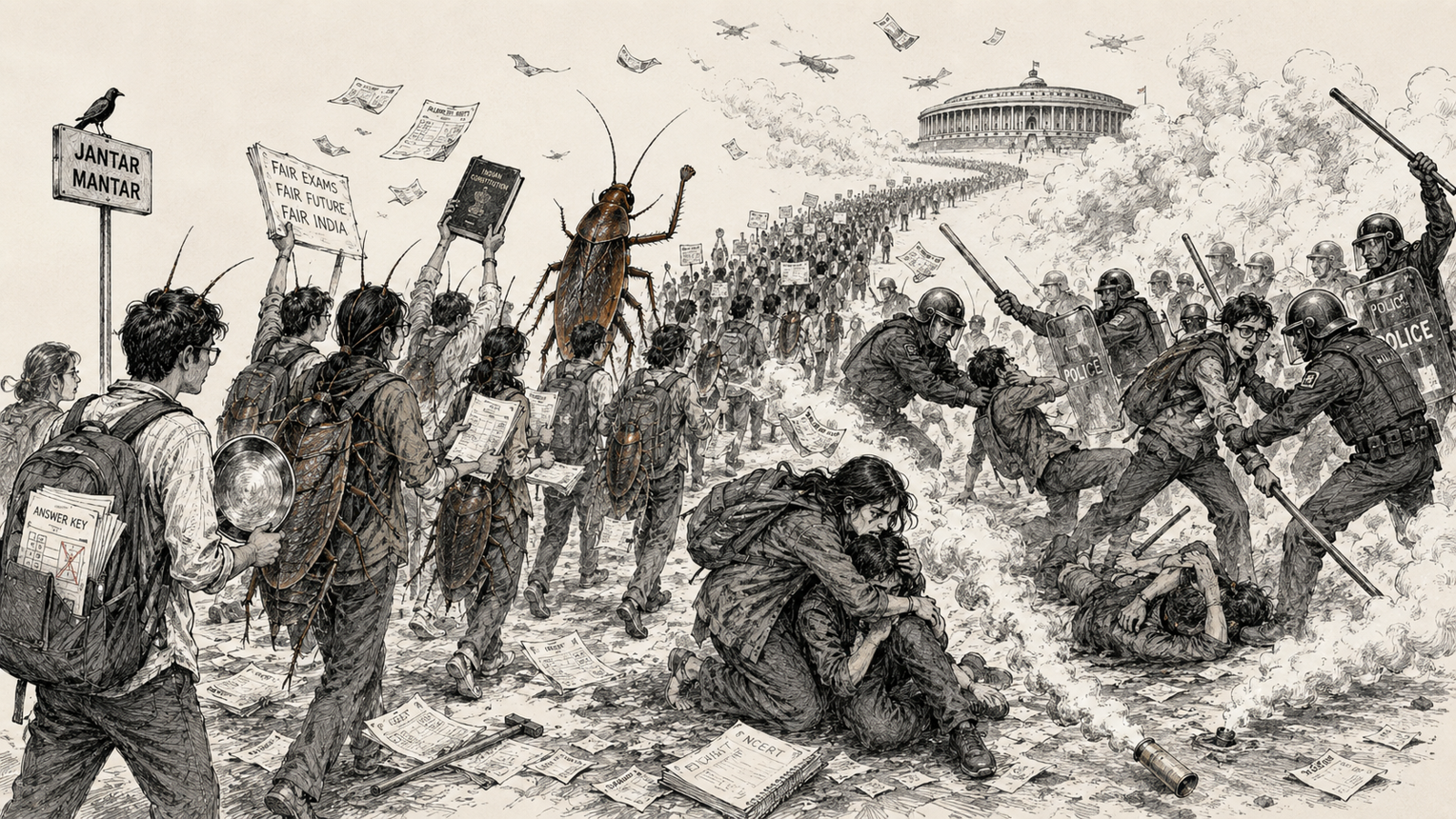
The composition of the agricultural workforce tells the same story from the gender side. Women's share of employment in agriculture rose from 57% in 2017-18 to 64.4% in 2023-24, and in rural areas the figure went from 73.2% to 76.9%. Men's rural agricultural share, over the same period, fell from 55% to 49.4%. Men have been leaving the fields. Women have been added to them.
The female labour force participation puzzle
Headline figures show India's female labour force participation rate rising from 23.3% in 2017-18 to 41.7% in 2023-24. Government commentary has framed this as the long-awaited rebound of women into paid work. Read against the composition data, it is mostly something else.
Ashwini Deshpande's work at the Centre for Economic Data and Analysis at Ashoka University has been the most systematic decomposition of what the headline number is hiding. In her 2023 essay, Deshpande shows that the share of unpaid helpers in household enterprises among self-employed women jumped from 33.1% to 38.4% between 2018-19 and 2019-20 alone. By 2023-24, the share of women working as helpers in household enterprises (the PLFS category for unpaid family labour) had risen from 9.1% to 19.6% of all working women. Over the same period, the share of women reporting that they were engaged in domestic duties fell from 57.8% to 35.7%.
What appears to be a doubling of female labour force participation is, in considerable part, a statistical reclassification of women who were already working unpaid on family land or in family enterprises and who are now being recorded as employed. Some of this is real, captured better by the redesigned PLFS instrument that asks more careful questions about hours worked. None of it represents the kind of move into wage employment that Lewis would have predicted, or that Bangladesh's garment workers exemplify.
This matters because of what Ester Boserup, in Woman's Role in Economic Development (1970), and a subsequent literature on the feminisation of agriculture (notably Bina Agarwal in A Field of One's Own, 1994) have pointed out. When men leave farms first and women remain to do the same agricultural work without wages, female labour force participation can rise on paper while women's economic position deteriorates in fact. Women become the residual workforce on land that the household can no longer afford to leave fallow. The work has not changed. Only the recorded label has.
Premature deindustrialisation, in Indian conditions
The reverse flow has a structural ceiling that must be named. India never built the manufacturing capacity to absorb the labour that was leaving agriculture in the first place. Dani Rodrik's Premature Deindustrialisation, published as an NBER working paper in 2015 and in the Journal of Economic Growth in 2016, set out the central evidence. Rodrik showed that the world's manufacturing employment share peaks at successively lower per capita income levels for each new generation of industrialising countries. Western European countries reached their manufacturing peaks at per capita incomes of around 14,000 dollars at 1990 prices, with Korea and Taiwan peaking at around 28% of manufacturing employment in the late 1980s. India, at less than two thousand dollars per capita and a manufacturing employment share that has never exceeded 13%, has effectively peaked already.
This is the box India is in. The economy never industrialised on the labour-absorbing scale that East Asia did. Manufacturing, where it grew, grew capital-intensive. The labour-absorbing manufacturing sectors of textiles, leather, food processing, and basic metalworking were repeatedly neglected in favour of pharmaceuticals, automobiles, and electronics, which are skill- and import-intensive. The Production-Linked Incentive scheme, which is the Modi government's principal industrial policy of the past five years, illustrates the pattern. The scheme, with an outlay of approximately ₹1.91 lakh crore across fourteen sectors (originally announced as ₹1.97 lakh crore in Budget 2021-22), has, by the government's own claim, generated 14.39 lakh direct and indirect jobs cumulatively as of December 2025. The 14.39 lakh figure aggregates direct and indirect (vendor and supplier chain) employment using a methodology the ministry has not publicly documented. Ministry-reported PLI employment as of August 2024 was approximately 9.5 lakh, and the leap is unexplained. India adds approximately seventy lakh new entrants to its workforce every year. The PLI scheme, after five years, has, on the most generous government count, generated less than two and a half years' worth of new entrant absorption.
The Parliamentary Standing Committee on Commerce, in its March 2025 report, recommended that PLI be extended to labour-intensive sectors, including chemicals, leather, and apparel. The recommendation was an implicit acknowledgement that the existing scheme was not generating the employment its capital outlay should have produced. Manufacturing's share of employment has stayed below 13% for two decades. Construction, mostly informal and casual, has absorbed most of the men leaving agriculture, but construction is the residual sink, not the driver of structural change.
When Rodrik's framework is applied to India, the conclusion is uncomfortable but clear. The country missed its manufacturing window. Workers leaving agriculture have nowhere productive to go, and when external shocks contract the urban informal economy, they have nowhere to stay either. They go back. The fields absorb them at zero or near-zero marginal product. The household plot becomes a labour reservoir. The Lewis road runs back because the modern sector is too small and too capital-intensive to hold them.
The MGNREGA floor, and what is happening to it
If the modern sector cannot pull workers out of agriculture, the only alternative for those workers is whatever the state offers as a wage floor in rural areas. For two decades, that floor was the Mahatma Gandhi National Rural Employment Guarantee Act. As I argued in the December 2025 essay on the Viksit Bharat G RAM G Bill (the legislation that has now replaced MGNREGA), the scheme served as the reservation wage for rural casual labour across most of India. When demand for rural labour collapsed, MGNREGA absorbed it; when private wages tried to fall below the MGNREGA notional rate, the scheme prevented them from doing so. The system was imperfect; wages were below state minimums in most states, and the work generated was less than the entitlement. It nonetheless kept rural labour markets from collapsing into outright distress.
That floor is being knocked out. The G RAM G Bill, passed in December 2025, replaces MGNREGA's demand-driven rights-based design with a normatively allocated scheme funded on a 60:40 Centre-State basis instead of the previous fully-Centre-funded structure. Section 4(5) requires the Centre to determine state-wise normative allocations that replace the open-ended labour budget; Section 6(2) requires State Governments to notify periods aggregating to sixty days during sowing and harvesting seasons in which no works may be undertaken; and Section 22(2) read with Section 22(7) establishes the 60:40 funding split that places forty percent of unskilled wage costs on most states whose fiscal positions are already squeezed.
The result is visible in real time. Down to Earth reported in late April 2026 that person-days generated under the renamed scheme in the first 15 days of April 2026 stood at 0.95 crore, compared with 26 crore in April 2025. That is roughly 4% of the previous year's number for the same period. Wage arrears were approaching ₹10,000 crore. State officials in several districts were enforcing an illegal cap of twenty works per panchayat, drawn from a 2021 NREGASoft circular that has no legal basis. The scheme has been administratively starved without being formally suspended.
What this means for the labour market is straightforward. The wage floor for rural casual labour, which had been declining in real terms even before the G RAM G transition, has effectively been removed during the months when rural labour demand is at its lowest. Workers who in earlier years would have absorbed at least some of their labour onto the public-works floor are now competing for whatever private wage labour exists in the village, doing unpaid family work, or migrating to construction sites where wages have themselves been stagnant. Each of these is a worse outcome than the MGNREGA option that just disappeared.
Labour codes and gig workers
While the floor of the labour market is being lowered, the structure above it is being restructured in ways that further weaken workers' positions. The four labour codes were notified into force on 21 November 2025. They consolidate twenty-nine central laws into the Code on Wages, the Industrial Relations Code, the Code on Social Security, and the Occupational Safety, Health and Working Conditions Code. The standard government framing has been that they reduce regulatory complexity and expand social security. The detail is more revealing.
The Industrial Relations Code raises the threshold for prior government approval of layoffs and closures from 100 workers to 300. This expands the share of the workforce that can be laid off without state oversight from a sliver to a majority of formal employment. The Code permits fixed-term employment with the same wages and benefits as permanent employment, which sounds neutral but, in practice, creates a parallel category of workers whose contracts can simply not be renewed. The strike-notice period has been extended. The conciliation period before a strike can be called is now mandatory. Workers' ability to organise collectively, which was already weak in Indian formal employment, has been further attenuated.
The Code on Social Security, the labour reform that the government has emphasised in public communication, formally recognises gig and platform workers as a category and creates the framework for an aggregator levy of one to two per cent of turnover, capped at five per cent of payments to workers. The e-Shram portal, launched in August 2021 and given an aggregator-onboarding Standard Operating Procedure in September 2024, had registered approximately 30.98 crore unorganised workers as of August 2025, of whom only 3.37 lakh were classified as platform or gig workers. NITI Aayog's 2022 report had projected the gig workforce at 23.5 million by 2029-30. What is being captured on e-Shram is, in other words, barely a per cent of the projected platform workforce, and the social-security entitlements that are supposed to follow registration have, as of April 2026, mostly not been operationalised.
The state laws, in particular the Rajasthan Platform-Based Gig Workers Act 2023 (whose rules were never notified by the successor government) and the Karnataka Platform-Based Gig Workers Act 2025, have done more concrete work in this area than the central code. The Karnataka law mandates algorithmic transparency, two-stage grievance redressal, and a welfare fee paid by aggregators. Whether these provisions will hold against likely industry pressure in the courts is another matter.
The point is that the social-security framework for the modern workforce, intended to compensate for the removal of older protections, is sparse, slow, and conditional. Its registration depends on a portal with incomplete coverage, and the benefits that are supposed to follow depend on aggregator levies whose collection has not begun in any sustained manner. For the average gig worker delivering food in Bengaluru or driving for a ride-share platform in Hyderabad, the formal recognition that the labour code provides has not, four months after the code came into force, translated into anything material.
The wage signature
The reverse structural transformation has a wage signature that confirms its identity. If workers were moving up the productivity ladder, real wages would be rising. They have not been.
Himanshu and Anwesha Kundu, in their analysis of the Wage Rate Index for Rural Labour, document that real wages for agricultural and unskilled non-agricultural rural labour grew at around five to six per cent per year between 2007 and 2013-14. ICRIER's calculations for the narrower 2009-10 to 2013-14 window put farm-wage growth as high as 8.6 per cent and non-farm rural wage growth at six per cent. Between 2014-15 and 2022-23, real wages stagnated or declined; drought years saw absolute falls. R. Nagaraj's contribution to The India Forum's analysis of India's economic slowdown, drawing on Damodaran's work, finds that average real wages for rural workers grew at 6.7% per year between 2009 and 2013, and at 0.5% per year between December 2014 and December 2018. Jean Drèze, in a Newslaundry interview in May 2024, described the past decade as a return to the old pattern of near-stagnation in real wages, made more severe because the stagnation persisted even as the economy grew.
The PLFS 2025 calendar-year report records that the average regular-wage male earnings rose from ₹22,891 per month in 2024 to ₹24,217 per month in 2025, a nominal increase of 5.8%. Female earnings rose 7.2% nominally to ₹18,353. Consumer price inflation over the same period was approximately 5%. Real wage growth, in other words, was negligible. For casual labourers and self-employed workers, where most of the post-2018 employment growth has occurred, the picture is worse. The ILO and Institute for Human Development's India Employment Report 2024 records that the real earnings of self-employed workers fell after 2019.
This is what reverse structural transformation looks like in the wage data. Workers move into lower-productivity sectors, their wages do not rise, and their share of national income falls. The functional distribution of income shifts from labour to capital. Studies using the RBI India KLEMS database, including the recent paper in MIT Press's Asian Economic Papers, document that the labour share of value added in Indian organised manufacturing has been falling since the early 1990s. Karabarbounis and Neiman's documentation of the global decline in the labour share applies to India in a particularly sharp form, because the offsetting expansion of formal employment that some other countries experienced has not occurred here.
What is driving the reversal
Workers did not return to villages by choice. The qualitative evidence from the Centre for Monitoring Indian Economy, the Stranded Workers Action Network during the pandemic, and field studies before and since all converge on the same finding. Workers who returned to villages in 2020 and afterwards did so because the urban jobs that had supported them collapsed. Most would prefer formal urban employment if it existed.
The pattern also predates the pandemic. By 2018-19, before COVID-19 reached India, the post-demonetisation contraction in informal employment and the GST-driven compliance squeeze on small firms had already begun pushing workers back to villages. Mehrotra and Parida's documentation of the post-2018 reversal in the agricultural employment share captures this pre-pandemic phase. The pandemic intensified the trend without initiating it.
The fiscal stance over the past decade has consistently chosen capital-intensive infrastructure over labour-absorbing public spending. MGNREGA's allocation, which on the NREGA Sangharsh Morcha's calculation cited in Down to Earth stands at 0.24% of GDP in FY 2025-26, is the lowest in real terms in over six years. Rural housing under the Pradhan Mantri Awas Yojana has been scaled back, and the Integrated Child Development Services budget has been compressed in real terms. The PM Kaushal Vikas Yojana, the government's signature skilling scheme, has placed approximately 22 per cent of its trainees in jobs across PMKVY 1.0, 2.0, and 3.0, per the Lok Sabha Standing Committee on Labour's December 2022 report and a March 2023 ministerial reply, a pattern I noted in the April 2026 essay on India's health system when discussing programmes designed to measure visible outputs while ignoring outcomes.
The choices have favoured capital, top-end manufacturing, and visible flagship schemes over the labour-absorbing public investment, primary education, primary healthcare, and labour-intensive manufacturing that Lewis-style structural change would have required. The reverse flow is the predictable consequence of those choices.
What can be done
A serious response to reverse structural transformation begins with the admission that the current trajectory is neither random nor reversible by industrial-policy gestures alone. The Lewis road, when it runs in the right direction, requires three preconditions that India has consistently underprovided.
The first is labour-absorbing manufacturing, which means apparel, leather, food processing, basic metalworking, and assembly industries of the kind that grew Korea, Taiwan, China, and Bangladesh. The PLI scheme should be extended, as the Parliamentary Committee on Commerce recommended, into these labour-intensive sectors, with employment-conditional incentives rather than output-conditional ones. Bangladesh's experience suggests that female-employment-conditional incentives are particularly effective.
The second is a strong rural wage floor. MGNREGA should be restored as a fully Centre-funded, demand-driven, rights-based scheme. Wage rates should be linked to either state minimum wages or the Anoop Satpathy Committee's 2019 recommendation of ₹375 per day, which has since been indexed. The G RAM G design should be reversed. The administrative caps and procedural exclusions built into the new scheme over the past four months should be removed. The Down to Earth reportage suggests that this is not merely a matter of reversing legislation; it requires reversing the field-level administrative practices that have accrued around MGNREGA's withering.
The third is a coherent policy on women's work. The female labour force participation rebound, as PLFS captures it, is more an artefact than a victory. The work that women do on family land and in family enterprises needs to be properly remunerated, formally recognised, and supported by care infrastructure. India's first Time Use Survey in 2019 documented that women spend approximately seven times as much time on unpaid domestic and care work as men. The 2024 Time Use Survey, currently being released, is likely to confirm that the gap has not closed. Maternity leave coverage, public childcare, public eldercare, and rural water and sanitation infrastructure all reduce the burden of unpaid work, freeing women's time for remunerated activity. They are also, not coincidentally, the kinds of public investments that absorb labour at high social returns.
A fourth element, harder to legislate but central to the problem, is the rebuilding of formal collective bargaining. The labour codes have weakened the right to strike, raised the threshold for layoff scrutiny, and consolidated the regulation of contract labour in ways that favour aggregators and large employers over workers. None of this is irreversible. The state laws on gig workers, particularly Karnataka's, demonstrate that legislative innovation in workers' favour is possible at the state level when political constituencies exist for it. The Indian Federation of App-based Transport Workers, the Telangana Gig and Platform Workers Union, the NREGA Sangharsh Morcha, and other organising platforms represent the existing fabric on which a more substantive workers' politics could be rebuilt. Their work, as I argued in the FCRA piece, has been actively impeded by a regulatory regime that treats any organised civic capacity as a threat to the state.
The Lewis road can be made to run in the right direction again. It requires the policy stance to face in the right direction. At present, it does not.
In the years since my fieldwork in Bangladesh, the pattern in the north Indian villages I have visited has been the inverse of what I saw there. The young women remain. The young men are gone, mostly to construction sites in Surat, Tiruppur, and along the Delhi border, mostly without their families. The pucca houses built under PMAY stand empty for most of the year. The women who remain till the family plot and are recorded by the survey enumerator as helpers in household enterprises. They have no wages, no contract, no leave. They are employed.
This is the labour market that May Day finds in 2026: structural transformation running in reverse, the public works floor knocked out, the manufacturing window closed before it opened wide enough, and the women who remain on family land doing the work of two generations without being paid for either.
The numbers in this essay are small in some places and large in others. The largest is one that does not appear in any single survey table. It is the cohort of young Indians who entered the workforce after 2018, who are better educated than any previous Indian cohort, and who are now disproportionately found either unemployed, underemployed, on family farms, or in casual urban work that pays no more in real terms than it did a decade ago. They are the cost of the reverse transformation, and they will be its political consequence. Successive Labour Days will continue to find them where the Lewis road, running back, deposits them.
Varna is a development economist and writes at policygrounds.press.
Further Reading
On structural transformation and India's stalled trajectory
W. Arthur Lewis, "Economic Development with Unlimited Supplies of Labour" (1954, Manchester School)
Dani Rodrik, "Premature Deindustrialization" (2015, NBER)
Santosh Mehrotra and Jajati Parida, "Stalled Structural Change Brings an Employment Crisis in India" (2021, Indian Journal of Labour Economics)
Azim Premji University, State of Working India 2023 and State of Working India 2026
ILO and Institute for Human Development, India Employment Report 2024
On women's work
Ashwini Deshpande, "Illusory or Real? Unpacking the Recent Increase in Women's Labour Force Participation in India" (CEDA, 2023)
Ashwini Deshpande and Jitendra Singh, "Dropping Out, Being Pushed Out or Can't Get In?" (IZA, 2021)
On real wages
Himanshu and Anwesha Kundu, "Downturn in Wages in Rural India" (Review of Agrarian Studies)
Jean Drèze and Himanshu in interview, "A Decade of Stagnation in Rural Wages" (Newslaundry, May 2024)
On the labour codes and gig workers
KPMG, "Government of India Issues Draft Rules on Four Labour Codes" (2026)
Asian Labour Review, "Beyond Welfare in India's Gig Sector" (2025)
NITI Aayog, "India's Booming Gig and Platform Economy" (June 2022)
On MGNREGA, G RAM G, and the rural wage floor
Ministry of Statistics, PLFS 2023-24 Annual Report
Down to Earth, coverage of the G RAM G transition standstill (April 2026)
The Wire, coverage of NREGA Sangharsh Morcha's analysis of the FY 2025-26 allocation

















Write a comment ...