
New York's first Muslim mayor revoked the IHRA definition on day one, supports BDS, called Gaza a genocide from the lectern at a St. Patrick's Day breakfast, and threw a Palestinian writer under the bus because a right-wing outlet asked him a question about his wife's freelance illustration work.
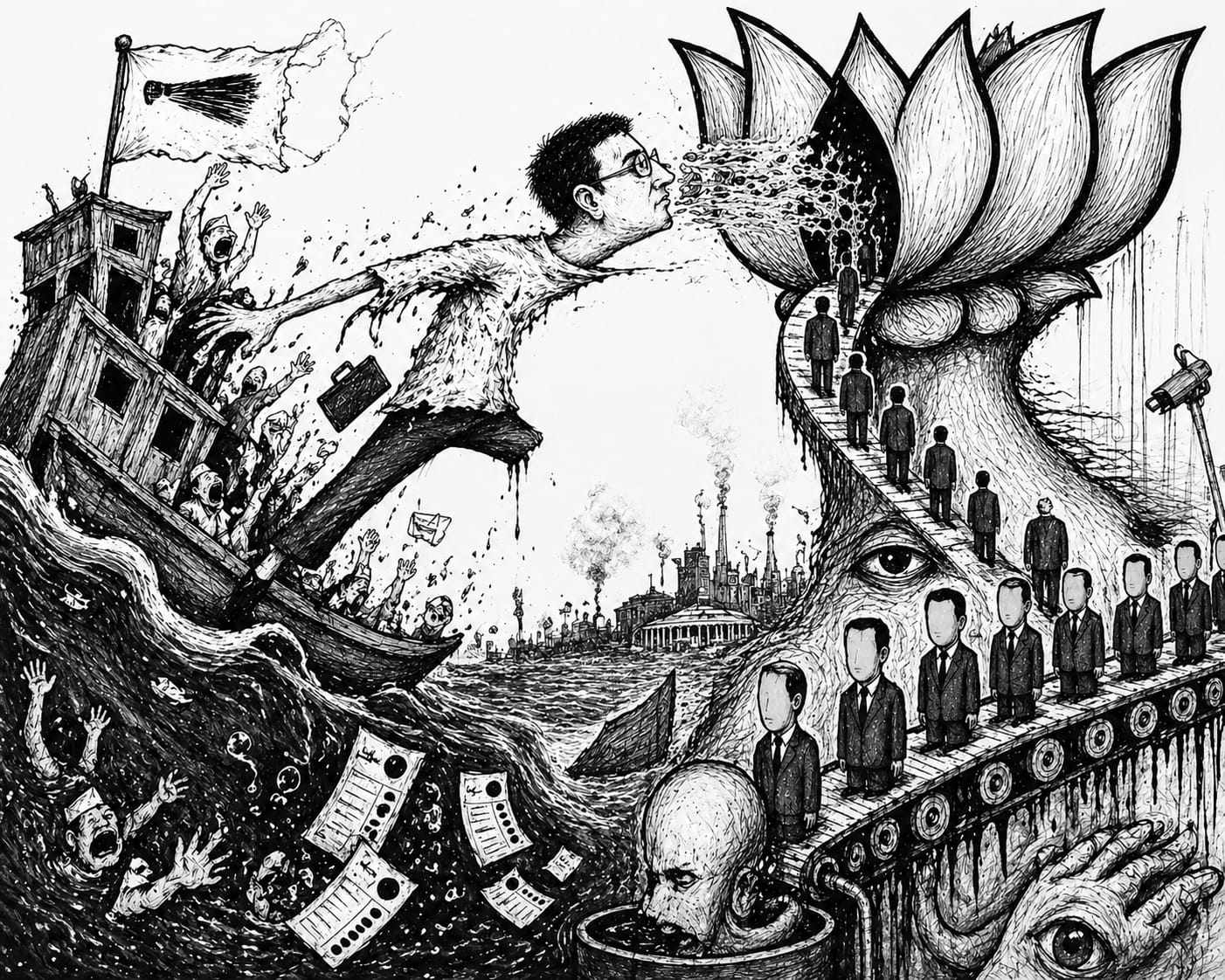
Zohran Mamdani is the most pro-Palestine mayor in American municipal history. He is also systematically undermining his own position every time he is personally pressured. The pattern is consistent: bold declarations on the macro questions (genocide, apartheid, BDS, the IHRA definition) paired with reflexive capitulation on the micro tests (a Palestinian writer's rhetoric, an aide's old social media posts, a reporter's question about his wife). This essay argues that the pattern is not a personal failing but a structural one, and that Mahmood Mamdani, the mayor's father and one of the foremost political theorists of the postcolonial world, has spent fifty years producing scholarship that explains exactly how it works.
I watched Zohran Mamdani's election night in June 2025 the way a lot of people outside America watched it: with the particular hope that attaches to a political possibility you did not expect to see in your lifetime. A 33-year-old Ugandan-Indian Muslim, the son of Mahmood Mamdani and Mira Nair, running on a platform of city-owned grocery stores and rent freezes and Palestinian solidarity, defeating Andrew Cuomo in the largest primary turnout in New York City history. Taking the oath on two copies of the Quran, one his grandfather's, the other from the Schomburg Center for Research in Black Culture. Bernie Sanders administering the ceremonial oath. The inaugural address: "I was elected as a democratic socialist, and I will govern as a democratic socialist."
I am not a New Yorker. I am an Indian development economist who writes about policy failures and institutional decay, mostly in India. But I have read Mahmood Mamdani since graduate school. Citizen and Subject changed how I understood colonial governance. Define and Rule changed how I understood identity as a tool of state power. Neither Settler nor Native, dedicated to Zohran, changed how I understood the Israel-Palestine question. So when Mahmood Mamdani's son entered electoral politics explicitly because of Palestine, promising a different kind of politics built on what he called "a universality in international law," it felt like something worth paying attention to.
Nine months into his mayoralty, I am paying attention. And what I see is a man who makes all the right declarations on the large stage and folds on every small test that arrives at his door. This essay is about what that pattern reveals, not just about Zohran Mamdani, but about the structural limits of solidarity when it meets power.
What he has done
The record is real and should be stated clearly. On his first day in office, January 1, 2026, Mamdani signed a blanket executive order revoking every order issued by his predecessor, Eric Adams, after 26 September 2024, the date of Adams's federal indictment. This swept away the city's adoption of the IHRA definition of antisemitism, which conflates certain forms of Israel criticism with antisemitism, and a separate order that prohibited city agencies from boycotting or divesting from Israel. Seven major New York Jewish organisations issued a rare joint statement lamenting the move. Israel's Foreign Ministry called it "antisemitic gasoline on an open fire." Mamdani did not reverse course.
He supports BDS and has done so since college. At Bowdoin in 2014, he co-founded the Students for Justice in Palestine chapter. At a UJA-Federation town hall in May 2025, he said: "My support for BDS is consistent with the core of my politics, which is nonviolence." On March 17, 2026, at a Gracie Mansion breakfast honouring Irish New Yorkers, with former Irish President Mary Robinson in the room, he said: "Over the past few years, as we've witnessed a genocide unfold before our eyes, there has been deafening silence from so many." He has hosted detained Columbia activist Mahmoud Khalil for a Ramadan iftar at Gracie Mansion. He has promised to arrest Netanyahu if he sets foot in New York. He kept the Office to Combat Antisemitism.
No American mayor has held these positions. On paper, Zohran Mamdani represents the political possibility his father's scholarship imagines: someone who refuses the frame.
The problem is what happens when the frame pushes back.
What happened with Susan Abulhawa
On March 12, 2026, the Washington Free Beacon published a story revealing that First Lady Rama Duwaji had illustrated a short story by Diana Islayih, a resident of Gaza, which was published in a collection compiled by Palestinian-American author Susan Abulhawa. Abulhawa, author of Mornings in Jenin, has used language about Israelis and Zionism that is raw, bitter, and at times dehumanising. The Free Beacon catalogued her words. The story was amplified by the New York Post, Fox News, and Jewish Insider.
At a press conference in Brooklyn the next day, Mamdani said: "I think that that rhetoric is patently unacceptable. I think it's reprehensible." He distanced his wife: "As is common for freelance illustrators, the first lady was commissioned to illustrate an excerpt of a book by a third party. She has never engaged with or met with the author." He described Duwaji as having no role in his administration, despite having called her "the best advocate" for influencing his policy decisions in a January interview. He did not mention that his own father and Abulhawa had both served on the Gaza Tribunal Advisory Policy Council and co-signed a 2018 letter to Saudi royals.
The backlash came, but not from where the Free Beacon intended. It came from his own people.
Mohammed El-Kurd, Jerusalem-based writer and editor-at-large at Mondoweiss, wrote on X: "Our issue is that we treat him as if he is a house of cards; as if his entire project would collapse if we dare criticise it. But the reality is simply different: if he is only getting pushback from the right, he will inevitably move to the right. Basic physics really." El-Kurd also revealed that Mamdani had told him in a prior meeting that when El-Kurd criticises him, he "gives people permission to go after his wife."
Susan Abulhawa responded in a 20-minute video. She was not angry, she said. She was instructive. On Palestinian rage: "No words can adequately capture the evil I have witnessed or experienced at their hands. I do not have sufficient language to describe what they have done to us." Directly to Mamdani: "You succumbed to forces that seek to pick away at you, at your talented, beautiful wife, and [are] clawing harder with each apology or concession you make. If you are not careful, they will siphon your soul before you even realise it."
Craig Mokhiber, former director of the New York Office of the UN High Commissioner for Human Rights, addressed Mamdani directly: "I know you are afraid. But forget what your aides are telling you. Fear is not a sound basis for politics at this moment in history."
Nerdeen Kiswani, co-founder of Within Our Lifetime, identified the political calculation underneath the capitulation: "He knows he'll anger us. He just believes that when the time comes, we'll fall in line anyway."
The pattern underneath the pattern
The Abulhawa episode would matter less if it were isolated. It was not.
On The View in October 2025, Sara Haines pressed Mamdani on what she called his "inflammatory statements" about Israel and his evasiveness about condemning Hamas. His response followed a precise choreography: first, the required condemnation ("Of course I condemn Hamas. Of course I've called October 7 what it was, which is a horrific war crime"), only then the bold declaration ("my belief in a universality and international law is the same set of beliefs that led me to describe what's happening in Gaza as a genocide"). The audience applauded the second statement. But structurally, the first statement was the price of admission. The condemnation ritual is the toll you pay for permission to speak about Palestinian suffering on American television.
On March 17, 2026, a Palestinian American named Anas Saleh confronted Mamdani at a public event, visibly distressed: "You are constantly defending the right for Israel to exist... people like me are constantly attacked by politicians for standing up for Palestine and you are constantly defending the right for Israel to exist." Mamdani listened. He did not meaningfully respond to the substance.
The staff controversies reveal the same inconsistency. Catherine Almonte Da Costa, his Director of Appointments, resigned after old antisemitic social media posts surfaced. Mamdani called her comments "reprehensible." Fair enough. But when Alvaro Lopez, his Brooklyn Borough Director, was found to have called people tearing down Israeli hostage posters "heroes," Lopez was not fired. The administration said the comment "does not reflect the beliefs or values of the administration," and Mamdani's spokesperson declined to say whether the mayor would personally denounce it. When Kaif Gilani, who co-founded the "Hot Girls for Zohran" canvassing effort, was found to have spread conspiracy theories about Israel's role in 9/11, and reporters asked Mamdani about it, Politico reported that he "ran away."
There is no consistent principle here. Classical antisemitism (Da Costa) gets a swift firing and is "reprehensible." A Palestinian writer's rage about colonialism (Abulhawa) is also considered "reprehensible." But a staffer calling hostage-poster tearers "heroes" gets a non-answer. A conspiracy theorist gets a literal sprint in the opposite direction. The operating logic is not ethical coherence but crisis management: whichever direction the pressure comes from hardest on a given day determines the response.
The Times of Israel identified the pattern with clinical precision: Mamdani condemns "classical expressions of antisemitism" like tropes about Jewish greed and swastikas, but not "inflammatory rhetoric related to Israel." The categories of acceptable and unacceptable speech are set by external pressure rather than by an internally consistent framework.
The father's scholarship and the son's practice
I keep returning to Mahmood Mamdani's work because it describes, with extraordinary analytical clarity, exactly what his son is doing wrong.
Define and Rule (2012) argued that colonial governance operated by defining and managing difference: creating categories of identity (settler/native, ethnic/tribal) and ruling through them. The key insight was that indirect rule was "far more insidious" than direct rule because "it divided African peoples into artificially contrived categories of difference that undermined attempts at mass resistance." The most effective form of domination, in Mamdani's framework, is when the categorised accept the categories imposed upon them.
Good Muslim, Bad Muslim (2004) translated this colonial framework to the post-9/11 world. The book's central argument: after 11 September, "unless proved to be 'good,' every Muslim was presumed to be 'bad.' All Muslims were now under obligation to prove their credentials by joining in a war against 'bad Muslims.'" When Mamdani explained this to the Asia Society, he said: "What Bush means by 'good' Muslims is really pro-American Muslims and by 'bad' Muslims he means anti-American Muslims."
Neither Settler nor Native (2020), dedicated to Zohran, argued that the nation-state and the colonial state "created each other," and that the path forward on Israel-Palestine requires dismantling the settler/native binary rather than choosing sides within it. On Zionism specifically, Mahmood Mamdani wrote: "The purpose of Zionism is precisely to make this translation: to make the experience of being Jewish, historically a matter of religious practice, upbringing, and lineage, into an experience of nationhood and to tie this nation to a state." His conclusion pointed toward "de-Zionisation" on the South African model: severing the state from the nation, creating "a state for all its citizens."
During the 2024 Columbia encampment, Mahmood Mamdani was the first faculty member to address the pro-Palestinian students, drawing parallels between the anti-apartheid divestment movement and solidarity with Palestine. On Democracy Now!, he described charges of antisemitism as "part of the currency the administration uses to demonise protests like this." In a December 2025 Jewish Currents interview, he said pro-Palestinian students at Columbia are "terrified" and "terrorised."
Now read the son's behaviour through the father's framework. When Zohran Mamdani is asked, "Do you condemn Hamas?" and answers, "Of course I condemn Hamas," before he is permitted to describe genocide, he is performing the loyalty test that Good Muslim, Bad Muslim identifies as the mechanism of sorting acceptable Muslims from unacceptable ones. When he calls Susan Abulhawa's language "reprehensible," he is accepting the discursive frame that Define and Rule documents: the frame in which certain emotional responses to colonialism are categorised as illegitimate regardless of the colonialism that produced them. When he repeatedly affirms "Israel's right to exist" while refusing to say "as a Jewish state," he is managing dissent within an imposed category rather than challenging the category itself, which is precisely what Neither Settler nor Native argues will never produce liberation.
I am not saying Zohran Mamdani should do whatever his father's books prescribe. I am saying that if your political project is built on the promise of refusing the frame, and the frame is exactly what your father spent fifty years anatomising, then every time you accept that frame under pressure, you are not making a tactical concession. You are proving the thesis.
The hundred-million-dollar machinery of discipline
Mamdani is not capitulating in a vacuum. The apparatus that disciplines Palestine solidarity in American politics is well-funded, systematic, and documented.
AIPAC and its super PAC, United Democracy Project, spent over $100 million during the 2024 election cycle, intervening in more than 80% of congressional races. The disciplinary examples are instructive. Jamaal Bowman lost his New York primary after AIPAC spent roughly $15 million against him, making it the most expensive House primary in American history. The attack ads did not mention Israel. They called him "too radical" and focused on domestic issues. Cori Bush lost her St. Louis primary after AIPAC spent millions against her through both its PAC and UDP. Bush's response: "All they did was radicalize me, so now they need to be afraid. AIPAC, I'm coming to tear your kingdom down."
Rashida Tlaib was censured by the House in November 2023 by a vote of 234-188, with 22 Democrats joining Republicans. She refused to apologise. She ran unopposed in 2024. AIPAC did not target her. Ilhan Omar was removed from the Foreign Affairs Committee in February 2023. She noted the paradox: since her removal, she has had more visits from parliamentarians and ambassadors than she would have had in years on the committee.
The IHRA definition functions as a governance instrument. Kenneth Stern, the lead author of the definition, opposes its use on campuses, saying it was intended for European data collectors, "never supposed to curtail speech." Human Rights Watch has urged the United Nations to reject it. Since October 2023, the Office for Civil Rights has opened 153 "shared ancestry" investigations, a fivefold increase, weaponising Title VI as what Palestine Legal describes as a tool to "censor people speaking up for Palestinian rights."
The architecture is designed to make the Mamdani pattern feel like the only rational choice. Condemn, distance, perform, survive. The question is whether it actually is the only choice, or whether Tlaib and Bush point to a different one: take the hit, refuse to apologise, and let the base decide.
The Ugandan-Indian inheritance
The biographical detail matters because Zohran Mamdani did not arrive at Palestine solidarity through American campus politics. He arrived through a family history of displacement.
His father, Mahmood Mamdani, was born in Mumbai in 1946 and raised in Kampala as part of the Gujarati Muslim merchant class. In August 1972, Idi Amin ordered the expulsion of roughly 80,000 South Asians from Uganda. Mahmood Mamdani, who had registered as a Ugandan citizen at independence, was expelled, rendered stateless, and placed in a transit camp on Kensington Church Street behind Kensington Palace. He returned after Amin's overthrow in 1979. In 1984, the Obote government stripped him of citizenship a second time. Stateless twice. His first book, From Citizen to Refugee (1973), documented the very expulsion he had experienced.
Zohran's mother, Mira Nair, met Mahmood Mamdani in Kampala in 1989 while researching Mississippi Masala (1991), the film that dramatises the Indian-Ugandan displacement. They married, and Zohran was born in October 1991, the same year the film was released. His middle name, Kwame, was given by his father in honour of Kwame Nkrumah, the first president of Ghana.
Zohran grew up in Kampala, Cape Town, and New York. In a 2020 Jacobin interview, he described the diasporic experience: "In Uganda, I'm told this guy is actually Indian; in India, I'm told this guy is actually Muslim; and in New York, I'm everything but a New Yorker." He speaks English, Hindi, Swahili, Luganda, Spanish, and Arabic. He holds dual Ugandan-American citizenship, having naturalised in 2018.
This is relevant because the connection between the expulsion of Indians from Uganda and the dispossession of Palestinians is not metaphorical. It is structural. Both involve the creation of political identities (settler, native, citizen, alien) as instruments of state power. Both involve the revocation of belonging. Both produce diasporic communities that carry the memory of home as a political claim. Mahmood Mamdani has spent his career making this argument precisely, tracing the thread from Kampala to Pretoria to Jerusalem. His son's political project was supposed to be what that argument looks like in practice.
What would honouring a different politics require
Zohran Mamdani ran on the promise of a different politics. Twenty-seven thousand volunteers believed him. He received over a million votes, the most for any mayoral candidate since 1969. He won not despite his pro-Palestinian position but, as Suchitra Vijayan of The Polis Project wrote, because of it.
Honouring that promise does not mean saying everything Susan Abulhawa has said. It does not mean endorsing every formulation used by every pro-Palestine activist. But it does mean developing an internally consistent framework for responding to these controversies and holding to it, rather than allowing the Washington Free Beacon to set the terms of your press conference.
What that framework might look like: a clear, public, repeatable position that distinguishes between antisemitism (which Mamdani has the Office to Combat Antisemitism to address) and the language that colonised and brutalised people use to describe their brutalisation (which is not Mamdani's job to police on behalf of right-wing media outlets). A framework that says: I will not call a Palestinian writer's grief "reprehensible" because a reporter from an outlet that believes Israel's response in Gaza was "far too lenient" wants me to. A framework that acknowledges, as Mahmood Mamdani's scholarship does, that the demand to condemn the oppressed for how they express their oppression is itself a tool of the oppressor.
Tlaib was censured by the House. She did not apologise. She won re-election. Bush lost her primary to an AIPAC-funded challenger. She did not apologise either. The electoral consequences are real. So is the alternative: a politics that bends every time the wind changes direction is, over time, indistinguishable from no politics at all. El-Kurd's observation is simple physics: if you are only getting pushback from the right, you will inevitably move to the right. Mamdani's base is watching. They put a million votes behind him. They are waiting to see whether the politics he promised were real or just a campaign.
Mahmood Mamdani dedicated Neither Settler nor Native to his son. The book's argument is that liberation requires dismantling the categories that power imposes, not managing dissent more skillfully within them. The son does not owe the father obedience. But he owes the people who elected him coherence. And he owes the political tradition he claims to represent, the tradition of refusing the frame, something more than performing its gestures on the big stage while abandoning its principles every time a tabloid calls.
Varna is a development economist and writes at policygrounds.press
Further reading:
Why is NYC's Mamdani facing criticism over response to attacks on wife? (Al Jazeera, March 2026)
What Zohran's "Reprehensible" Comment Reveals About Power and Palestine (The Polis Project, March 2026)
What NYC Mayor-elect Zohran Mamdani has actually said about Jews, Israel and antisemitism (Times of Israel / JTA)
How the politics of Mamdani's parents shaped NYC's new mayor (Times of Israel / JTA)
How The Israel Lobby Silenced Democratic Dissent (The Lever)
How Does AIPAC Shape Washington? We Tracked Every Dollar (The Intercept)
Mahmood Mamdani, Define and Rule: Native as Political Identity (Harvard University Press, 2012)
Mahmood Mamdani, Neither Settler nor Native: The Making and Unmaking of Permanent Minorities (Harvard University Press, 2020)
Mahmood Mamdani, Good Muslim, Bad Muslim: America, the Cold War, and the Roots of Terror (Doubleday, 2004)














Write a comment ...