
$12 billion in two weeks. Oil above $108. The Strait of Hormuz shut. 3.2 million Iranians are displaced. In Delhi, families are paying ₹3,000 for a black-market LPG cylinder.
The joint US-Israeli war on Iran, now nineteen days old, has produced what the IEA calls the largest oil supply disruption in history, sent Brent crude above $108, shut the Strait of Hormuz to commercial shipping, displaced 3.2 million Iranians, and triggered an LPG crisis across India. This essay argues that the war follows a seventy-three-year pattern of Western powers destroying sovereign states in the name of freedom while externalising the costs onto the world's poorest people. India, which imports 88% of its crude oil and has 9.8 million citizens in the Gulf, is not a spectator to this war. It is paying for it.
I was five years old during the 1990 Gulf crisis. I do not remember it. But my parents, both journalists, remember it clearly, and it was one of the stories that shaped how I came to understand the world. India had $1.2 billion in foreign exchange reserves, barely enough for three weeks of imports. Oil prices spiked after Saddam invaded Kuwait. The government organised the largest civilian air evacuation in history, with Air India flying 488 flights over 59 days, carrying 170,000 Indians overland from Kuwait to Amman and then home to Bombay. India pledged gold reserves to the Bank of England and the Union Bank of Switzerland to avoid sovereign default. My father covered the crisis for his newspaper. The lesson my parents took from 1990, and passed on to me, was simple: wars fought by powerful countries for their own reasons arrive uninvited at the doorsteps of countries that had no part in starting them.
That lesson has come back. On February 28, 2026, the United States and Israel launched joint airstrikes on Iran, including a decapitation strike that killed Supreme Leader Ali Khamenei in central Tehran. Iran retaliated with ballistic missiles against Israel, US military bases, and oil infrastructure across the Gulf. The Strait of Hormuz, through which 20% of the world's oil and a quarter of global seaborne oil trade passes, was declared closed by an IRGC commander on March 2. It has been effectively shut to commercial shipping since.
Nineteen days later, Brent crude has surged from $71 to above $108. The US has spent $12 billion in two weeks. 3.2 million Iranians are internally displaced. South Korea experienced its worst stock market crash since 2008. Pakistan recorded the largest single-day decline in its stock exchange's history. Qatar's helium production, which supplies a third of the global semiconductor supply chain, has halted after strikes on the Ras Laffan Industrial City. And in Delhi, where I live, families are paying ₹2,500 to ₹3,000 for black-market LPG cylinders that officially cost ₹913.
This essay is about who pays for wars and who profits from them. I do not support the Iranian theocracy's brutal treatment of women, its suppression of dissent, or its authoritarian governance. But I support, without reservation, the right of Iranians to determine their own political future. And I have yet to find, in seventy-three years of evidence, a single case where bombs dropped by the United States, or Israel, delivered the freedom they promised.
1953 and what followed
The history matters because the people prosecuting this war would prefer you did not know it.
On August 19, 1953, the CIA and MI6 overthrew Iran's democratically elected Prime Minister, Mohammad Mossadegh. The operation was codenamed Ajax by the Americans and Boot by the British. Mossadegh's offence was nationalising the Anglo-Iranian Oil Company, now known as BP, after the company refused to share revenues equitably. Between 1945 and 1950, AIOC's net profits were nearly three times the royalties paid to Iran. Mossadegh offered a 50-50 split, the same arrangement Aramco had accepted in Saudi Arabia. Britain refused and imposed a global oil embargo on Iran. When economic strangulation failed, the CIA manufactured street protests, bribed military officers, and installed Shah Mohammad Reza Pahlavi on the Peacock Throne.
The Shah ruled for 26 years with the backing of SAVAK, his secret police, trained by the CIA and Mossad. Amnesty International's 1976 report said Iran had the "highest rate of death penalties in the world" and described torture as routine and systematic. The US sold the Shah billions in weapons while his regime crushed every form of democratic opposition, trade unionism, and free press. By the late 1970s, the only institution with the organisational capacity to challenge the Shah was the mosque. When the revolution came in 1979, it was Islamic in character because every secular, liberal, and leftist alternative had been systematically destroyed by a regime the West had installed and maintained.
The United States then spent the 1980s backing Saddam Hussein's Iraq in an eight-year war against Iran that caused an estimated one to two million casualties. Declassified CIA files, published by Foreign Policy magazine in 2013, proved that the US provided battlefield intelligence and satellite imagery to Iraq even after confirming that Saddam was using chemical weapons. The Reagan administration's response was to send Donald Rumsfeld to Baghdad to shake Saddam's hand.
In July 1988, the USS Vincennes, a US Navy cruiser operating in Iranian territorial waters, shot down Iran Air Flight 655, a civilian Airbus A300 on its scheduled route from Bandar Abbas to Dubai. All 290 passengers were killed, including 66 children. The captain, William C. Rogers III, was not court-martialed. He later received the Legion of Merit. A month after the shoot-down, Vice President George H.W. Bush told a campaign rally: "I will never apologise for the United States of America. I don't care what the facts are." The quote was widely understood as his response to Iran Air 655, though he did not name the incident directly. He separately defended the shoot-down at the United Nations, calling it a "wartime incident" and blaming Iran for allowing a civilian flight to fly over a combat zone.
I dwell on this history because it is the substrate on which the current war is built. Every major US policy decision on Iran, from sanctions to sabotage to the January 2020 assassination of Qasem Soleimani, follows from the original decision to destroy Iranian democracy in 1953 to protect British oil profits. The Islamic Republic exists because the CIA destroyed the secular democratic alternative. The nuclear programme exists because a country surrounded by hostile nuclear-armed states and subjected to decades of military assault sought a deterrent. The "Axis of Resistance" proxies exist because Iran, unable to match American conventional military power, adopted asymmetric strategies for regional survival. There is a straight line from Mossadegh to Khamenei. And now the people who drew the line are bombing the end of it.
The deal that was working, and the one they killed
The Joint Comprehensive Plan of Action, signed in 2015, was working. Under the deal, Iran limited uranium enrichment to 3.67%, reduced its stockpile by 97%, disabled two-thirds of its centrifuges, and submitted to the most intrusive nuclear inspections regime in history. The IAEA confirmed Iranian compliance in every quarterly report from the January 2016 Implementation Day through to Trump's withdrawal. Iran only began exceeding JCPOA-mandated limits in July 2019, more than a year after the US had already walked away.
Trump withdrew in May 2018 for reasons that had nothing to do with nonproliferation and everything to do with Obama's legacy, Netanyahu's lobbying, and domestic politics. He reimposed sanctions under a programme of "maximum pressure" that deliberately targeted the Iranian civilian economy. The rial collapsed. Inflation exceeded 40%. Iran's GDP shrank for consecutive years. A Stanford University Press study found that sanctions "strengthened the Iranian state, impoverished its population, increased state repression, and escalated Iran's military posture." This is the documented, peer-reviewed, replicated result of economic sanctions on authoritarian regimes: they hurt the people and help the rulers. Djavad Salehi-Isfahani, the economist at Virginia Tech who has tracked Iranian living standards for decades, has shown how sanctions shrank Iran's middle class while the regime's inner circle adapted.
The escalation that produced this war did not need to happen. On February 27, 2026, one day before the strikes, Omani mediators announced a diplomatic breakthrough. Iran had agreed to never stockpile enriched uranium, accept full IAEA verification, and downgrade enrichment below weapons-grade thresholds. Formal talks were scheduled for March 2. The US and Israel struck on February 28. Diplomacy was not given a chance to fail. It was not given a chance to begin.
The largest oil supply disruption in recorded history
The IEA's March Oil Market Report calls this the largest oil supply disruption in the history of the global oil market: roughly 8 million barrels per day removed from supply. Before the war, Brent crude traded around $71. It crossed $100 by March 8, peaked near $126, and has settled around $108 as of March 18. Goldman Sachs has warned it could reach $150 if the Strait remains closed. Neil Shearing and his team at Capital Economics project that in a prolonged scenario, Brent could average $130 through Q2, pushing eurozone inflation above 4%, US inflation to 3%, and Japanese inflation to 2.5%. Oxford Economics models a severe scenario in which global inflation peaks at 5.8%.
The Strait of Hormuz did not require a naval blockade to close. Iran deployed cheap drones against commercial shipping, with at least 16 attacks on vessels since the war began, and the war-risk insurance market did the rest. When Protection and Indemnity clubs withdrew coverage, shipowners pulled their vessels. Over 150 ships now sit anchored outside the strait. LNG charter rates surged from $40,000 to $300,000 per day. Airlines rerouted across 15% of global air traffic corridors that pass through closed Gulf airspace. Dubai International Airport, the world's busiest by international passengers, sustained damage from Iranian strikes.
The cascade goes well beyond energy. The Persian Gulf is a critical corridor for petrochemicals, plastics, resins, and fertiliser feedstocks. Qatar, the world's largest LNG exporter, declared force majeure after drones hit its Ras Laffan facility. The same facility produces roughly a third of global helium, a non-substitutable gas used in semiconductor fabrication for wafer cooling, leak detection, and etching. Helium spot prices surged 70 to 100% in one week. Liquid helium evaporates within 45 days regardless of storage, meaning global semiconductor fabs face roughly three months of buffer before production cuts.
The American Farm Bureau Federation warned President Trump in a March letter that farmers face fertiliser supply disruptions that could lead to a "shortfall in crops" and "a threat to our food security." Urea prices have risen roughly 40%. For sub-Saharan Africa, which imports over 90% of its fertiliser, this means higher food prices for populations already food-insecure. The ADB specifically flags the Philippines, Pakistan, Sri Lanka, and Bangladesh as most vulnerable. Bangladesh has shut four of five fertiliser factories. Sri Lanka has reintroduced weekly fuel rationing. Nepal is half-filling LPG cylinders. The Philippines has moved to a four-day government work week.
I spent four years in Rangpur Division, Bangladesh, working on the No Lean Season programme studying seasonal hunger and migration. What I learned there is that for the world's poorest people, a 30% increase in the price of rice or cooking fuel decides whether children eat twice a day or once, whether they stay in school or are sent to work, whether a family stays in their village or joins the millions who migrate because they have no other option. When Donald Trump and Benjamin Netanyahu decided to bomb Iran on 28 February, they were thinking about the nuclear programme, the Axis of Resistance, the midterms, and their legacies. The rice price in Rangpur was not in the room. It never is.
What the war is doing to India
India imports 88% of its crude oil. Half of that crude and more than three-quarters of its LPG imports transited the Strait of Hormuz before the war shut it down. India is the world's third-largest oil consumer and the second-largest destination for Hormuz crude after China.
The rupee has fallen roughly 5 to 6% since the war began, from around ₹87-88 to ₹92.87 per dollar as of March 18, a record low. The RBI burned through $11.68 billion in forex reserves in a single week ending March 6, the largest drawdown since November 2024. MUFG projects the rupee could reach 95 if the conflict is sustained, and 97.50 in a worst-case scenario with oil at $120.
The LPG crisis is where the war enters people's homes. India imports nearly half its LPG. On 8 March, the government invoked the Essential Commodities Act, imposed a 25-day inter-booking period, and redirected industrial LPG to households. Despite this, black-market prices have hit ₹2,500 to ₹3,000. Three hundred and thirty million Indian households cook with LPG. The National Restaurant Association of India estimates the food service industry loses ₹1,200 to ₹1,300 crore per day. Three urea plants have cut output due to LNG shortfalls. In Bengaluru, only 10% of hotels received gas supply by 10 March.
The fiscal arithmetic is brutal. Every $ 10-per-barrel increase in crude oil widens India's annual import bill by $17 to $18 billion and the current account deficit by 0.4 to 0.5% of GDP. Goldman Sachs had already flagged that the current account deficit widened to 2.8% of GDP in Q4 2025, before a single bomb fell on Tehran. MUFG warns it could now approach 3%. The entire RBI monetary easing cycle of 2025, 125 basis points of repo rate cuts designed to stimulate growth, is at risk of reversal. The overnight index swap market is pricing in at least two rate hikes from August. If those hikes materialise, they will tighten credit for precisely the small businesses and consumers the easing cycle was designed to support. One country's war becomes another country's monetary policy reversal, and the chain of causation is direct enough that you can trace it from the Strait of Hormuz to the Reserve Bank's rate committee.
Then there are the 9.8 million Indians in the Gulf. Over $50 billion in annual remittances flow from Gulf-based Indian workers to their families, roughly 3.5% of GDP. CNBC reported a short-term 20 to 30% surge in remittances as anxious workers repatriated savings, but warned that prolonged conflict would devastate these flows. Policy Circle noted that Kerala alone accounts for ₹1.27 lakh crore in annual Gulf remittances. Several Indian nationals have been killed in Iranian strikes across the Gulf. The government has facilitated the return of 67,000 Indians, but with 40% of usual Gulf flight operations suspended and 2,600 flights cancelled by Indian airlines, the pace is painfully slow. CBSE Class 10 and 12 examinations have been cancelled across all seven Gulf countries.
And then there is the irony of Russian oil. I have previously written about India's role in financing Russia's war through discounted crude purchases, and the moral and economic architecture that sustained that trade. Under US pressure, India had reduced its Russian crude purchases from a peak of nearly 2 million barrels per day to about 1.1 million barrels per day in early 2026. Then Trump's war shut the Strait of Hormuz and forced India back to Russian crude, with the US Treasury issuing a special 30-day sanctions waiver for Indian refiners on March 5. India snapped up roughly 30 million barrels, but at premiums of $2 to $8 above Brent, compared with the $10 to $13 discounts it had previously enjoyed. Trump's own war undid Trump's own sanctions policy. India pays the spread.
Counting War
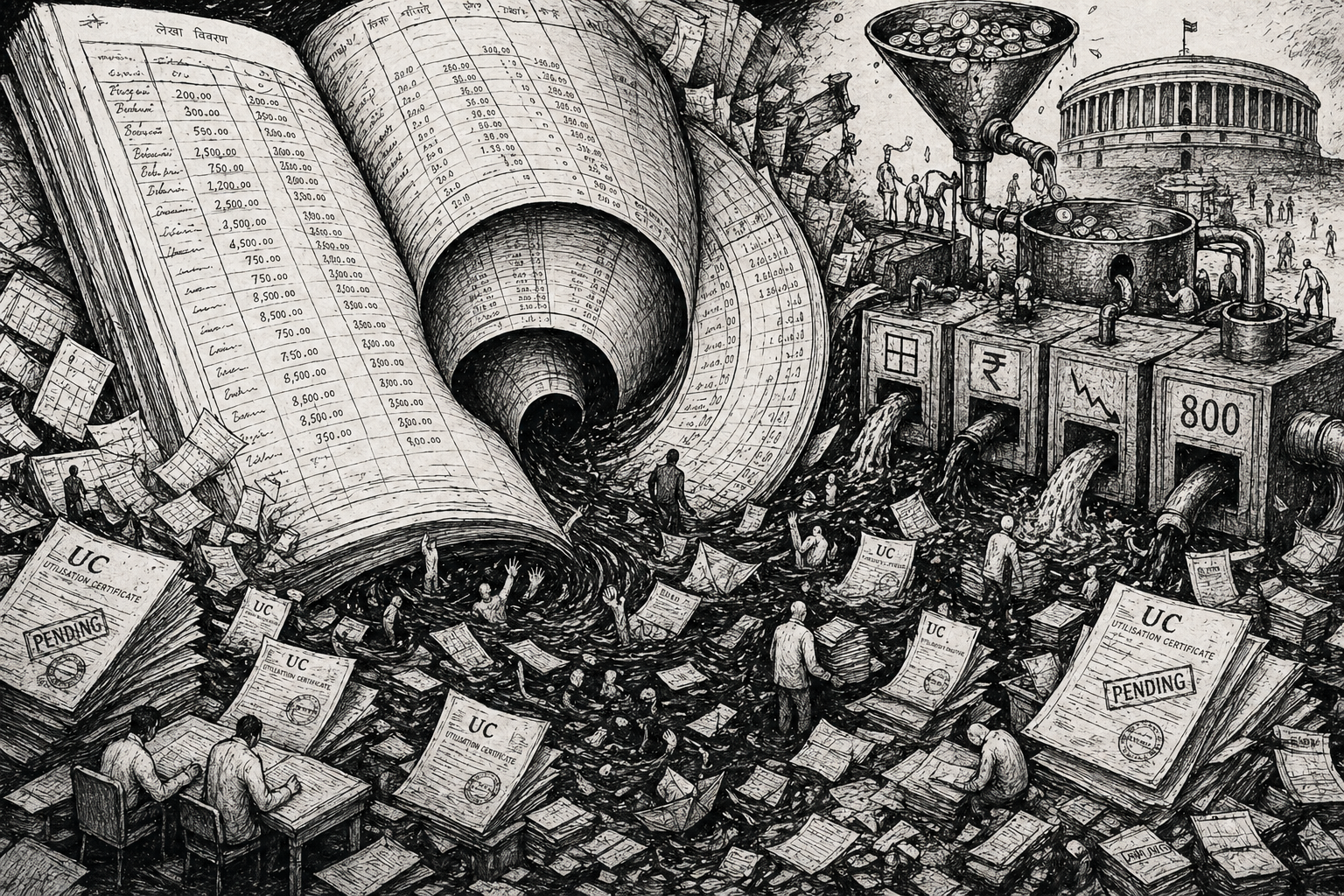
The US government has spent $12 billion in two weeks on this war. Kevin Hassett, Director of the National Economic Council, confirmed the figure on CBS. A Pentagon briefing to Congress put spending at $11.3 billion in the first six days. CSIS estimates $16.5 billion by day twelve. The burn rate is roughly $1 billion per day.
Time magazine calculated what $12 billion could alternatively fund: 1.6 million Pell Grants at the maximum award, 166,000 teacher salaries (roughly the entire teaching workforce of Florida), the National Park Service for 3.6 years, and healthcare coverage for 1.3 million Americans. Republicans in Congress had just refused to extend Affordable Care Act subsidies at a cost of $30 billion per year. The war will last for at least five weeks.
Joseph Stiglitz and Linda Bilmes established this framework in their landmark 2008 study, The Three Trillion Dollar War. The Bush administration projected Iraq would cost $50 to $60 billion. The actual cost exceeded $3 trillion. Stiglitz and Bilmes counted what government ledgers hide: lifetime veterans' care, interest on war debt (Iraq was financed entirely by borrowing while cutting taxes), macroeconomic damage from oil price spikes, and the opportunity cost of investment foregone. Brown University's Costs of War Project has since calculated that post-9/11 US wars cost $8 trillion, with 900,000 direct deaths and an estimated 4.5 to 4.7 million total deaths from indirect causes. The Intercept's analysis applies the Stiglitz-Bilmes methodology to the Iran war and concludes total costs could reach "trillions" when long-term obligations are included.
Brown's research also quantifies the employment dimension: military spending generates roughly five jobs per million dollars; education generates thirteen, healthcare nine, clean energy seven to eight. Development economists track this the same way they track any other public expenditure decision: as an allocation trade-off with measurable consequences.
Meanwhile, the beneficiaries are identified by the ticker symbol. Lockheed Martin stock is up roughly 40% year-to-date. Northrop Grumman gained 46% since June 2025. ExxonMobil's market capitalisation has surged to an all-time high of $643 billion. Chevron is up 30%. Jacobin reports that on March 2 alone, the top three defence contractors added an estimated $25-$30 billion in combined shareholder wealth. Responsible Statecraft noted that the greatest threat to defence investors is peace.
Woman, Life, Freedom belongs to the women of Iran
The US-Israeli justification for this war invokes a familiar trinity: nuclear threat, terrorism, and the liberation of an oppressed people, particularly women. Netanyahu explicitly invoked the "Woman, Life, Freedom" slogan to justify the strikes. Israeli military communications celebrated images of female fighter pilots in the bombing campaign.
The Women, Life, Freedom movement was born from the death of Jina Mahsa Amini in September 2022, rooted in the Kurdish feminist tradition of "Jin, Jiyan, Azadi," sustained by hundreds of thousands of Iranian women and men at the cost of at least 551 documented deaths. In the OHCHR's characterisation, it was "egalitarian, secular, humanist, and peaceful." It demanded regime change through domestic mobilisation, not through F-35s. The movement's own activists have explicitly warned against military intervention. Iranian feminist scholar Dr Azadeh Sobout has argued: "War destroys these spaces precisely. Universities close, labour networks collapse, cultural institutions disappear."
The scholarly evidence on how external military pressure affects domestic reform movements confirms this. Sebastian Hellmeier's 2021 study in the European Journal of International Relations found that international pressure tends to increase pro-government mobilisation in authoritarian states. Reports from inside Iran confirm that support for the opposition has dipped since the strikes began. Bombing regimes do not weaken them domestically. It gives them a war to rally around.
Columbia anthropologist Lila Abu-Lughod coined the concept of "securo-feminism" to describe the collusion between women's rights rhetoric and the security establishment after the 2001 invasion of Afghanistan was marketed as "the first feminist war in all of history." After twenty years of occupation and $2.3 trillion spent, the Taliban returned in eleven days. Women's rights were catastrophically reversed. You cannot bomb patriarchy out of existence. You can only destroy the institutions, imperfect as they are, that might someday dismantle it from within.
The double standard is clarifying. Saudi Arabia ranked 132nd out of 146 countries on the World Economic Forum's 2025 Global Gender Gap Report. Until 2018, Saudi women could not drive. The male guardianship system still restricts marriage, employment, and medical procedures. Women's rights activists, including Loujain al-Hathloul, were arrested and tortured. Saudi Arabia murdered journalist Jamal Khashoggi, and the US confirmed Crown Prince Mohammed bin Salman approved the operation. Saudi Arabia remains a close US ally, a major arms customer, and the anchor of the petrodollar system. No invasion was proposed. No "liberation" offered. The criterion for American military action has never been human rights. It has been the alignment of the target state's resources and strategic orientation with American and Israeli interests.
India's silence
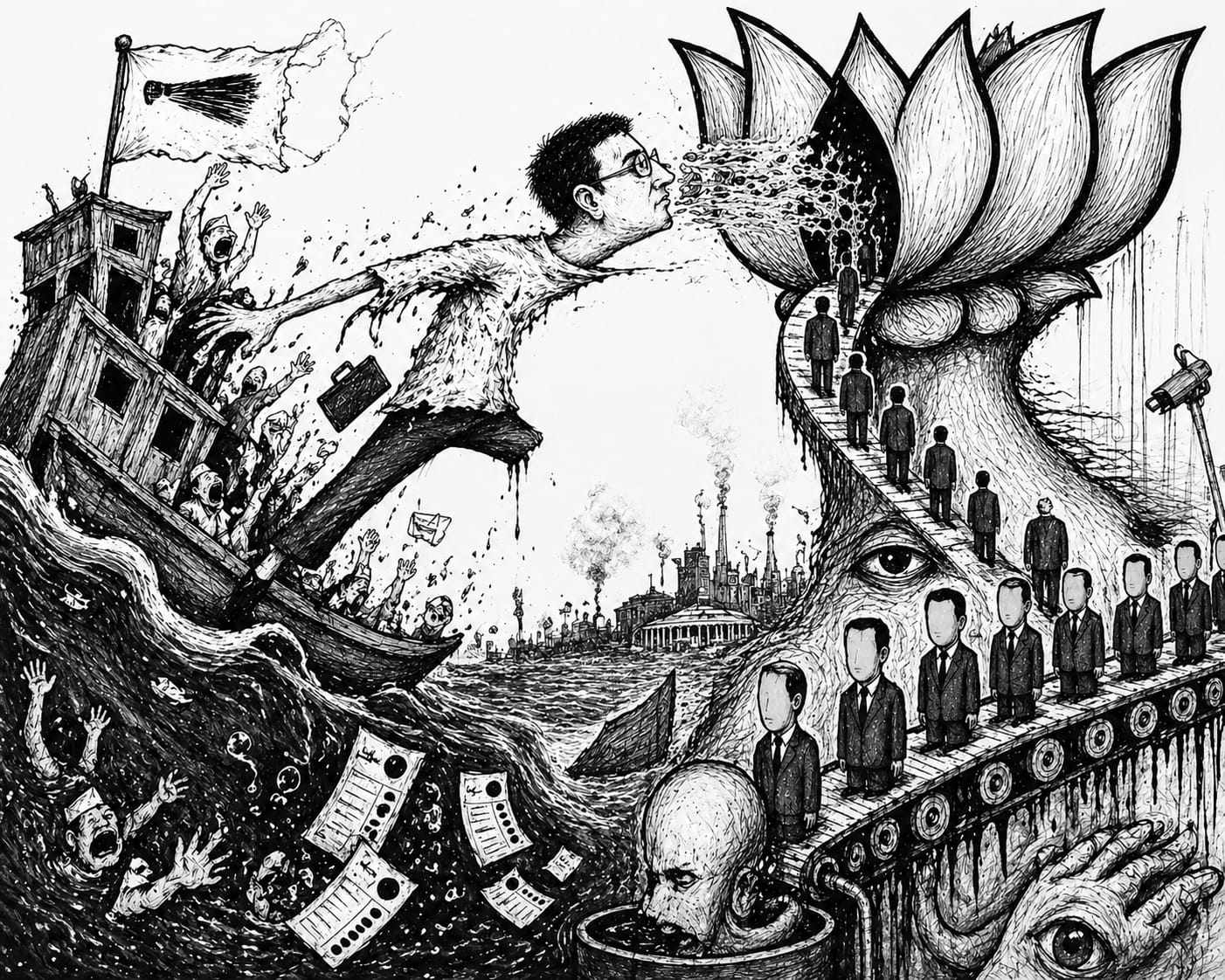
India co-sponsored the UNSC resolution condemning Iran's retaliatory strikes while declining to criticise the US-Israeli strikes that provoked them. This is selective morality calibrated to maintain the US trade deal signed in February 2026 and the "strategic partnership" with Israel that Prime Minister Modi has cultivated since 2014. India chairs BRICS in 2026. Iran is a BRICS member. The bloc has not issued a joint statement eighteen days into a war against one of its own. Middle East Eye described BRICS as "missing in action."
India, of all nations, should understand what is at stake here. A country that spent two centuries under colonial rule, justified at every stage by the civilising mission, should recognise imperial benevolence when it sees it. India was a founding leader of the Non-Aligned Movement because Nehru understood that sovereignty is the precondition for self-determination, including women's rights, democratic governance, and economic development. Supporting Iranian sovereignty does not mean endorsing the Islamic Republic. It means insisting that the right to determine political futures belongs to the people who live under them.
What needs to happen
The war is ongoing, and the situation evolves by the hour. But some things are clear, and they go beyond the platitudes about "diversifying energy sources" that get trotted out after every oil shock and forgotten the moment prices fall.
Start with the fiscal picture. Budget 2026-27, presented on 1 February, assumed oil prices of roughly $75 to $80 a barrel. It assumed a current account deficit of around 1.5-2% of GDP. It assumed the RBI's easing cycle would continue supporting growth. It assumed stable remittance inflows. Every one of these assumptions is now wrong. Brent is above $108. The current account deficit is headed toward 3%. The OIS market is pricing in rate hikes. Remittance flows face disruption across every Gulf corridor. The Budget's entire fiscal architecture, from subsidy estimates to deficit targets to the growth projections underpinning tax revenue forecasts, needs to be revised. The government has not indicated it plans to do so. This is the pattern I have written about before: the gap between the official statistical framework and the ground reality, between the numbers on the dashboard and the lived experience of the people the numbers are supposed to represent.
The LPG crisis lays this bare. I have previously argued that the shift from demand-driven entitlements like MGNREGA to consumption subsidies like Ujjwala represents a fundamental restructuring of how the Indian state relates to poor households, from guaranteeing work to distributing goods. When the goods stop arriving, the architecture collapses entirely. Three hundred and thirty million households cooking with LPG cannot switch to firewood or dung cakes overnight, not least because the National Family Health Survey data shows that the transition to clean cooking fuel was itself the product of a decade of subsidy infrastructure. That infrastructure is now being stress-tested by a war India had no part in starting, and the stress test is revealing exactly how thin the margin is between a welfare delivery system and a welfare crisis.
The energy diversification question is real, but the framing is wrong. India has approximately 50 days of crude and refined product cover and a strategic petroleum reserve capacity of under 40 million barrels. The US SPR holds roughly 714 million barrels, enough for over six months at current usage. That gap is not a planning failure that can be fixed in the next budget cycle. It reflects a structural political economy: the fossil fuel import system is deeply embedded in the subsidy architecture, the refinery infrastructure, the petrochemical value chain, and the fiscal revenues from excise duties on fuel.
Countries that invested in renewables before this crisis are demonstrably more resilient to the oil shock. China, where over 50% of new car sales are electric. Nepal, where 70% are EVs. Even Pakistan has reduced its LNG dependence through the growth in solar power. India's renewable ambitions remain perpetually underfunded and subordinated to fossil fuel interests. The question this war forces is whether that subordination is a policy choice or a structural lock-in, and what it would actually take, in investment terms, in institutional terms, in political terms, to break it.
The remittance pipeline needs its own crisis infrastructure. India has built evacuation capacity (Operation Devi Shakti from Afghanistan, Operation Kaveri from Sudan, and now 67,000 evacuees from the Gulf in this crisis). But it has not built economic resilience for the communities that depend on Gulf remittances. Kerala alone receives ₹1.27 lakh crore annually from Gulf-based workers. When those flows are disrupted, the impact ripples through local economies: real estate, retail, education spending, and healthcare.
The 1990 crisis taught us this. The 2008 financial crisis repeated the lesson. And still there is no standing mechanism, no remittance insurance scheme, no counter-cyclical fiscal transfer targeted at remittance-dependent districts, to cushion the blow when the next disruption comes. It always comes.
The diplomatic framework destroyed on February 28 can be rebuilt. Iran had already agreed to the core nonproliferation demands. India chairs BRICS in 2026 and has a seat at the G20 table. The Non-Aligned Movement, for all its institutional decay, still represents a constituency of nations whose interests are systematically absent from the rooms where wars are planned. India's voice in these forums should be saying plainly what the evidence shows: that the diplomatic path was working, that it was deliberately destroyed, and that the costs of the war are being borne by countries that had no say in starting it.
The costs also need to be documented and attributed, systematically, not as rhetoric but as accounting. Every increase in Indian petrol prices, every LPG shortage, every cancelled CBSE exam in the Gulf, every remittance that does not arrive in a Kerala village, every basis point of inflation eroding the purchasing power of India's poorest citizens: these are costs of this war. They have authors. Development economists, journalists, and civil society organisations have a responsibility to trace the causal chain from Washington's decisions to Delhi's doorsteps, the way the Costs of War Project at Brown has done for American wars and the way I have tried to do in my own work on the gap between policy announcements and ground realities.
The question from 1990 returns
My parents' generation learned from the Gulf crisis that India's economic sovereignty was inseparable from the geopolitics of oil. The reforms of 1991, forced by the foreign exchange crisis the war precipitated, reshaped India's economy for a generation. The lesson was supposed to be that dependence is dangerous.
Thirty-six years later, the dependence is deeper. India imports more oil today than it did in 1990, from the same region, through the same strait, with the same vulnerability.
3.2 million Iranians are displaced inside their own country tonight. 330 million Indian households are wondering when the next LPG cylinder will arrive. 815,000 Lebanese are displaced for the second time in two years. Farmers in Bangladesh, the Philippines, and sub-Saharan Africa face a fertiliser shortage that will translate into hunger by the next harvest. Defence stocks are at all-time highs. Oil companies are printing money. And a man in Washington who inherited a real estate empire and lost a series of casinos is spending a billion dollars a day of other people's money to destroy a country whose democratic government his own intelligence agency overthrew in 1953.
From the Tomahawk missile to the Raytheon share price. From the closure of Hormuz to the ₹3,000 LPG cylinder in Malviya Nagar. From the diplomatic breakthrough on February 27 to the first bombs on February 28. The people who bear the costs of wars are never the people who choose them.
Varna is a development economist and writes at policygrounds.press
Further reading:
Economic impact of the 2026 Iran war (Wikipedia, continuously updated)
The global price tag of war in the Middle East (World Economic Forum, March 2026)
How the War With Iran Is Impacting Economies in Asia (Time, March 2026)
What US Spending on the War in Iran Could Fund Instead (Time, March 2026)
How Israel-US war on Iran puts $50bn in Indian remittances at risk (Al Jazeera, March 2026)
India growth forecasts cut, inflation risks rise as Iran war drags on (Business Standard, March 2026)
Joseph Stiglitz and Linda Bilmes, The Three Trillion Dollar War (W.W. Norton, 2008)
Costs of War Project (Brown University, Watson Institute)
War Won't Liberate Iran: Iranian Feminist Challenges the West's Narrative (Open Magazine, March 2026)













Write a comment ...