
A judge's insult became a political party, a sit-in at Jantar Mantar, and a march on Parliament that met lathis and tear gas on the first day of the Monsoon Session. Underneath the satire sits an examination agency that has produced two leak scandals in three years, and a labour market that offered 8,868 railway posts to 1.22 crore applicants. The student crowd is the oldest recurring actor in Indian politics, and the state's playbook against it has changed less since 1974 than the students have.
On 15 May 2026, during a hearing in the Supreme Court of India, Chief Justice Surya Kant compared unemployed young Indians to cockroaches. "There are youngsters, like cockroaches, who don't get any employment and don't have any place in the profession," he said, in remarks reported by Al Jazeera. "Some of them become media, some of them become social media, some of them become RTI activists." The remark was made in passing, the way such remarks usually are.
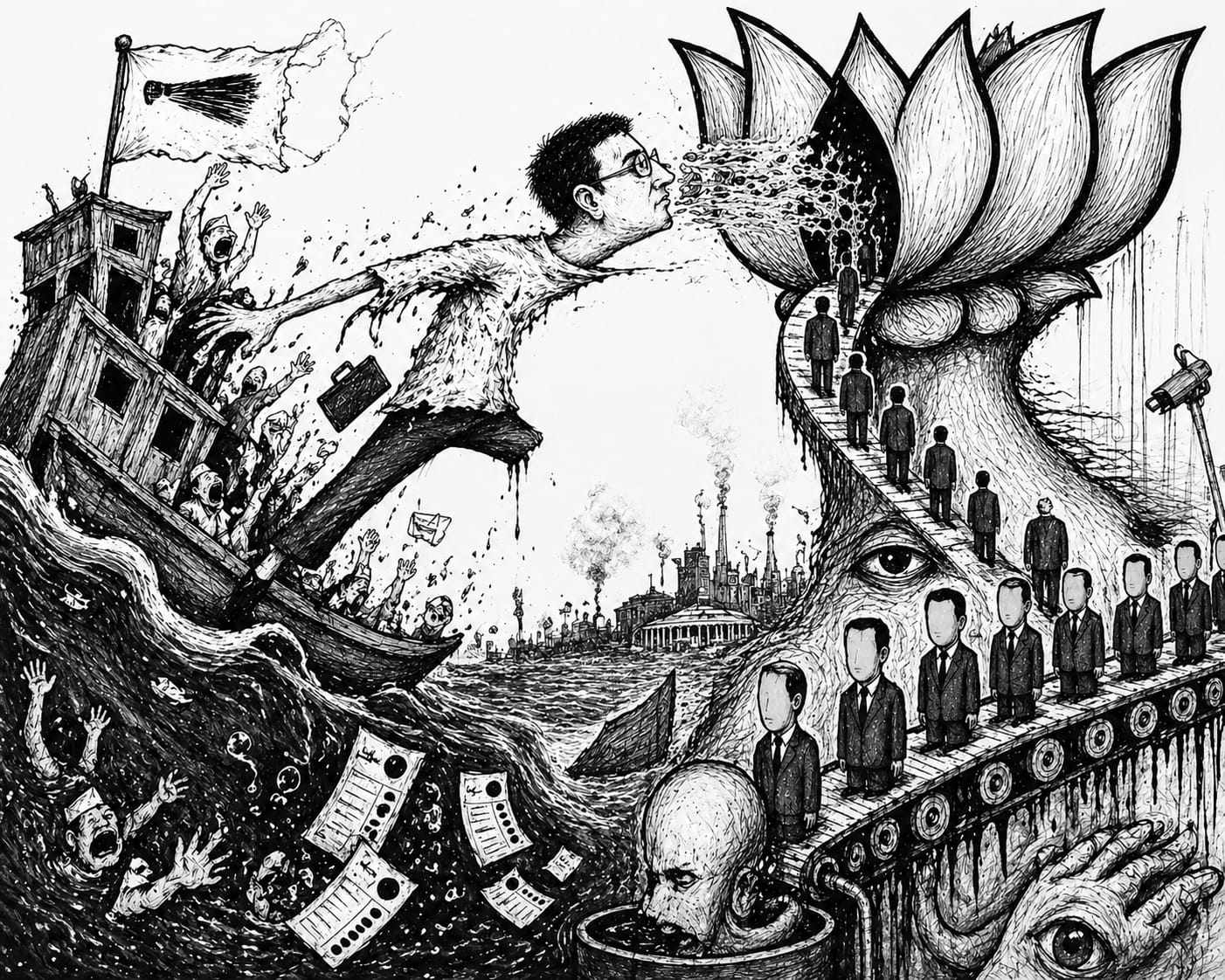
Abhijeet Dipke, a thirty-year-old journalism graduate from Aurangabad who was then studying in Boston, read the coverage and posted a question: what if all the cockroaches came together? The next day he founded the Cockroach Janta Party, a name that sits one letter of dignity away from the ruling party's. Its Instagram account crossed three million followers within 78 hours and some twenty million inside a week, overtaking the BJP's official handle. The Ministry of Electronics and Information Technology ordered the party's X account restricted under Section 69A of the Information Technology Act on 21 June. The Delhi High Court unblocked it on 7 July, noting that the stated justification, a risk of chaos around a re-examination, no longer held.
This morning, 20 July, on the opening day of Parliament's Monsoon Session, more than ten thousand people tried to walk from Jantar Mantar to Sansad Marg behind that name. Delhi Police met them with lathi charges and tear gas near Patel Chowk and Raisina Road. Five Metro stations were closed, internet services were suspended in parts of central Delhi, and protesters were detained at Jantar Mantar, Mandi House, Patel Chowk, Janpath and Parliament Street, then driven to scattered locations so they could not regroup. The Lok Sabha adjourned for the day. Sonam Wangchuk spent the march in Safdarjung Hospital, on day 23 of a hunger strike, having been carried there by police two days earlier. Dipke broke his own fast at 11.15 a.m., at the request of Rajesh Mal, the father of a NEET aspirant who died by suicide, and then joined the march.
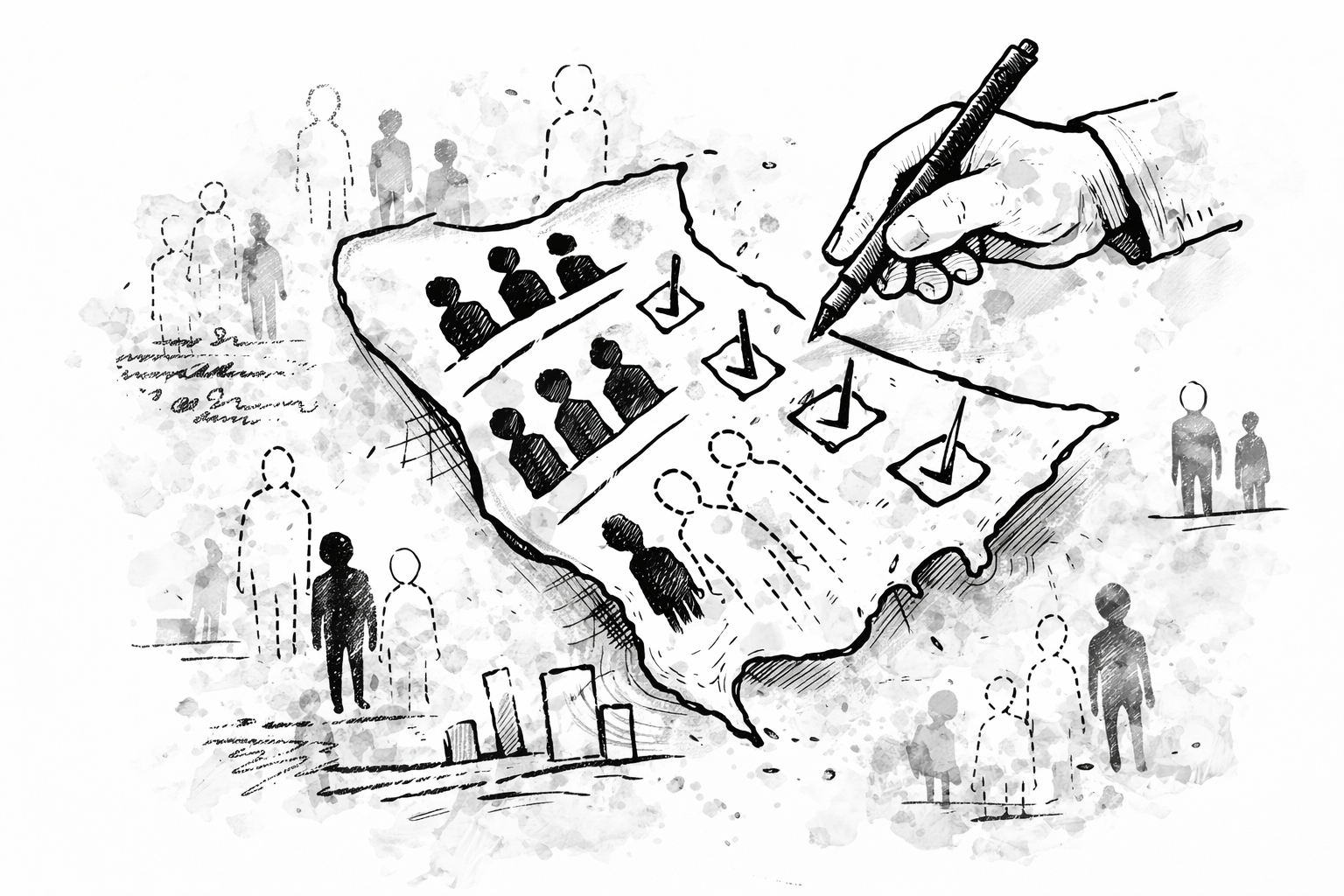
This essay is about the distance between a meme and a movement, and why that distance closed in nine weeks. It reads the Cockroach Janta Party against the labour market arithmetic that produced it, against sixty years of Indian student politics, against the state's standard repertoire for containing student anger, and against three neighbouring capitals where versions of this confrontation have already run to their conclusions. It ends with what the Union government should do now, almost none of which it is currently doing.
A remark in court and a party named for it
Dipke is an unlikely insurgent and says so. Born in Aurangabad in 1995, a journalism degree in Pune, a master's in public relations from Boston University, three years as a social media volunteer for the Aam Aadmi Party and an adviser to Delhi's education department before he left for the United States in 2023. He built the party's website, manifesto and posters with AI tools. The CJP has three official spokespersons, the journalist Saurav Das among them, and it has refused, repeatedly and on the record, any comparison with the uprisings in Kathmandu and Dhaka. Dipke has pledged dissent "within the bounds of the Constitution" and asked marchers to carry two things: the national flag and a book.
The party's first street outing, at Jantar Mantar on 6 June, was permitted until 5 p.m. as a "one-time exception," with about a thousand police in attendance. On 11 June, at Savitribai Phule Pune University, Dipke launched a national campaign and released a five-point exam manifesto that included ₹10,000 in compensation for any student whose examination leaks. On 20 June the second Jantar Mantar gathering banged steel thalis with spoons, a reference the government understood immediately, and this time the crowd stayed. The sit-in had begun. Wangchuk arrived on 28 June and stopped eating. With him fasted six students, among them Neha Bora, the national president of AISA and a PhD scholar at JNU, whom fellow protesters would later shield inside a human chain when the police came for the stage.
The geographer Craig Jeffrey spent years in Meerut listening to educated young men describe their lives with one English word: timepass. His 2010 book of that title recorded a generation with degrees, without work, waiting at tea stalls and coaching centres for a future that kept receding. What Jeffrey documented as private limbo, the CJP has converted into public identity. The cockroach works as a symbol precisely because it concedes the insult. The Chief Justice said the young were vermin scuttling at the edges of the professions; the party's founding act was to agree, and then to ask how many vermin there were. Philip Altbach argued half a century ago that Indian student politics functions as a training ground for the political class. The 2026 twist is that the training ground has produced, instead of apprentice politicians, a satire of the political class, built by a viral online campaign that became a protest movement in the space of a summer.
Two leaks, one examination agency
NEET-UG 2026 was held on 3 May for some 22.7 lakh aspirants. On 8 May, the National Testing Agency referred the paper to central agencies. On 12 May, it cancelled the examination outright, after investigators matched a pre-circulated "guess paper" to the real one, with overlaps reported across the biology and chemistry sections. The CBI took over the same day. Arrests followed in Pune: P.V. Kulkarni, a chemistry professor who worked as an NTA translator with access to the paper; Manisha Gurunath Mandhare, a biology professor; and Manisha Sanjay Havaldar, a school headmistress and NTA subject expert, arrested on 22 May over the physics paper, which she said she had reconstructed from memory. Rajasthan's Special Operations Group confirmed the guess paper had circulated in Sikar. The re-examination's results arrived on 20 June, the day the sit-in began.
None of this was new. I wrote about the 2024 leak in The Paper Travels First: the confirmed breaches at Hazaribagh and Patna, the 1,563 candidates first given and then stripped of grace marks, the students detained near Parliament that July for protesting it. The Supreme Court, in Vanshika Yadav v Union of India (2024 INSC 568), declined to cancel that year's examination, holding that cancellation is justified only where sanctity is compromised at a systemic level, while observing of the NTA's grace-marks reversal that "flip-flops are an anathema to fairness." The Court widened the remit of a seven-member committee under the former ISRO chairman K. Radhakrishnan to cover CCTV surveillance, secure transport of papers, digital tracking, identity verification and grievance redressal. The Union filed its compliance report in December 2024. Parliament had already passed the Public Examinations (Prevention of Unfair Means) Act that year. UGC-NET was cancelled a day after it was held that June.
Two years later, the same agency lost the same examination in the same way, through its own personnel. Education Minister Dharmendra Pradhan has admitted a "breach in the command chain" and announced that NEET will move to computer screens from 2027. That answers the wrong question. The 2026 leak was a custody failure involving the NTA's own translators and subject experts; a screen does not secure a paper that agency insiders can carry out in their heads. Writ petitions now before the courts ask whether the NTA should exist at all, and the question hanging over them is the one the 2024 judgment left open: if two cancellation-scale failures in three years do not amount to systemic compromise, what does?
The other trigger drew less attention. The CJP's manifesto names the CBSE's on-screen marking irregularities alongside NEET, an episode I examined earlier this year in The Screen That Could Not Read. Result delays and evaluation errors do not make national television the way a leak does. They ruin years all the same.
Then there are the deaths. The party's memorandum to Health Minister J.P. Nadda this afternoon demanded ₹1 crore for the families of NEET aspirants who died by suicide, "more than 20 of whom have lost their lives" by the party's count. That number needs careful handling. Individual cases are documented: a nineteen-year-old in Odisha's Bhadrak district in mid-July, another aspirant in Berhampur after the re-examination results. A consolidated official count does not exist. The National Crime Records Bureau counts student suicides as a category, 13,892 in 2023 in its most recent release, the highest in a decade and a rise of about 73 per cent since 2014, but publishes nothing exam-specific, and one broadcast tally put the 2026 figure at twelve over 37 days. Twenty may be right. It is a claim, and this piece treats it as one. The grief, whatever its count, is organised now: it was a bereaved father who asked Dipke to eat.
The queue behind the examination
A leaked paper, on its own, produces litigation. The movement grew from what stands behind the paper.
The Periodic Labour Force Survey for 2023-24 put unemployment among Indians aged 15 to 29 at 10.2 per cent, against 3.2 per cent for the population as a whole. The first calendar-year PLFS, for 2025, records a marginal improvement to 9.9 per cent, with urban youth at 13.6 per cent, and reports that 25 per cent of all Indians aged 15 to 29 are in neither employment, education nor training. The ILO and Institute for Human Development's India Employment Report 2024 supplied the sharpest numbers: youth made up 82.9 per cent of the country's unemployed in 2022, the share of the unemployed with at least secondary education had risen to 65.7 per cent from 54.2 percent in 2000, and unemployment among graduates stood at 29.1 percent, against 3.4 percent for those who cannot read or write.
For women graduates, the figure was 34.5 per cent. The report's own tables show unemployment rising with every additional level of education. Private trackers run higher still; CMIE's household survey has put unemployment in the 15 to 24 band above 40 per cent, though its methodology differs from the PLFS and its figures should be read as a private series, whatever one makes of the gap.
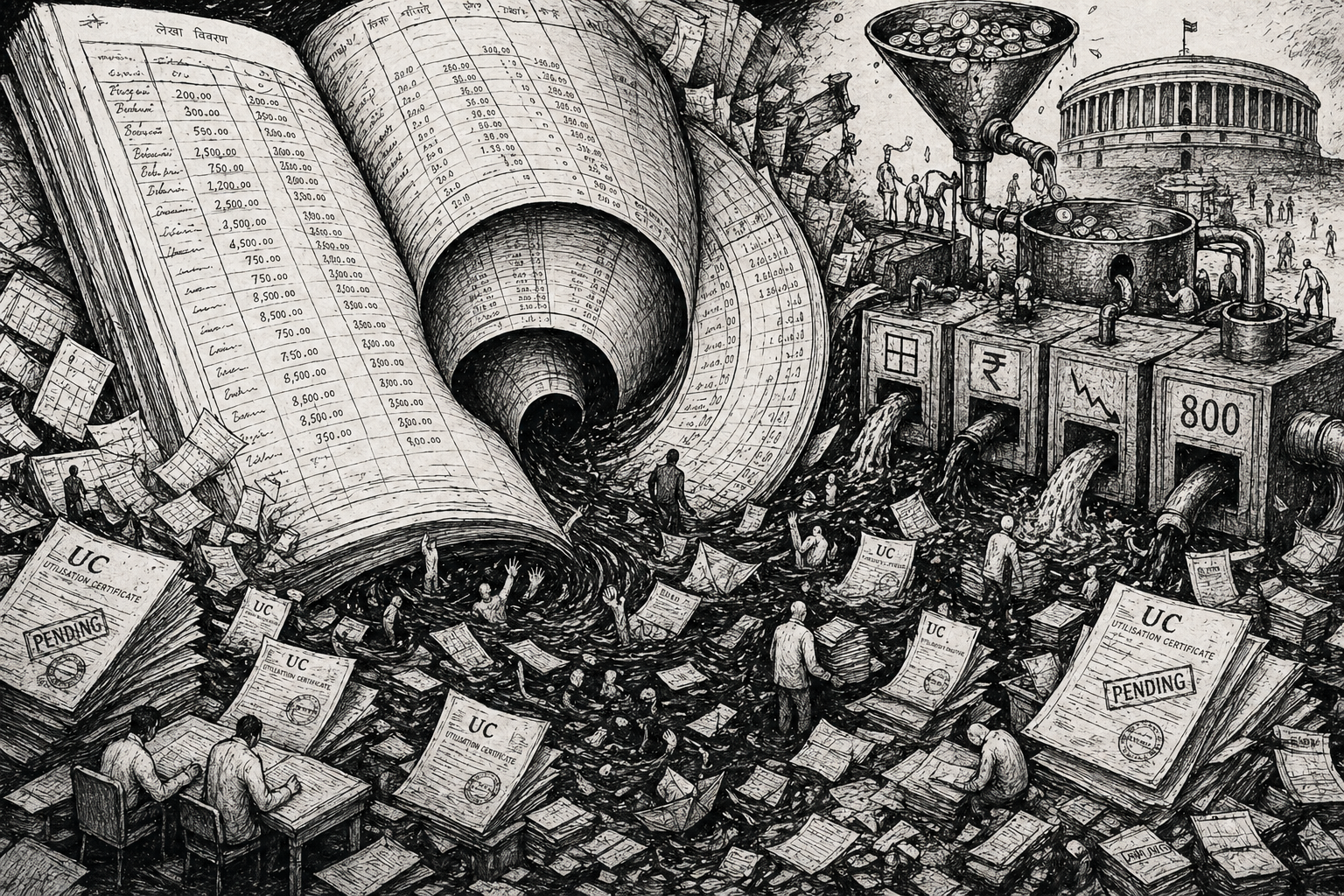
The examination is the visible tip of this queue. This year's railway recruitment round for non-technical popular categories offered 8,868 posts and drew 1,21,68,895 applications by the recruitment portals' tally of the board's zone-wise data, roughly 1,372 candidates per post. The vacancy line matters as much as the applicant line. The equivalent round in 2019 advertised more than 35,000 posts; 2024 offered 11,558; 2026 offers 8,868. The queue lengthens from both ends, more aspirants pressing against fewer posts.
The queue is rational. Kunal Mangal, studying 147 candidates preparing for civil service examinations in Pune, estimated that the amenity value of a government job- the security, the pension, the standing- makes up at least two-thirds of its total compensation. In the classic Harris-Todaro logic, people wait in line for a scarce formal job as long as the expected value of winning exceeds the certain wage of informal work, and a premium of that size justifies years of waiting. The waiting carries its own cost. Mangal's study of Tamil Nadu's hiring freeze of 2001 to 2006, published in the Journal of Development Economics, found that applications did not fall when vacancies collapsed, competition per post jumped by about 390 per cent, and the male graduates who stayed out of work to keep preparing bore the damage in both the short and the long run.
Kota is the physical form of this bet. At its peak the town held over two lakh aspirants; enrolment has since fallen to around one lakh and industry revenue has halved, to near ₹3,500 crore, after 29 students died by suicide there in 2023, the worst year in nearly a decade. District interventions brought the 2024 figure down to 17. Independent studies put the success rate in the top examinations near two percent. Behind the queue sits the structure. India's median age is about 29.8 years, 26 percent of the population is between 10 and 24, and 68 percent is of working age: the demographic dividend window, and it is closing on schedule. Dani Rodrik's premature deindustrialisation thesis explains why the window is not being used. Manufacturing employment peaked at income levels far below those of the early industrialisers, so the ladder from farm to factory to office is missing its middle rungs. The ILO report records the consequence: after 2018-19 the long shift of workers out of agriculture reversed, and people went back to the farm. I traced that reversal in The Road That Runs Back. The examination hall is where a demographic dividend goes when the factory never arrives.
The statistical label for a young person outside employment, education and training happens to be NEET. One in four Indians aged 15 to 29 answers to it.
Students in the street, 1974 to 2020
A government inclined to treat this as a traffic management problem has sixty years of evidence to consult on how that tends to end.
The habit predates the republic. Students walked out for Swadeshi in 1905, filled the national universities of Non-Cooperation in 1920, and carried much of Quit India in 1942; the All India Students' Federation, the country's oldest student body, was founded in 1936 and its successors were on the pavement at Jantar Mantar this week.
In December 1973, students at the L.D. College of Engineering in Ahmedabad struck over a hostel mess bill that had risen by about twenty rupees a month. Ghanshyam Shah's account in the Economic and Political Weekly of August 1974 traced how a canteen grievance, meeting food inflation and a corruption-tainted state government, became the Nav Nirman movement: 63 days of agitation across 23 towns. Chief Minister Chimanbhai Patel resigned on 9 February 1974; the assembly was dissolved on 15 March. The cost is disputed to this day. Outlook's retrospective counts 85 killed in police firings; the scholarly account by Dawn and Rodney Jones puts reported deaths above one hundred. Both figures should travel together.
Gujarat's students inspired Bihar's, and Bihar's found Jayaprakash Narayan. The Chhatra Sangharsh Samiti's agitation became JP's Total Revolution, and the road from there ran through the Allahabad High Court's judgment of 12 June 1975 to the Emergency declared on the night of 25 June. The student generation jailed under MISA became a governing class: Lalu Prasad Yadav, Nitish Kumar, Sushil Modi and Ram Vilas Paswan came out of the Bihar movement, and Arun Jaitley out of the Delhi University students' union presidency. The ABVP grew through those years, and in Gujarat so did a young RSS pracharak named Narendra Modi, attached to the anti-Emergency underground. The party governing India is itself, in large part, the child of a student movement. It has better reasons than most to know how these things compound.
Assam ran the experiment again. The All Assam Students' Union led the anti-foreigner agitation from 1979, and six years of confrontation ended in a document: the Assam Accord, signed on 15 August 1985. The Asom Gana Parishad was assembled out of AASU's leadership, and Prafulla Mahanta became Chief Minister at 32. Sanjib Baruah's work remains essential reading on how a student union became a government and what the transformation cost.
Mandal broke the pattern of unity. When V.P. Singh announced OBC reservation in central services in August 1990, the counter-mobilisation came from upper-caste students; Rajeev Goswami's self-immolation attempt that September became its image. Christophe Jaffrelot's reading is the durable one: 1990 recomposed campus politics along caste lines, and the student movement stopped being a single actor. The liberalisation decades that followed brought fee hike battles and the slow bureaucratisation of union elections under the Lyngdoh Committee's 2006 rules, but nothing that shook a government.
Then came the sequence this government made. The FTII strike of 2015 and Occupy UGC opened it. Rohith Vemula died at the University of Hyderabad on 17 January 2016, and the movement his death ignited ran into the JNU sedition case within a month. The 2019 JNU fee hike protests followed, then the police entry into Jamia Millia Islamia's library and the action at AMU in December 2019, then the masked mob inside JNU on 5 January 2020. Students began the anti-CAA mobilisation; Shaheen Bagh's grandmothers made it permanent, until the courts and a pandemic cleared the road. And then the long tail: the Delhi riots conspiracy case, under which Umar Khalid and Sharjeel Imam have now spent more than five years in jail without conviction.
The Supreme Court refused them bail on 5 January 2026, finding a prima facie case and a "central and formative role"; the review was dismissed in April, and on 4 July a trial court refused bail again, the judge recording that he had no option. Under the Watali standard, the prosecution's case is taken at face value at the bail stage, and the delay-based exception carved out in K.A. Najeeb has been read down to a sliver. When JNU students protested the January rejection, the university filed a police complaint against them.
Two dress rehearsals for 2026 came from the exam queue itself. In January 2022, the Railway Recruitment Board's NTPC results brought aspirants onto the tracks in Bihar and Uttar Pradesh, with trains burned; in June 2022, the Agnipath scheme's four-year contracts did the same across a dozen states. Both were leaderless, both were about the arithmetic of posts and applicants, and both were forgotten in Delhi within the month. The CJP is what happens when that anger acquires a name, a mascot and a lawyer's insistence on nonviolence.
Between 1974 and 1985, student movements removed a chief minister, fed the coalition that ended Congress rule nationally for the first time, produced an interstate accord and created two ruling parties. That is the baseline against which "it's only a meme" should be assessed.
The state's repertoire
The official response to the CJP has followed a settled sequence. It is worth setting out step by step, because every step has case law attached, and most of the case law is being ignored.
The first step is designation. Jantar Mantar is Delhi's licensed pen for dissent, a regime built from a National Green Tribunal order of 2017 and the Supreme Court's decision in Mazdoor Kisan Shakti Sangathan v Union of India (2018), which directed the police to frame guidelines balancing the right of assembly against residents' convenience. Permission is granted by the hour; the CJP's first protest was allowed until 5 p.m. as a one-time exception. Prohibition follows: Section 163 of the Bharatiya Nagarik Suraksha Sanhita, the renumbered Section 144, covered the New Delhi district today, and the march was denied permission because Parliament was in session, which is precisely when a march to Parliament means anything.
Then comes medicalisation. On 18 July, day 21 of Wangchuk's fast, police carried him from the stage to Safdarjung Hospital. DCP Sachin Sharma stated the shift was made under Delhi High Court orders and expert medical advice, given his deteriorating condition; he had lost about 9.5 kilograms, and the hospital's bulletin recorded that he was refusing intravenous fluids and medication. His wife, Gitanjali Angmo, said he was taken without informing him or her, and has moved the High Court for his transfer to a private hospital. His conditions for breaking the fast were written by hand on a piece of tissue paper: accountability for the education system's failures, an assurance the issue would be raised in Parliament, or senior leaders visiting him with such an assurance. The Supreme Court held in the Ramlila Maidan incident case of 2012, after police cleared sleeping protesters at midnight, that the state's power over assemblies is bounded by proportionality. Fourteen years on, the method has softened into paperwork: the fast is not broken by force, merely managed under medical orders until it stops being a spectacle.
Dispersal and detention followed this morning: preventive detentions at five sites, detainees released after "verification of antecedents," the crowd scattered by relocation. The D.K. Basu safeguards on arrest and custody apply on paper. Anita Thakur v State of Jammu and Kashmir (2016) established compensation for police excess during protests, and the standing asymmetry persists regardless: FIRs follow protesters and rarely follow the lathi. The internet suspension in central Delhi sits badly against Anuradha Bhasin v Union of India (2020), which requires necessity and proportionality for any shutdown. The Shaheen Bagh judgment, Amit Sahni v Commissioner of Police (2020), gave the state its favourite sentence, that public ways cannot be occupied indefinitely. It says nothing about cutting a city's internet to stop a walk.
Last comes the staged audience. A two-member CJP delegation, Das and Ashutosh Ranka, waited two hours to meet Nadda for about ten minutes and handed over a memorandum with three demands: Wangchuk's immediate release, Pradhan's resignation or dismissal, and ₹1 crore in compensation for the families of the dead. Nadda posted that the talks were held in a cordial atmosphere and appealed for the sit-in to end. Pradhan, who last month called the CJP the "B team of disruptive elements" and detected "tukde tukde" forces at Jantar Mantar, met Amit Shah inside the Parliament complex. No statement from the Prime Minister was on record when this piece was filed. Rahul Gandhi called Wangchuk's removal wrong and accused the government of untruth and violence; Akhilesh Yadav and Sharad Pawar followed.
The playbook's wager is fragmentation: permit narrowly, medicalise the fast, detain and scatter, receive juniors with regret, wait. Today gave the wager some support: a miscommunication split the march, and the party spent an hour walking back reports of its own founder's detention that it had itself put out. The crowd, though, was the movement's largest yet, and it assembled two days after the state removed its most famous face.
Dhaka, Kathmandu, Colombo
The CJP disavows these comparisons. The government should study them anyway, because in each case the decisive escalations were supplied by the state.
Bangladesh's quota movement began with a court order, the High Court's restoration on 5 June 2024 of a 56 per cent quota in government jobs, nearly a third of it reserved for descendants of freedom fighters. A movement about the allocation of scarce public employment, in a labour market shaped much like ours. Police shot the student Abu Sayed on 16 July; a nationwide internet shutdown followed on the 18th; Sheikh Hasina fled to India on 5 August, and Muhammad Yunus's interim government took office three days later. The UN human rights office's fact-finding report, released in February 2025, concluded that the crackdown left as many as 1,400 people dead in 46 days, the vast majority shot by security forces, with children about one in eight of the dead; its preliminary analysis the previous August had counted more than 600, and open-source investigators documented the police violence positionally. A day-by-day timeline compiled for the EU's asylum agency records how five weeks sufficed.
Nepal moved faster. On 4 September 2025, the government ordered 26 unregistered social media platforms shut; the ban met the already viral Nepo Kids campaign about politicians' children, and on 8 September Human Rights Watch confirmed at least 19 protesters killed on the first day. The final toll, per the Nepali Army's own report, was 76. Prime Minister K.P. Sharma Oli resigned on 9 September as Parliament and the Supreme Court burned. The former Chief Justice Sushila Karki was sworn in as interim Prime Minister on 12 September, her name emerging partly from a Discord poll in which 7,713 people voted, 3,833 of them for her. Elections were held on schedule in March 2026, and Oli was arrested on 28 March over the protest deaths.
Sri Lanka's Aragalaya of 2022 came out of an economic collapse, foreign debt near 101 per cent of GDP by 2021, default, and queues for fuel and medicine. The Inter University Students' Federation under Wasantha Mudalige supplied much of the organisation. The movement stayed largely nonviolent; the worst bloodshed came on 9 May 2022, when pro-government mobs attacked the protest camp, and the ensuing clashes killed at least ten people and injured over two hundred. Two months later, crowds filled the presidential residence and its swimming pool, and Gotabaya Rajapaksa resigned on 14 July.
India differs from all three: far larger, federal, its electoral machinery still turning, its Union government holding a mandate barely two years old. The CJP is explicitly constitutionalist where Kathmandu's crowds torched their parliament. The three cases forecast nothing about Delhi. Each records where the lethal escalation came from: the state, by a shooting, a platform ban, a mob let loose. Youth unemployment supplied the crowd. Delhi controls the first variable completely. The second, it has left unattended for the twelve years I audited in Eleven Years, Six Asks, and a suspended internet connection in the capital's core, is not the conduct of a state that has read the neighbourhood's file.
What needs to happen now
Start with the examinations, because that is where trust broke. The screen migration announced for 2027 touches the delivery mode and leaves the custody problem where it was. The Radhakrishnan committee's recommendations should be published against an implementation audit, item by item, so Parliament and litigants can see which safeguards existed on paper alone. The Public Examinations Act of 2024 should be applied to institutional insiders with the same energy it promises against coaching mafias. The writ petitions seeking the NTA's restructuring or dissolution deserve answers on the merits, and the answer should draw on Tamil Nadu's experience: the Justice A.K. Rajan committee's case against single-gate examinations has aged well through two leak cycles. Its 2021 report found that 71 per cent of NEET's successful candidates that year were repeat-takers, that the Tamil Nadu state board's share of applicants had fallen from 95 per cent before NEET to about 64 per cent, and that admissions from households earning under ₹2.5 lakh a year had shrunk.
Weight should move back towards school boards and multiple admission windows, and states that want their own routes to their own medical seats should get them. The design principle is simple to state: reduce what one stolen morning can destroy.
Hiring is cheaper to argue. The railway round that drew 1.22 crore applications this year advertised a quarter of the posts it did in 2019. Parliamentary replies across ministries tell the same story of sanctioned posts standing vacant in teaching, health, police and the courts. Filling sanctioned vacancies asks little of the exchequer that it has not already promised; the posts are budgeted in principle, and every year of vacancy transfers the cost onto queue-standers in coaching fees and foregone earnings. Recruitment calendars should carry statutory timelines, and delay should carry compensation. The CJP's demand of ₹10,000 for every student whose exam leaks is liquidated damages by another name, and better economics than its critics allow: it prices an externality the state currently imposes for free. The states' own hiring capacity is squeezed by the fiscal settlement I described in The Bill Comes Due, which is one more reason the Sixteenth Finance Commission's award matters to a twenty-two-year-old in a coaching hostel.
For those already in the queue, the state owes work in the meantime. Jean Drèze's DUET proposal, an urban counterpart to MGNREGA built around placement in public institutions, has sat in the public domain since 2019; Rajasthan launched a version in 2022, the Indira Gandhi Urban Employment Guarantee. The 2024 budget's employment-linked incentive and internship schemes should be audited for uptake, with the results published, instead of advertised, and where the private wage subsidy has not produced jobs, the public employer should stop outsourcing its own responsibility.
The money question sits under all of it. NEP 2020 restated a target first set by the Kothari Commission in 1968: public education spending at 6 per cent of GDP. It has never been reached, as NEP's own text records, and the Economic Survey 2025-26 puts general government education expenditure at 2.7 per cent of GDP, lower than it was in FY20. The gap is filled privately, by education loans and coaching fees, a tax on aspiration collected from the families now at Jantar Mantar.
Protest governance needs repair on its own terms. Ramlila Maidan and Anuradha Bhasin are law, and applying them as written would already transform this week: no blanket internet suspensions to stop a walk, detention lists published within a day, force answering to proportionality rather than to the session calendar. Student union elections, suspended or hollowed on many campuses, should be restored, and the Lyngdoh rules reviewed after two decades. And the state should stop reading every campus assembly through the conspiracy case. Five years of jail without conviction is itself a message, and every student at Jantar Mantar has received it.
Representation is the slowest fix. The average member of the Lok Sabha that adjourned today is 56 years old, on PRS Legislative Research's count of the 18th House, against a national median age near 30, and only 11 per cent of MPs are aged 40 or younger. The queue's generation is governed, examined and policed by institutions in which it barely sits. Parties should field it, and the Opposition, which condemned Wangchuk's removal in the morning and lost the floor by noon, now has the plainer duty of converting adjournment into agenda: the memorandum's substance, the vacancy data, the implementation audit, placed on the record of the House the marchers could not reach.
Pradhan's position is a political question, and this essay does not pretend otherwise. It is worth stating the narrower point: two cancellation-scale examination failures in three years, on one minister's watch, with the second executed by the examining agency's own personnel, is the kind of record for which parliamentary systems invented resignation. The demand outside Parliament today was, in that sense, the most conventional thing about the day.
The Assam Accord was signed on 15 August 1985, six years after Delhi first classified the students behind it as a law and order problem. Prafulla Mahanta, who led them, was Chief Minister of Assam before the year ended, at thirty-two.
Varna is a development economist and writes at policygrounds.press.
Further reading
The July 2026 movement Al Jazeera's explainer on the march · Bloomberg on the education crisis as political test · Outlook's live file from 20 July · AFP on the baton charge · The News Mill on the left student groups joining · The running timeline
The examinations Vanshika Yadav v Union of India · The July 2024 detentions of NEET protesters
The labour market PLFS 2023-24 release · PLFS 2025 release · UNFPA's 2024 population estimates for India · Kota's contraction
The history The Jones and Jones study of the 1974 Nav Nirman riots · Wikipedia on Nav Nirman · Outlook's 1974 retrospective · Al Jazeera on the Khalid and Imam bail record · The Quint on the July 2026 trial court order · A case note on the Supreme Court's UAPA order · JNU's January complaint against protesting students
The neighbourhood OHCHR's preliminary analysis of the Bangladesh protests · UN News on the fact-finding report · PBS on the 1,400 estimate · CIR's visual investigation of the police violence · The EUAA timeline of July and August 2024 · HRW on Nepal's first day · Harvard Chan's three-part Nepal analysis · Nepal's Gen Z protests · Sushila Karki · Oli's arrest · The 2022 Sri Lankan protests · Crisis Group on the Aragalaya · PTI on the 9 May violence












Write a comment ...