
My son sits for his first board examinations two years from now, so I read this May's news from CBSE as a parent before I read it as an economist. The board moved Class XII evaluation onto computer screens, told students the machine had made the old right to a recheck unnecessary, then had to rescan sixty-eight thousand answer books because the machine could not read them. This is an account of a reform sold as transparency, the safeguard it took away, and the older habit it repeats.
In 2028, my son will sit down for the first board examination of his life. I have started, the way parents do, to look at the machinery he will be fed into, and this spring, the machinery did something that should worry anyone with a child in a CBSE school. It changed how the answer book is read, told the country that the change would make results more accurate, and then produced the least-accurate result cycle in years.
The public face of it was a handful of students who refused to be quiet. A Class XII student in Delhi, Vedant, opened his result on 13 May, found a Physics score far below what his school examinations had predicted, and paid for a scanned copy of his answer book. When the file came, the writing on it was not his. After his post spread online, the board took up his case and admitted the mistake. A girl named Sanjana, holding 11 out of 70 in Chemistry, asked for her script and said the same: the answers were not in her hand. The board also admitted an error in her case.
This essay is about what a government does when it treats the measurement of learning as a problem of logistics, and hands a scanner a trust the rest of the system has not earned. CBSE introduced On-Screen Marking (OSM) for Class XII this year, calling it a step toward efficiency and transparency. The decision that mattered came folded inside it. The board announced that post-result verification of marks would end, reasoning that a digital system removes the totalling errors verification was built to catch. Then the first cycle produced errors in their tens of thousands, and the recourse the board had called unnecessary had to be reopened. I set the OSM story against three things: what an examination mark is actually for, the board's own record of removing safeguards and being forced to reinstate them, and an almost identical episode in England five years ago.
A line I should put down before anything else, because it is easy to lose in the anger. On-screen evaluation can be done well. Large examination systems abroad have marked on screen for years, and a careful digital process can anonymise scripts, distribute them evenly, and shorten the wait. The damage this year came from the speed, the training that never happened, a tender whose standards were lowered until a bidder could clear them, a safeguard withdrawn on a confidence the board had not earned, and a decade of underfunding that the scanner was asked to cover for.
What the board built
CBSE runs the Class X and Class XII examinations for close to 46 lakh students in India and in 26 other countries. On 9 February, it sent a notice to every affiliated school stating that Class XII answer books would be evaluated through On-Screen Marking this year, while Class X would remain on paper. Physical scripts would be scanned at designated centres, the candidate's identity masked, and the images sent to examiners, who would mark on-screen, with question-wise entry and automatic totalling. The Controller of Examinations, Sanyam Bhardwaj, set out the case in a webcast: faster results, no totalling errors, teachers marking from their own schools without travelling to centres, lower transport costs.
One promise inside that list carried the rest. Because the system would be so accurate, the board said, post-result verification of marks would be discontinued. The student's oldest protection against a wrong mark was being retired on the strength of a system that had not yet marked a single real paper.
The people who would do the marking were not sure the machinery was ready. At the end of February, the Delhi Government School Teachers' Association asked the board to delay the rollout to the next session, on the grounds that most teachers lacked certified training on the platform. They said they welcomed digitisation and were warning about preparation. The board's answer to the wider unease was not reassurance.
In March, it warned teachers of legal action if they posted what it called misleading information about the evaluation, a warning that even extended to teachers who were not part of it. An institution that begins a reform by telling its own staff to stay silent is telling you something about its confidence.
The first cycle, counted
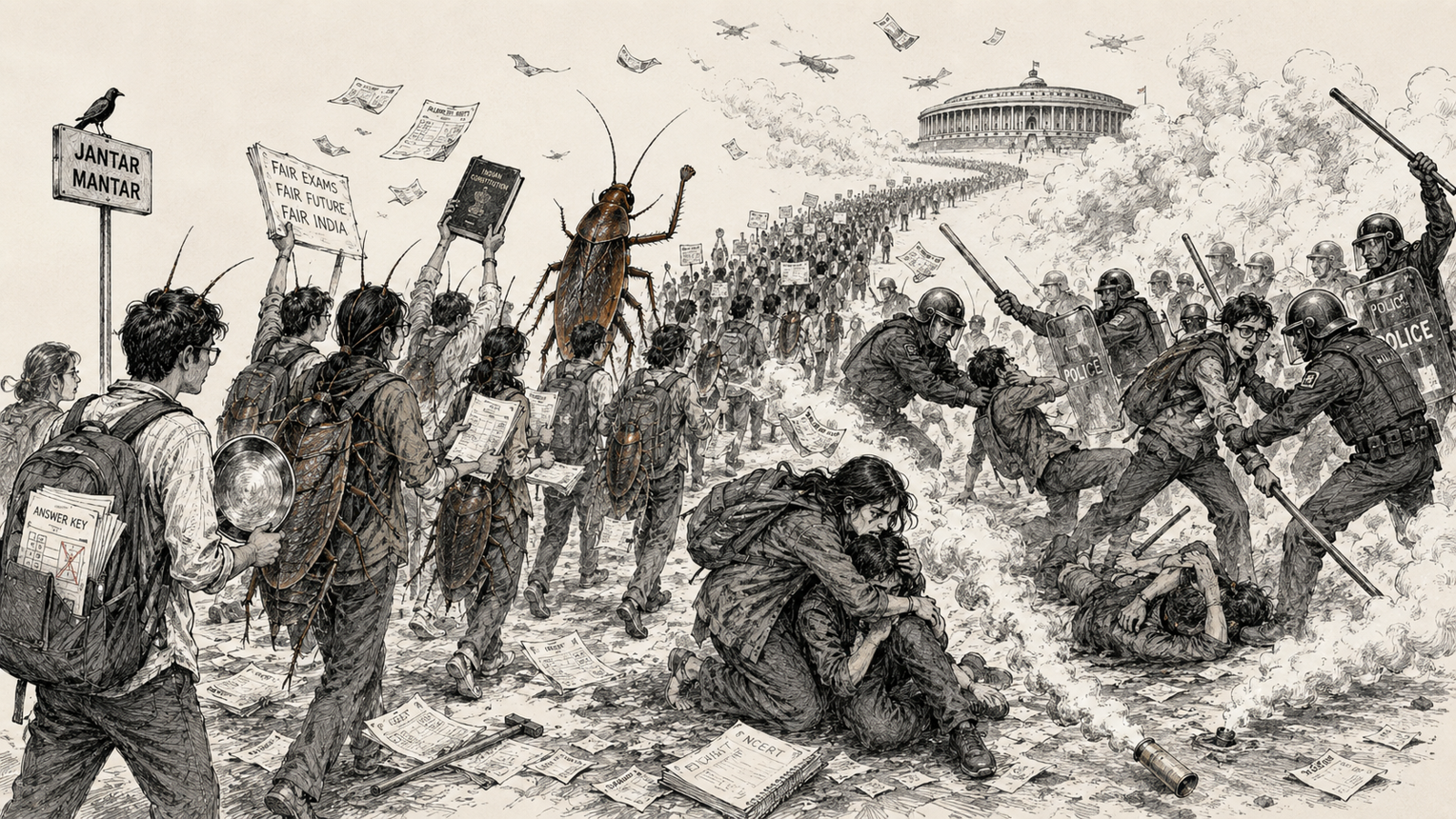
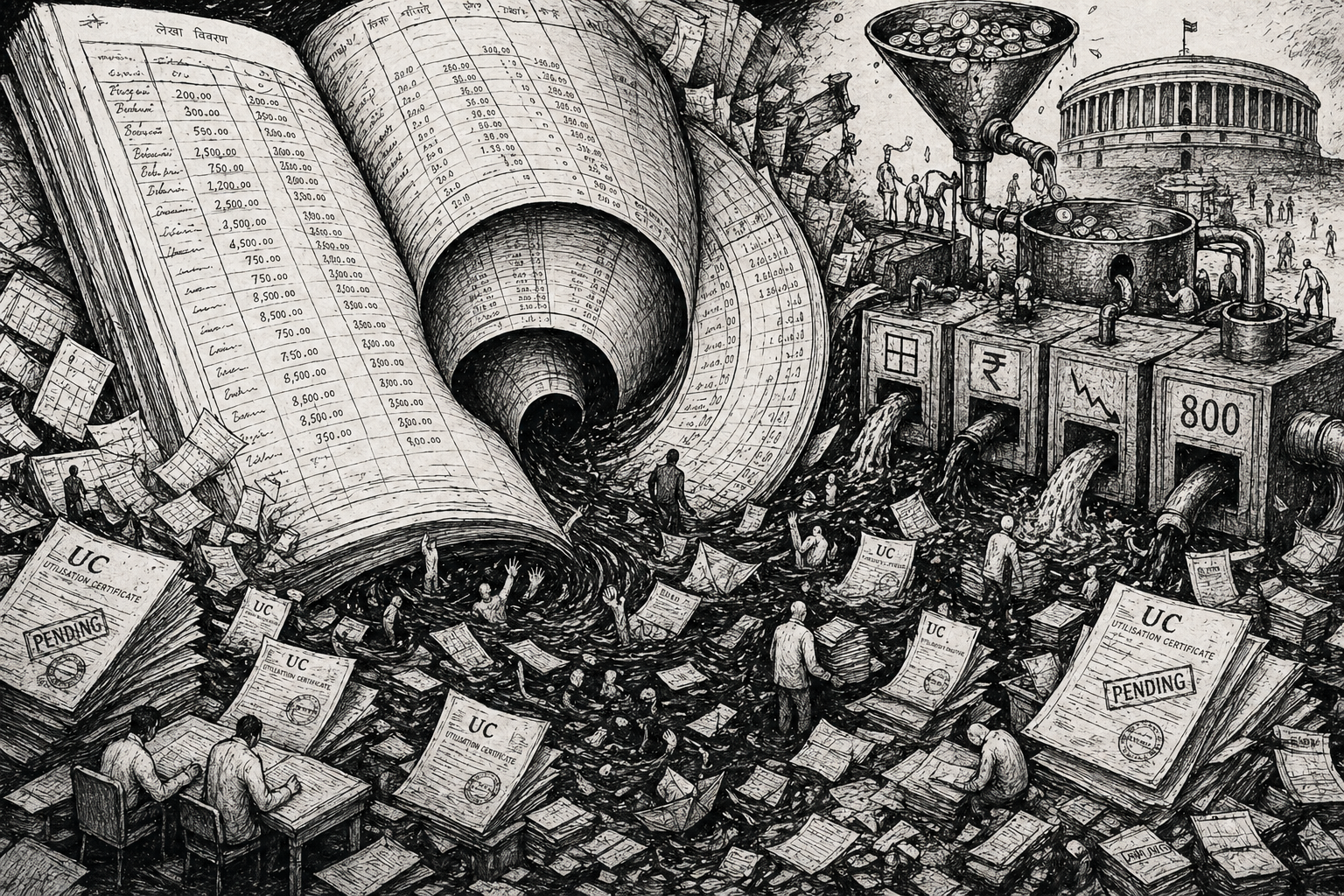
The results came on 13 May, and the numbers settled the question of whether this was a few unlucky students or something structural. Of the 98,66,622 answer books evaluated, 68,018 had to be rescanned because the image was too poor to read, and 13,583 were pulled out for manual checking after scanning failed to produce a legible copy. A Physics examiner in Delhi told the Hindustan Times that of about 760 scripts sent to him, nearly 100 came back unusable, blurred, partly scanned or missing pages. That is one script in eight, in a single examiner's pile, that the system could not show him well enough to mark.

Figure 1. Of nearly 98.7 lakh Class XII answer books evaluated on screen in 2026, 68,018 were rescanned for poor image quality, and 13,583 were checked by hand after scanning failed. Source: CBSE figures reported by Business Today and Outlook, citing the Hindustan Times.
The headline figure was the pass rate. At 85.20 per cent, it was down 3.19 points from 88.39 per cent the previous year, the lowest since the examinations went back to their ordinary form after the pandemic. Girls passed at 88.86 per cent and boys at 82.13 per cent, the widest gap in years. Trivandrum, usually near the top, fell to 95.62 from above 99; Prayagraj came in at 72.43.

Figure 2. The Class XII pass rate fell 3.19 points in 2026, the first year of On-Screen Marking, to its lowest since exams returned to their normal form after the pandemic. The 2022 cycle was pandemic-affected. Vertical axis truncated. Source: CBSE results as reported.
I want to be careful here because the easy version of this story is wrong. This was not a flat downgrade of everyone. The top of the distribution held, with more than 94,000 students still above 90 per cent and over 17,000 above 95 per cent. The squeeze was at the margin, among students near the pass line and in the numerical sciences, sitting next to a run of individual disasters of the Vedant and Sanjana kind. A fall of 3.19 points in a single year is too large to write off as ordinary variation, and it arrives in the exact year the marking method changed, pointing to some mix of stricter application of the scheme by seventy-seven thousand examiners working a new tool for the first time and a layer of scanning error underneath.
What the board did next is the most useful evidence in the whole affair. Having told students in February that verification was no longer needed, it reopened the entire post-result process, photocopy, verification, re-evaluation, and cut the fees steeply: the scanned copy down from Rs 700 to Rs 100, verification from Rs 500 to Rs 100, re-evaluation set at Rs 25 a question. The Education Minister, Dharmendra Pradhan, asked the board for a report on the server crashes and payment failures students were hitting, and the ministry brought in expert teams from IIT Madras and IIT Kanpur to steady the portal.
A cheaper recheck is a good thing for families, and it is also a confession. A board that truly believed its system had removed the need for verification would not, ten days later, be making verification almost free and urging students to use it. The fee cut acknowledges that the February announcement denied that large numbers of students had reason to doubt the mark the machine gave them.
How the contract was let
The haste is written into the procurement record, which is where this stops being a technology story and becomes a political one. CBSE floated three separate tenders for the OSM system before it could award the work. The first drew no bids. The second produced no technically eligible bidder. The board then relaxed its requirements and issued a third tender in August 2025, roughly six months before the system was rolled out across the entire Class XII cohort. The work went to a firm called Coempt; the much larger TCS lost out.
What was relaxed matters, because it goes to the heart of why the scanner could not read. Reading the tender documents, the Congress leader Jairam Ramesh listed the dilutions: the minimum scanning resolution dropped from 300 DPI to 200, the required process-maturity certification fell from Level 5 to Level 3, the penalty clauses were re-pointed away from marking errors and toward speed, the instruction to scan without cutting the spine of the answer book was removed, and the provision for a robotic scanner was dropped. A board worried about reading every page, faintly written in a village school, lowered the very specification that decides whether a faint page can be read.
The opposition has fixed on exactly this. Rahul Gandhi called the episode a scam and a calculated conspiracy, demanded an independent judicial inquiry and a special investigation team, alleged that the contracted firm had earlier operated under another name in Telangana, and said the Prime Minister should have removed the Education Minister. Those last claims are allegations and should be read as such until a probe tests them; CBSE has denied any wrongdoing and says it followed the government's financial rules. The part that needs no probe is the timeline. A national examination that decides the futures of close to eighteen lakh young people was run on a system bought after the board loosened its own standards to find a taker, six months before go-live, with the teachers' association warning it was not ready.
What a mark is for
To see why the noise matters beyond the immediate distress, it helps to ask what a board mark does in the first place. The answer is older than CBSE. In 1973, Michael Spence published Job Market Signalling, the paper that later won him a share of the Nobel and gave economics its modern account of credentials. Education, in his telling, does two jobs at once. It may build skill, and it also sends a signal, a costly and observable marker that lets employers and institutions sort people they cannot otherwise tell apart. A Class XII mark is one of the cleanest signals the Indian system produces. It opens or closes a college seat, sets a cut-off, decides a scholarship, and follows a young person for years as a compressed claim about what they can do.
A signal is worth something only when it is believed, and it is believed only when two students with the same mark are roughly comparable. Put noise into it, through a blurred scan, a misallocated script, a scheme applied unevenly across a vast new corps of first-time on-screen examiners, and the mark stops sorting and starts misdescribing. The student who wrote a strong Physics paper and got a weak grade has not only been wronged. She has been mislabelled by every institution that will read her result, and those institutions are now making decisions based on incorrect information.
Donald Campbell and Charles Goodhart, writing in the 1970s, named the trap from two directions: once a measure becomes the target, it stops measuring well. CBSE's old moderation policy was that failure running upward, marks inflated to hold pass parity until a ninety-five meant less than it said. This year's combination, a tighter machine plus the removal of appeal, is the same disease running the other way, the instrument's verdict treated as final at the precise moment the instrument is least proven.
There is a distributional point the signalling literature tends to bury, and in an Indian reading, it belongs at the centre. Measurement error in a high-stakes signal is not shared out evenly. A family with means can sit an improvement examination, take a year again, pay someone to chase a correction, or apply abroad where the Indian mark counts for less. A first-generation learner in a small town, whose parents cannot work a three-stage online re-evaluation window with a deadline the board does not extend, absorbs the bad number and lives inside it. Noise in the signal moves risk from the system that made the error onto the students least able to insure against it. Reetika Khera and Jean Drèze have documented the same shape in welfare for a decade, where Aadhaar-linked digitisation, sold as efficiency and transparency, produced exclusion that fell hardest on the poorest, who were then told the technology had made such errors impossible. A scanner that rejects a rural school's faint answer book is the examination-hall cousin of a fingerprint reader that cannot authenticate a labourer's worn hands.
The deepest version of the argument is Lant Pritchett's. In The Rebirth of Education, he showed that schooling is not the same as learning, and that a system can hand out more certificates while the underlying competence remains flat. India sits inside that learning crisis. Responding to it by changing how the answer book is photographed, while leaving the classroom that produced the answer book alone, mistakes the patient's readout. Karthik Muralidharan's work on Indian state capacity makes the matching point: the binding constraint is rarely a clever delivery technology; it is the thin administration beneath it. Bolt a digital evaluation system onto a board that could not attract a qualified bidder and onto teachers it had not trained, and the technology inherits the weakness it was meant to fix.
The board has done this before
CBSE's instinct to withdraw a safeguard and call it progress has a history, and the last time it tried, the courts stopped it. The board had already ended the 2017 re-evaluation, noting that only a small fraction of students used it. In April 2017, together with more than thirty other boards, it agreed to scrap the moderation policy that had been padding marks, and it did so after the examinations were over. A parent and a lawyer took it to the Delhi High Court, which directed the board to keep the policy for that year and called the mid-cycle change unfair and irresponsible. The board even wrote to Delhi University asking it to give CBSE students weightage in admissions, expecting a fall in scores.
The same period exposed how often the board's own marking was wrong. When students challenged the end of re-evaluation, the Delhi High Court questioned the credibility of the board's checking, and the governing body resolved to use only senior, specially trained teachers for rechecking, a tacit admission that the work had been error-prone in exactly the way verification existed to catch. The lesson on offer in 2017 was plain. Take away the student's right to contest a mark, and you take away the mechanism that surfaces the board's mistakes, and you will be made to give it back. CBSE absorbed the lesson, mislaid it, and in 2026 paid the price again, faster.
England, 2020
The sharpest parallel is not Indian. In the summer of 2020, with examinations cancelled due to the pandemic, England's regulator Ofqual replaced SAT exams with grades produced by a standardising algorithm. When the A-level results landed on 13 August, around 40 per cent of teacher-assessed grades were marked down by at least one grade. The model leaned on each school's past performance, so a strong student at a school that had never produced a top grade was, in effect, held back by the building. The downgrades fell hardest on state-school pupils and lifted private-school ones, copying the inequality the system already carried. Within days, the protests forced a full reversal, the grades were thrown out for teacher assessments, and the Prime Minister disowned the tool his own regulator had commissioned, calling it a mutant algorithm.
The mechanisms are not the same, and I will not pretend they are. Ofqual's was an algorithm predicting grades for exams nobody sat; CBSE's OSM is human marking of real scripts that students did write. The screen does not invent the mark. What the two share is the way they were governed, and the governance is what should worry us. A central authority, anxious about inflation or logistics, brought in an opaque standardising mechanism, justified it on the grounds of fairness and efficiency, declined to open it to scrutiny, and removed the human judgement that used to absorb errors. Ofqual's board minutes recorded a decision to consult the exam boards but not the public on the model, and a discussion of whether the teacher grades could be kept confidential. CBSE warned its teachers against speaking. Both reached for opacity first, and in both, the cost arrived at the door of the students with the least cushion before the public revolt did. England took its reversal in one loud week. CBSE is taking its own in instalments, one fee cut and one IIT committee at a time.
The wider record
OSM does not stand by itself. It is the newest entry in a record of examinations under this government that families have learned to dread, and the pattern is what makes this political rather than merely technical.
The reference point is NEET-UG 2024, which I wrote about at length in The Paper Travels First and in a shorter argument on the Times of India edit page. That medical entrance came with a confirmed paper leak and arrests in Bihar, with grace marks for 1,563 candidates on the basis the National Testing Agency had not disclosed beforehand, and with a strange cluster of 67 students on a perfect 720, six of them from a single centre in Jhajjar, in Haryana. The Supreme Court told the agency that the sanctity of the examination had been compromised and described its handling of grace marks as an anathema to fairness. The 1,563 grace-mark candidates were offered a fresh test, which the testing agency held that June; the Court, finding the malpractice localised rather than systemic, declined to cancel the examination as a whole.
The less-remembered twin came a fortnight later. On 18 June 2024, the NTA held UGC-NET for more than nine lakh candidates, and the next day the Ministry of Education cancelled it outright, citing intelligence that its integrity might be compromised, and handed it to the CBI. Student groups across the political range demanded that the agency be scrapped and the minister resign. The ministerial reflex ran the same way through both. On NEET, Pradhan first said there was no corruption and no proof of a leak, then conceded that some irregularities had surfaced; on UGC-NET, he eventually admitted the paper had leaked on the darknet. Deny first, concede later.
Beneath the individual failures sits a number that explains the thinness of the machinery. The National Education Policy of 2020 restated a target the Kothari Commission first set in the 1960s, that India should spend six per cent of GDP on education. The target remains unmet, with the Centre and states together stuck between three and four per cent for decades and the broader measure around 4.6 per cent. Avani Kapur and her colleagues at the Centre for Policy Research have spent years showing how little of what is promised reaches the school. A state that will not fund the classroom and will not staff the testing agency properly instead reaches for the cheap signal of reform: a new portal, a scanner, and a dashboard that reports efficiency while the substance thins out. I have called this accounting theatre before, writing about Union finances and about a health system that bought insurance without building the hospital. OSM is the same play staged in the examination hall.
Where the cost falls
It is easy, in a piece about signals and tenders, to lose the seventeen-year-old. For most Indian families, the Class XII result is the single most consequential document a child produces before adulthood, and what rides on it is not figurative. Result-day distress has, in cases recorded year after year, ended in tragedy. To hand that document to a system that mis-scanned sixty-eight thousand scripts, and to tell students for three months that the old way of contesting it was gone, is to gamble with stakes the board does not carry, and the child cannot walk away from.
The cost also falls along the lines predicted by economics. The student who knows to apply for a photocopy on the first day, who can tell the difference between verification and re-evaluation, whose parent is free to fight a portal that keeps crashing, will most likely get her correction. The student in a Prayagraj school whose region passed at 72 per cent, who does not know the windows exist, who cannot spare even the reduced fee, and whose family treats the board's word as final because the board is the state, will not.
The errors arrive at random and settle by class. That pairing, an arbitrary harm sorted by privilege, is the worst property a public institution can carry, and it is what James Scott described in Seeing Like a State when he wrote about schemes that impose one legible grid from the centre and erase the local knowledge that made the old arrangement work. The travelling examiner who knew a region's handwriting has been replaced by a machine that rejects a page for being faint.
What a credible system would need
None of this is an argument for going back to lorries full of paper. It is an argument for doing the digital thing honestly and for refusing to let the technology launder a failure of governance.
Start with the safeguard. Verification should be a standing right, permanently written into the post-result process for every cohort, with windows long enough that a student without a lawyer in the family can meet them, rather than a concession that appears only when social-media pressure does. The board should publish, in full, the error data it now reveals only through leaked reports: how many scripts rescanned, how many marked by hand, how many corrected on re-evaluation and by how much, broken down by region and by school type, so the way the harm sorts by class can be seen and answered instead of denied. An independent audit of this first cycle should follow, run by examiners and statisticians from outside the board rather than by a committee the ministry picks to reassure itself, as England's regulator was eventually forced to open its model to outside eyes.
Then slow down. The teachers asked for a phased rollout with certified training before any of this happened, and the answer was a threat of legal action. Staggering the introduction, by class and by subject, with every examiner trained on the platform and the marking scheme published, is the minimum care owed to a national examination. The contract let in haste after the board lowered its own standards should be examined by someone other than the board that let it, and the question of why a system this consequential was procured six months before deployment belongs in Parliament, not in a press note.
Under all of it is the money, and the honesty to spend it. A board that could attract serious vendors, train its teachers, build its own evaluation capacity instead of renting it from the lowest bidder it could qualify, and run an examinations ombudsman with real powers, would not need to dress a thin system in the language of transparency. That means moving toward the six per cent of GDP the country has promised itself since the 1960s and never paid, the same refusal I traced through this government's wider policy ledger. A signal the state will not pay to keep clean will, sooner or later, lie to the children who depend on it.
My son has two years before he sits down to write. By then, the scanners will still be there, and the board will have had time to decide whether it wants them to read every page or only the ones that scan cleanly the first time. I would like to know which one it has chosen before he hands in his paper.
Varna Sri Raman is an independent development economist.
Further Reading
On the 2026 On-Screen Marking cycle: the board's February notice to schools, reporting on the relaxed tender norms and vendor selection, the rescanning figures, the blurred scans and answer-sheet mix-ups, the minister's report, and the fee reduction.
On the board's earlier reversals, the 2017 moderation fight, the end of re-evaluation from 2017, the credibility questions, and the senior-teacher resolution.
On the English parallel, the University of Bristol's analysis of the 2020 grading algorithm, coverage of who the downgrades hit, and the decision not to consult publicly.
On the wider examinations record NEET-UG 2024 and the Supreme Court's findings, the cancellation of UGC-NET, and the unmet six per cent target.
On the economics: Michael Spence, Job Market Signalling (1973); Lant Pritchett, The Rebirth of Education (2013); Reetika Khera on Aadhaar and exclusion (2015); James Scott, Seeing Like a State (1998); Karthik Muralidharan, Accelerating India's Development (2024).









Write a comment ...