
India has opened a route for companies to meet part of their legal duty to spend on social ends by buying instruments listed on a stock exchange. A bill now before a parliamentary committee would shrink the set of companies that owe the duty at all. Read together, the two moves narrow a public obligation and hand what survives of it to a market that has barely begun to function.
The first land record I ever held was a barga register in a block office in Bardhaman. I was there as a researcher, looking at how West Bengal had recorded its sharecroppers under Operation Barga, the drive the Left Front began in 1978 to register bargadars and give them security of tenure on the land they worked. The register was an ordinary ledger: names in columns, the plot, the share owed. What was recorded was not ordinary. Before the entry, a sharecropper's hold on a field rested on custom and on the forbearance of the man who owned it, and could be ended at the close of a season. After the entry, the hold was a fact that the state would defend. The economists who later studied the reform, Abhijit Banerjee, Paul Gertler and Maitreesh Ghatak, found that this recorded security raised agricultural productivity, because a tenant who cannot be evicted at will has reason to work the land as though some of its future belongs to him (Banerjee, Gertler and Ghatak, Journal of Political Economy, 2002).
What the register taught me was that a thing as unwieldy as a person's claim to a field had to be flattened into a line in a ledger before the state could see it and act on it. The flattening cut in more than one direction. The same act of making a relationship legible lets the state protect a bargadar against eviction. The same kind of act, in other hands and to other ends, can be used to sort people, to exclude them, or to price them. In Bardhaman, the legibility served the weaker party to the contract. That is not what legibility does everywhere it is applied.
This essay is about a set of changes to Indian law that take the act of flattening, the conversion of a social claim into a recorded and fundable unit, and build a market on top of it. On 27 May 2026, the Ministry of Corporate Affairs notified rules allowing a company to discharge part of its statutory corporate social responsibility by subscribing to a security listed on the Social Stock Exchange. At the same time, a bill before a joint committee of Parliament would raise the profit threshold at which the responsibility bites and create the power to exempt companies from it entirely. The first move reroutes mandated welfare funds through the capital markets plumbing. The second narrows the base of firms that owe the money in the first place.
I want to set out what each does, trace where the idea came from, and say plainly why I think it is wrong. My own position is not neutral, and I will not pretend otherwise. I read the Social Stock Exchange as the extractive habit of capital reaching into the one domain that ought to be walled off from it, the provision a society owes its members as a matter of right rather than of investment. The development economist's usual move is to ask whether an instrument works. I want to ask a prior question that the literature tends to leave implicit, and it is the contribution I am after here.
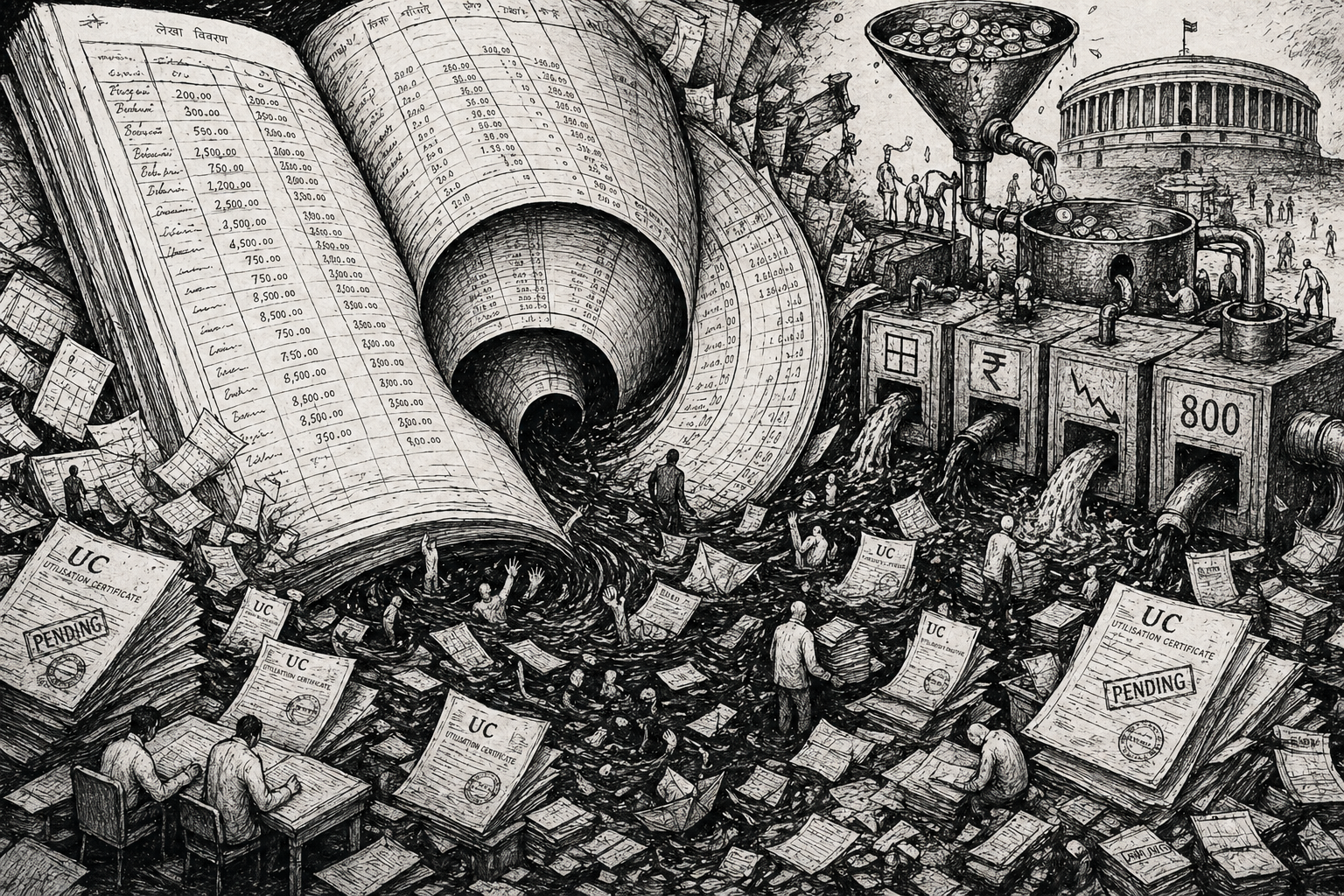
The work on making the social legible, from land titling and tenancy reform through to Daniela Gabor's account of the de-risking state, treats legibility as something that can cut either way. It can secure the weak, as Operation Barga did, or it can serve capital, as the financialisation of development does. The Social Stock Exchange lets me put the point more sharply than "financialisation is bad." The same administrative act, writing a social fact into a register that the state will honour, is being run in reverse. In Bardhaman, the register was built to bind the stronger party to the contract, the landlord, in favour of the weaker, the tenant. The zero-coupon zero-principal register is built to make the weaker party, the non-profit and the people it serves, legible to the stronger party, the corporate subscriber and the regulator who watches the issue. So the welfare question is not whether the social gets measured. It is in whose favour the measurement runs. By that test, the exchange fails, and it fails even as the same state moves through the bill to shrink the duty the register was supposed to discharge.
Section 135 and the duty it created
India wrote corporate social responsibility into company law in 2013. Section 135 of the Companies Act requires a company above certain size thresholds to spend at least two per cent of its average net profit over the preceding three years on activities drawn from a fixed list in Schedule VII of the Act, covering education, health, poverty, the environment and a set of named government funds. A company is caught if it meets any one of three triggers in the preceding financial year: net worth of five hundred crore rupees, turnover of one thousand crore, or net profit of five crore.
The design was unusual at the time. India became the first large economy to make a CSR contribution a legal obligation rather than a voluntary gesture, and the rule carried an older Indian inheritance, the Gandhian idea of the industrialist as a trustee of wealth held on behalf of society, recast as a statutory percentage.

Figure 1. From trusteeship to a listed instrument. Source: Companies Act 2013; Union Budget 2019-20; SEBI SSE framework; MCA G.S.R. 415(E), 27 May 2026; Corporate Laws (Amendment) Bill, 2026.
It helps to be honest about what the mandate was from the start. It was a way for the state to make private firms pay for a slice of social provision that the state itself was not funding from the budget. That is a transfer of responsibility, and the research on it is not flattering. Shivaram Rajgopal of Columbia and Prasanna Tantri of the Indian School of Business studied how the 2014 mandate affected companies that had been giving voluntarily before the law took effect. Their finding, published in the Journal of Accounting Research, is that firms which had spent above two per cent of profits when giving was discretionary cut their spending back toward the new floor once the floor became law (Rajgopal and Tantri, 2023).
The mandate did not lift corporate generosity. It crowded out the part that had been voluntary, because once giving became compliance, it lost the signalling value that had motivated some of it in the first place, the point Michael Spence made long ago about why agents spend to be seen spending. Rajgopal's earlier work with Hariom Manchiraju had already shown that the announcement of the mandate cut about four per cent off the share price of exactly those firms (Manchiraju and Rajgopal, 2017).
So the mandate begins from a weak position. It is a substitute for tax-financed provision, it shrank the voluntary giving it displaced, and it concentrated whatever spending remained. In the most recent year for which there is clean data, companies on the main board of the National Stock Exchange spent 22,212 crore rupees on CSR against a mandated 22,732 crore, and the top ten spenders alone accounted for thirty four percent of the total, led by Reliance, HDFC Bank, Tata Consultancy Services, ONGC and ICICI Bank (PRIME Database, reported in Business Standard, April 2026).
National CSR Portal figures show total reported spend rising from 24,834 crore in 2014 to above 34,909 crore in 2023-24 (CSRBox India CSR Outlook, 2025). The money is real and large. It is also a privatised levy collected and spent at corporate discretion, sitting where public spending might otherwise be, a point I have made before about how the state's books hide the gap between stated and actual provision (Reading the Centre's Books).

Figure 3. CSR concentration: the top 10 companies account for about 34 per cent of spend (FY2024-25) and the top 10 states for about 60 per cent of receipts. Source: PRIME Database / primeinfobase.com; National CSR Portal / MCA.
The new route through the exchange
The 27 May rules do not touch the two per cent. They change where part of it can go. The Ministry notified the Companies (Corporate Social Responsibility Policy) Amendment Rules, 2026, through gazette notification G.S.R. 415(E), and they came into force the day they were published (The Tribune, May 2026). A new Rule 4A allows a company to meet its CSR obligation by subscribing to a zero-coupon zero-principal instrument issued by a not-for-profit organisation registered on the Social Stock Exchange segment of a recognised exchange. Schedule VII was amended to list that subscription as a permitted CSR activity, thereby giving the route statutory standing (taxguru, full text of the rules). The rules cap the route at ten per cent of a company's total CSR spend in a year, so the exchange is meant as one channel among several rather than a replacement for direct work (The Tribune, May 2026).
Two features of Rule 4A deserve attention because they tell you what the route is for. The first is that a company subscribing to one of these instruments is released from the duty to carry out an impact assessment of the project it funds (thecsruniverse, on Rule 4A(2)). The ordinary CSR regime requires an impact assessment for larger projects. The exchange route removes that requirement from the company and pushes it onto the issuing organisation. The second is the discipline imposed on the issuer. The not-for-profit must complete the funded project within three financial years of issue, and on termination of the instrument, it must transfer any unspent money to a Schedule VII fund and report compliance to the Securities and Exchange Board of India (SEBI, under the 2026 rules).
The framing is that of a capital market product. There is an issuer, a tenor, a use of proceeds, a reporting line to the securities regulator, and a clawback. What there is not, for the company writing the cheque, is any obligation to find out whether the money did any good.
The instrument and the market it feeds
The instrument at the centre of all this is worth describing for what it actually is. A zero-coupon zero-principal instrument pays no interest and returns no principal. The subscriber is treated as a donor for accounting purposes and gets nothing back in cash. The only return is the social outcome the issuing organisation reports, and a record of having funded it (Zerodha Varsity, on ZCZP instruments).
It is, in plain terms, a grant given the form of a security. It is issued in dematerialised form, is listed, falls within the SEBI disclosure regime, and cannot be traded in the secondary market, though it can be transferred to legal heirs. It is also not a retail product: under the SSE rules, only institutional and non-institutional investors may subscribe to ZCZP instruments, with retail money confined to the for-profit segment (NSE, Social Stock Exchange FAQs). A grant has been wrapped in the machinery of an exchange, registration, disclosure, audit, and settlement, so that an act of charity can be made to look like a financing.
The Social Stock Exchange itself was announced in the 2019-20 Union Budget and built out by SEBI as a segment of the Bombay and National exchanges over the following years, the rules consolidated in a master circular dated 19 January 2026. The premise was that disclosure and standardised reporting would draw private capital toward the social sector at scale, the premise that bodies like the World Bank had been pressing for development finance more broadly.
The premise has not held. As of early 2026, registrations across the two exchanges ran into the low hundreds, but fewer than twenty organisations had actually listed an instrument and raised money, and the whole platform had channelled about forty-four crore rupees since it opened (TheCSRUniverse, interview with Neeraj Ahuja of Transform Rural India, May 2026). Two years earlier, the position was thinner still: the Economic Survey recorded nine organisations having raised twelve point four crore between them (Zerodha Varsity, citing the Economic Survey). Set forty-four crore raised over the life of the exchange against the 22,212 crore of CSR spent in a single year, and the scale of the thing comes into view. A market built to attract capital has, after several years, almost no flow through it.
The regulator's response has been to loosen the terms rather than ask whether the design was sound. A SEBI circular in April 2026 reduced the minimum subscription required before an issue can release funds from 75 per cent to 50 per cent, and now allows an organisation to remain registered for up to 3 years without raising any funds (SEBI circular, April 2026; Lexology summary). Read in sequence, the steps describe a market that did not work on its own terms, followed by a decision to feed it mandated corporate money so that it would. The CSR rules are the feeding mechanism. They take a pool of legally required spending that runs into tens of thousands of crores a year and direct a tenth of it to a venue that private donors had largely ignored.

Figure 2. About Rs 44 crore raised on the SSE over its life, against Rs 22,212 crore of CSR in a single year (NSE main board, FY25) and Rs 34,909 crore of total CSR (FY24). Log scale; fewer than 20 of a few hundred registered NPOs have raised any funds. Source: Transform Rural India / TheCSRUniverse; PRIME Database; National CSR Portal.
There is a further turn here that I have written about in a different setting. The Indian state has spent a decade tightening the Foreign Contribution (Regulation) Act to choke off foreign funding to civil society organisations, cancelling registrations and freezing the flow of money to the groups most likely to hold it to account (The Unaccountable State).
The Social Stock Exchange is the domestic, regulated, state-sanctioned channel offered in place of the one being shut. An organisation that cannot take in foreign money without risking its existence is instead invited to list an instrument, accept the disclosure burden of a securities issuer, and compete for a slice of corporate CSR. The funding does not simply move from abroad to the home. It moves to a venue that the state controls and can watch.
The bill before the joint committee
While the rules route the money, a bill would reduce the amount available to route. The Corporate Laws (Amendment) Bill, 2026, was introduced in the Lok Sabha by the Finance Minister on 23 March 2026 and referred the same day to a joint committee of Parliament, whose twenty-four members were notified about two months later (PRS Legislative Research, bill page; composition of the joint committee). It is a large bill, running to more than a hundred clauses across the Companies Act and the Limited Liability Partnership Act, and most of it is about easing corporate procedure: decriminalising a list of offences, simplifying mergers, widening buy-back limits, and naming the Insolvency and Bankruptcy Board as a valuation authority (Lexology, on the bill's restructuring provisions). Two of its clauses touch CSR directly, and they matter more than their length suggests.
The bill raises the net profit trigger for CSR from five crore rupees to ten crore, or to such other figure as the government may later prescribe. And it adds a power to exempt companies that meet prescribed conditions from CSR provisions altogether (PRS, bill summary; bill text). The same clause makes two smaller adjustments in passing, giving companies ninety days rather than thirty to move unspent CSR money to its designated account and raising the penalty ceiling for default from fifty lakh to one crore. The first change needs to be read precisely, because the easy reading overstates it. The three CSR triggers are alternatives, not cumulative. A company is caught if it crosses any one of them.
Raising the net profit limit to ten crore, therefore, does not release a company with a turnover above one thousand crore or a net worth above five hundred crore, since those firms remain caught on the other two limbs. What it releases is the smaller, profitable company that was caught only because its profit crossed five crore, while its turnover and net worth remained below the higher thresholds. The base that shrinks is the tail of mid-sized profitable firms.
The second clause is the open one. A power to exempt companies meeting prescribed conditions, with the conditions left to be written by the executive in delegated rules, is a power to widen the carve-out later without returning to Parliament. The statute would set the door; the government would decide how far to open it. It is worth recording who has been asking for exactly this. Pranav Haldea of PRIME Database, whose firm produces the CSR spending figures cited above, has argued for years that the thresholds should rise to keep smaller companies out of the net, on the ground that the original intent was to capture only large firms (PRIME Database, in India CSR). The bill answers that call. The same bill also lifts the definition of a small company, raising the share capital ceiling to twenty crore and the turnover ceiling to two hundred crore, which moves a further band of firms into the lighter-touch regime (PRS, bill summary).
The two changes are worth holding together, because their interaction has not been spelt out in the commentary, and it is where the policy reveals itself. The exchange route is capped at 10% of a company's CSR. The bill is shrinking the base of companies that have any CSR at all. Practitioner estimates put the number of firms caught only by the five crore profit trigger, and so released by the move to ten crore, at somewhere between thirty and forty thousand (IncorpX, on the threshold change).
These are small firms, so the rupee drop is modest, but the direction is not in doubt: the most the exchange can ever take in is a tenth of a pool the same government is cutting. A company making seven crore in profit, which owes about fourteen lakh in CSR today, would owe nothing once the threshold moves, and the lakh-odd it might have routed through a ZCZP goes with it. So the state has opened a new pipe into the social sector while draining the tank behind it, both in the same session of Parliament. What is being widened is the form of the thing. What is being narrowed is the duty itself.

Figure 4. The 10 per cent SSE cap applies to a base that the Bill is shrinking, as an estimated 30,000-40,000 firms in the Rs 5-10 crore profit band fall out. Bar heights are schematic, illustrating direction rather than exact totals. Source: affected-firm estimate from IncorpX (a practitioner figure, not official); 10 per cent cap from MCA G.S.R. 415(E); author's schematic.
I should be careful about the bill's status, because it changes how much weight to put on it. It is not the law. It is with a joint committee, and the CSR clause could be altered or dropped before the bill returns to the House. The honest claim is about direction, not enactment. One instrument, already in force, channels mandated CSR money into a market. Another instrument, still in committee, would narrow the set of firms that owe the money and hand the executive a lever to narrow it further. Both point the same way, toward a smaller mandated obligation, delivered increasingly through market instruments.
What is this a version of
The move has a name in the development economics literature, and it is not a flattering one. Daniela Gabor has described what she calls the Wall Street Consensus, the effort to reorganise development around partnerships with private finance by making social and infrastructure outcomes investible (Gabor, Development and Change, 2021). Her argument is that this requires two things at once. The state has to risk-proof the assets, taking onto its own balance sheet the dangers that would otherwise scare off private money, and the local financial system has to be reshaped so that portfolio investors can move in and out. Gabor's sharpest phrase is that this marks a shift from what David Harvey called "accumulation by dispossession" to "accumulation by de-risking". The state does not seize. It underwrites, so that private capital can earn from the things the state used to provide.
The Social Stock Exchange is a small, domestic instance of the same logic applied to welfare rather than infrastructure. It does not yet move portfolio capital, and the ZCZP returns no money, so the analogy is imperfect. What it shares with Gabor's account is the prior step, the conviction that a social outcome becomes more fundable once it is turned into a standardised, disclosed, audited unit that sits inside the regulatory furniture of a market. The instrument that does this work in richer countries is the social impact bond, where an investor funds a programme and is repaid by an outcome funder, often the state, if pre-agreed metrics are met. Christian Berndt and Manuel Wirth have traced how that instrument works on the social policy it touches, drawing programmes toward whatever can be measured cheaply and paid against, and away from the slower, less legible work that resists a metric (Berndt and Wirth, Geoforum, 2018). The Indian framework already contemplates development impact bonds alongside the ZCZP, so the fuller version is on the menu.
This is where the Bardhaman register returns. The thing that made a sharecropper's claim defensible was that it had been written into a ledger the state would honour. The ledger could hold only what fit its columns, the name, the plot, the share, and the rest of what a tenancy was, the relations and the history around it, stayed outside the entry. The exchange does the same selection to welfare. It funds what can be issued, disclosed and reported against, which is to say it funds the part of the social world that has already been flattened into an instrument. The flattening is the entry condition for the money, not a by-product of it. I have argued elsewhere that India's refusal to measure its own income distribution is itself a political choice about what the state will and will not make legible (India Has Never Measured Its Own Inequality). The exchange is the same politics from the other side: a decision about which needs get rendered into countable units, and on whose behalf.
The case against commodifying provision
The deeper objection is older than any of these instruments and it comes from Karl Polanyi. Polanyi argued that land, labour and money are fictitious commodities, things not produced for sale that a market nonetheless treats as though they were, and that subjecting them fully to market pricing tears the social fabric that holds them, which is why society throws up protective counter-movements. Welfare provision sits in the same category. Access to schooling, to a clinic, to food in the lean season is not a thing produced for sale, and turning it into a unit to be issued and subscribed does not make it one. It makes it look like one for as long as the disclosure documents hold.
Gøsta Esping-Andersen gave the positive version of the same idea when he made de-commodification the measure of a welfare state, the degree to which a person can secure a decent life without depending on selling themselves or buying back their security in a market. By that measure, a strong welfare system is one that takes provision out of the market. The Social Stock Exchange runs in the opposite direction. It is a deliberate re-commodification, the insertion of market form into a domain whose value depends on being insulated from it. I have argued the same point in the narrower case of health, where India has built an insurance market on top of a missing public system and called the enrolment numbers a success (What Ails India's Health). The pattern across sectors is consistent. The market form arrives before, and instead of, the public provision it claims to extend.
There is also a question of who answers to whom. Linsey McGoey, writing on the Gates Foundation and the rise of what she calls philanthrocapitalism, has shown how giving structured through private vehicles escapes democratic accountability while claiming the authority of public purpose (McGoey, No Such Thing as a Free Gift, Verso, 2015). Rob Reich, the Stanford political theorist, makes the constitutional version of the argument, that large private philanthropy is an exercise of power over public matters that sits awkwardly inside a democracy and deserves scrutiny rather than tax-subsidised praise (Reich, Just Giving, Princeton, 2018). A CSR mandate already moves decisions about social priorities from the legislature, where they can be contested and voted on, into the boardroom, where they cannot. Routing that spending through an exchange adds another set of hands between the citizen whose need is at issue and the body deciding whether it is met: the issuer, the auditor, the regulator. All of it is offered as transparency. Most of it is distance.
None of this is an argument that the organisations raising money on the exchange do bad work. Many do excellent work, and some will use the route well. It is an argument about what the state is doing when it builds the route. The state is declaring that the way to finance social provision is to make it investible, to narrow the mandatory contribution that funds it, and to channel what remains through a venue modelled on a securities market. That is a statement about the proper relationship between the market and the social, and I think it is the wrong one. A clinic is not an asset class, and a child's place in a school is not a use of proceeds to be reported against. Treating them as if they were is not a neutral technical choice about how to deliver; it is the reach of an old habit, the one that has spent two centuries turning whatever it touches into something to be priced and listed and traded, into the last few things that were meant to stay outside it. It should be called that, not received as modernisation.
What provision would require
The alternative is not complicated to state, though it is hard to put into practice. Provisions that a society has decided its members are entitled to should be paid for out of tax and delivered as a public obligation, because that is the only arrangement under which it does not wait on a company turning a profit or a market developing an appetite for it. India's problem here is not a shortage of clever instruments. It is a gross tax take stuck around eleven per cent of output, and a divisible pool thinned by cesses and surcharges the states cannot touch. The honest route to better welfare runs through the budget and the Finance Commission settlement, not through a new listing segment.
If the CSR mandate is to stay, and politically it will, the design choices should run against commodification rather than toward it. The base should be kept broad rather than narrowed, since the case for releasing profitable mid-sized firms rests on an ease-of-doing-business claim that has nothing to do with whether the social need exists. The open-ended power to exempt by prescribed condition should come out of the bill, because a carve-out that the executive can widen by rule is not a threshold; it is a discretion. The exchange route should not carry an impact-assessment exemption, since the one thing a public-purpose spend should never be relieved of is the duty to find out whether it worked. And the measurement that any of these instruments depends on should be treated as the partial and gameable thing it is, useful where it fits and silent where it does not, rather than as the definition of what counts as social value.
Where the state wants private money in the social sector, the cleaner tools already exist and do not require a market wrapper. Direct grants, with real evaluation attached, do the funding job without the pretence that a grant is a security. Strengthening the public systems that the CSR money currently patches over, the school, the clinic, the nutrition programme, does more for provision than any listing segment, and it does it for everyone rather than for the catchment of whichever organisation managed the disclosure load of an issue. The measure of a welfare arrangement is whether a person can rely on it without having to enter the market.
In Bardhaman, the line in the ledger was drawn to protect the weaker party in the contract, the tenant who would otherwise be put off the land. The Social Stock Exchange takes the same act of writing a social fact into a register and turns it toward capital, recording welfare so that it can be subscribed, while the bill before the joint committee shrinks the duty that pays for it. The people on the other side of the disclosure document will be sorted, as people in front of a ledger always are, into those whose needs can be listed and those whose cannot.
Further Reading
The land-reform evidence, Banerjee, Gertler and Ghatak, "Empowerment and Efficiency: Tenancy Reform in West Bengal," Journal of Political Economy, 2002
The mandate and its effects Rajgopal and Tantri, "Does a Government Mandate Crowd Out Voluntary Corporate Social Responsibility? Evidence from India," Journal of Accounting Research, 2023 · Manchiraju and Rajgopal, "Does CSR Create Shareholder Value? Evidence from the Indian Companies Act 2013," Journal of Accounting Research, 2017 · ISB summary of the crowding-out finding
The rules and the Exchange Companies (CSR Policy) Amendment Rules, 2026, full text · SEBI circular easing SSE norms, April 2026 · NSE Social Stock Exchange FAQs · Pacta, on the 2026 rules and the state of the SSE
The bill, The Corporate Laws (Amendment) Bill, 2026, PRS Legislative Research · Bill text
The financialisation of development and welfare, Gabor, "The Wall Street Consensus," Development and Change, 2021 · Berndt and Wirth, "Market, metrics, morals: The Social Impact Bond as an emerging social policy instrument," Geoforum, 2018 · McGoey, No Such Thing as a Free Gift, Verso, 2015 · Reich, Just Giving, Princeton, 2018
Varna is a development economist and writes at policygrounds.press.


















Write a comment ...