
Both elections on May 4 2026, were won through cash transfers, expanded right up to polling day. A month on, Bengal's new government has doubled its transfer and made it conditional on proof of citizenship. The cash continues; what changed is who the recipient is and who owns the politics of giving it.
The Election Commission's West Bengal dashboard at 4:18 PM on Tuesday, May 5 2026, showed the Bharatiya Janata Party at 207 seats out of 294. The Trinamool Congress was at 80. The Indian National Congress had two. The Communist Party of India (Marxist) had one. In Bhabanipur, the constituency Mamata Banerjee had chosen for her political rebirth after losing Nandigram in 2021, she had been defeated by Suvendu Adhikari by roughly 15,000 votes. The Assam dashboard, declared the previous evening, showed the National Democratic Alliance at 102 of 126 seats. In Jorhat, the Congress's declared chief ministerial face, Gaurav Gogoi, had been defeated by 23,182 votes by Hitendra Nath Goswami, a five-term MLA who had held Jorhat first for the Asom Gana Parishad and then for the BJP. Himanta Biswa Sarma, who had staked his reputation on this election, had a personal majority of around 89,500 votes in Jalukbari, his sixth consecutive win there.
Look at the political map of India's east and Northeast on the morning after that count. Sikkim runs the Sikkim Krantikari Morcha, which has aligned with the National Democratic Alliance since 2024. Assam has a third Himanta Biswa Sarma government. Arunachal Pradesh has had a BJP majority since 2019. Manipur, after a year of President's Rule imposed in February 2025, has since February 2026 had a BJP-led government under Yumnam Khemchand Singh, with Kuki and Naga deputy chief ministers in the same cabinet.
The Nationalist Democratic Progressive Party runs Nagaland in alliance with the BJP. The National People's Party runs Meghalaya in alliance with the BJP. Tripura is run by Manik Saha's BJP, which returned to power in 2023 with 32 of 60 seats. Mizoram, where the Zoram People's Movement won 27 of 40 seats in 2023, is the closest the region has to a holdout, and an ambiguous one: the ZPM sits in neither the NDA nor the INDIA bloc and presents itself as a regional party independent of Delhi, even as its lone Lok Sabha member has given the NDA issue-based support at the Centre. And as of May 5 2026, West Bengal will form a Suvendu Adhikari government. The eastern frontier of the BJP's political project, which has been one for a decade, is no longer a frontier.
This essay is about how welfare politics in India's east and northeast did not collapse in the years that produced this map. It expanded. The cash transfers grew larger, reached more recipients, and were defended by every incumbent in the field. Both manifestos in West Bengal in 2026 promised more cash to women, not less. Assam's Orunodoi 3.0 reached 38 lakh families before the polls. Tripura launched two new schemes for girl children in March 2025.
What changed is not the size of the welfare programme but its political authorship and the category through which the recipient was constituted. The cash arrived. What arrived with it was membership in a political body defined by whom it excluded. The fiscal substrate that made this possible runs through the 14th, 15th, and now 16th Finance Commission awards, through the centralisation of Centrally Sponsored Schemes, and through the steady growth of cesses and surcharges that have shrunk the divisible pool while leaving its headline share intact. That is the substrate. The categorical reconstitution of the welfare relationship is the political product.
What the welfare schemes actually offered
The TMC entered the 2026 Bengal election with Lakshmir Bhandar raised to Rs 1,500 per month for general-category women and Rs 1,700 per month for Scheduled Caste and Scheduled Tribe women. It promised to extend Kanyashree, Rupashree, Juba Sathi, and Swasthya Sathi. None of this was a retreat from welfare. It was a welfare incumbent running on its record of cash delivery to women, and the record was real.
The BJP did not contest that record by promising less. It promised more. It's Sankalp Patra committed Rs 3,000 a month to women, in nominal terms, roughly twice the most generous Lakshmir Bhandar slab. The pattern was the same across the field. Assam's Orunodoi, the monthly transfer to women that Sarma's government built into its flagship instrument, had moved through successive expansions to its third iteration and 38 lakh families before polling.
Tripura's Mukhyamantri Bishwakarma Sahay Yojana scooty scheme, its bond for girl children from below-poverty-line families, and the two new schemes for girls launched in March 2025 sat alongside the older tribal-welfare delivery. Every government in the region went to the polls defending a cash transfer and offering to enlarge it.
The point worth holding onto is that the welfare instrument itself, the monthly transfer into a woman's bank account, was common to winners and losers alike. It did not distinguish the TMC from the BJP in Bengal, nor did it distinguish Sarma's Assam from the Congress's promises. If the cash were the whole story, the 2026 results would be unreadable because every contestant offered it. The difference lies elsewhere.
What changed was authorship and the category.
The difference is in who the recipient is understood to be, and who is understood to be giving. A welfare instrument that reaches a household because a citizen has a claim on the state is one kind of object. A welfare instrument that reaches a household as a gift from a benefactor is a different object, even when the rupee amount and the bank account are identical. And the benefactor's gift comes attached to a category.
In Assam, the category is indigeneity, set against the Miya Muslim and the so-called infiltrator. In Bengal, it is the Bengali Hindu, assembled across caste and class lines and extended through outreach to Matua and Koch-Rajbongshi communities. These categories are not descriptions the recipients arrived with. They are produced by the state and the party and then filled with welfare. The Miya Muslim is a category named by the Assam government, rather than a self-description used by Bengali-speaking Muslims in Assam.
The Bengali Hindu is a category activated by the BJP's outreach in Bengal, rather than the settled political identity of any particular set of voters. The state names the category, then delivers the cash to it, and the act of delivery confirms the category as the salient political fact about the recipient.
This is the spine of the argument. The redistributive claim of people with low incomes to the state, which animated welfare politics in the Left Front's Bengal and in the early-UPA rights-based moment, has been displaced by a relationship in which the recipient is a member of an ethno-religious population segment who receives an entitlement at the discretion of a benefactor. The aspiration vocabulary, Viksit Bharat, the double-engine, the beneficiary as the face of the new India, is the language in which this relationship is sold. The categorical sorting is the relationship itself.
Annapurna Bhandar and the citizenship test
The clearest demonstration of this argument arrived after the votes were counted. Suvendu Adhikari was sworn in as Bengal's first BJP chief minister on May 9 2026. Within three weeks, his government had replaced Lakshmir Bhandar with a new scheme called Annapurna Bhandar, paying women Rs 3,000 a month, with the first instalments reaching accounts in the first week of June. The transfer doubled in nominal terms. The eligibility rule changed underneath it. Of the roughly 2.2 crore women enrolled under Lakshmir Bhandar, about 30 lakh were excluded from the automatic migration, their names struck from the electoral roll in the Special Intensive Revision. Those among them who have filed under the Citizenship Amendment Act or lodged an appeal before a tribunal keep the payment until their case is decided. The rest lose it.
The same government discontinued the monthly honoraria paid to imams and muezzins under the previous administration. The cash to women went up. The payment to a religiously marked group went to nothing. Read the two decisions together and the categorical reconstitution stops being an analytical claim and becomes an administrative fact. The Special Intensive Revision had already removed about 91 lakh names from the Bengal roll, roughly 27 lakh of them struck after adjudication found them ineligible, shrinking the electorate by nearly twelve per cent. The revised roll is now the register of who counts, and the cash follows that register. The Annapurna application form, as The Wire reported, pulls Aadhaar, ration card, voter ID, PAN, asset ownership and citizenship status into a single household record that the chief minister has said will govern eligibility across schemes, not this one alone. A welfare entitlement that the TMC had built as a near-universal transfer to women has become, in a month, a benefit reserved for women whose membership of the political body the state has already certified. The bank account is the same. The condition attached to it is citizenship as the state chooses to define and document it.
The fiscal substrate beneath the cash
None of this floats free of money. The categorical politics is expensive, and the question of who can afford to author it turns on the structure of fiscal federalism. Three trends matter.
The first is the headline number on tax devolution to states. The 14th Finance Commission raised devolution from 32 to 42 per cent of the divisible pool. The 15th Finance Commission set it at 41 per cent for 2021 to 2026, accounting for the carve-out of the Jammu & Kashmir and Ladakh union territories. The 16th Finance Commission, chaired by Arvind Panagariya and covering 2026 to 2031, has retained the 41 per cent, against the request of a large majority of states for an increase to 50 per cent. The headline has been steady at roughly two-fifths of the divisible pool for a decade.
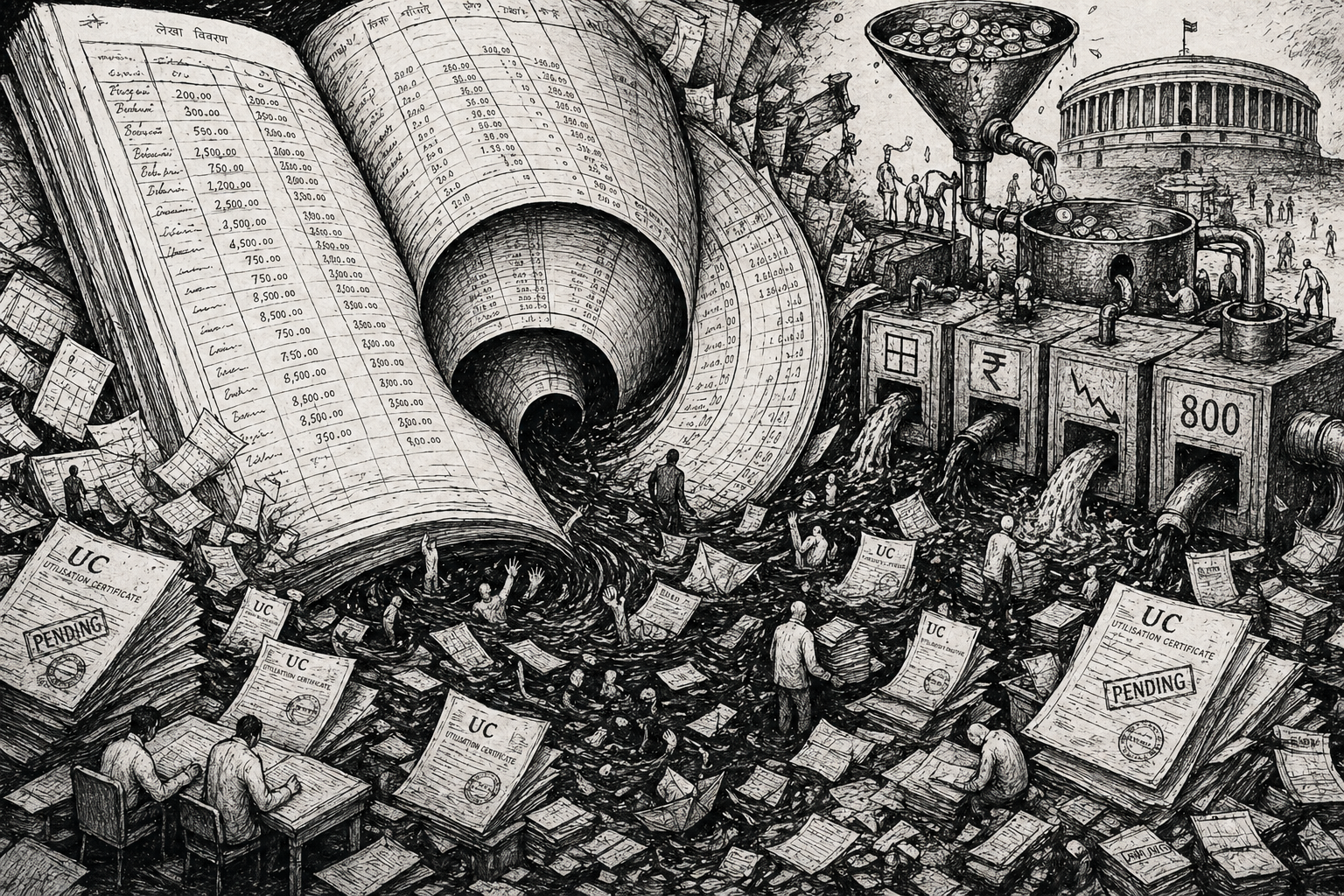
The second is what has happened to the divisible pool itself. The divisible pool excludes cesses and surcharges. As I argued in the CAG Report No. 6 of 2026 piece, the Centre has steadily expanded its reliance on cesses and surcharges, which are not shared with the states. The Comptroller and Auditor General's findings on cess short transfers and on the opacity of Minor Head 800 are not separate stories from this one. They are about how the Union narrows the base on which the states' constitutional share is calculated. A state's share of 41 per cent of a shrinking divisible pool is fiscally smaller than a state's share of 32 per cent of a fuller one. Pinaki Chakraborty and Manish Gupta, in their NIPFP study Enhanced Devolution and Fiscal Space at the State Level (2024), put numbers on it: the divisible pool fell to about 75.7 per cent of the Union's gross tax revenue in 2022-23, from close to 90 per cent in 2011-12. The headline devolution number has been stable. The effective fiscal space of the states has not.
The third is what has happened specifically to the Northeast. NIPFP's work on dependence had Nagaland's reliance on central transfers in the range of 90 to 93 per cent of revenue receipts, Manipur at 90 to 92 per cent, Mizoram at 88 to 93 per cent, Arunachal at 81 to 98 per cent, and Tripura at 85 to 91 per cent, with Assam the low outlier at well under half. The pattern has not eased. PRS Legislative Research's State of State Finances 2025 estimates that the north-eastern and Himalayan states will draw about 68 per cent of their revenue receipts from central assistance in 2025-26. These are not states that can fund welfare programmes from their own revenues. They cannot fund their administration from their own revenues. The 90:10 cost-sharing pattern for Centrally Sponsored Schemes in the Northeast and Himalayan states has been retained by every Finance Commission, including the 16th. Still, the political arithmetic of who owns the resulting schemes has shifted. As the EPW noted in its analysis of the 15th FC's Northeast award, the structural disabilities of these states require Union budgetary support that goes beyond the Finance Commission. That support is increasingly delivered through schemes whose branding belongs to the Centre.
The 16th FC has taken a further step. It has recommended discontinuing key components such as revenue deficit grants and certain sector-specific grants. NIPFP estimates that total grants-in-aid to Manipur will fall from Rs 13,804 crore under the 15th FC to Rs 2,131 crore under the 16th FC, an approximate 85 per cent reduction. At the same time, the Commission has flagged the proliferation of large-group cash transfer schemes and recommended that subsidies and transfers which do not meet an evidence-and-externality test be phased out.
The Commission's own figures show how far this has gone. Cash transfers rose from about three per cent of subsidy spending in 2018-19 to roughly a fifth by 2025-26, and within unconditional transfers, large-group schemes grew to nearly half. The body recommending that states wind these schemes down is also the body documenting how central they have become to the way states now govern. The Centre is, in other words, narrowing the fiscal space of the very states whose cash transfers just produced the May 4 result, while reserving to itself the branding and credit for the schemes that survive.
The mechanism that ties this together is credit-claiming. As long as the Centre owns the financing, through cesses, surcharges, and the branding rules attached to Centrally Sponsored Schemes, and as long as the state government remains a delivery channel whose ability to claim political credit is constrained by the Centre's branding, the politics travels with the money. The state delivers. The Centre is credited. The recipient is sorted into a category that the Centre has named. The double-engine slogan, on this reading, is a reasonably accurate description of the funding structure rather than a piece of rhetoric.
State by state across the eastern frontier
The shape of the BJP's project varies from state to state, and these differences are instructive about which mechanism is doing the work where.
In Assam, the cash-transfer state and the indigeneity state have fused. Orunodoi 3.0 is the cash. The eviction drives, the SIR, the foreigners tribunals, the rhetoric of "demographic invasion" and "land jihad," and the institutional inheritance of the Assam Accord and the NRC are the categories. The BJP's account of the win, in the coverage that followed, rested on two planks: ten years of development, which Sarma credited to Modi, and the protection of indigenous Assamese identity, which ran as the defining emotional argument of the campaign. The 102-seat majority in a 126-seat house is what the combination produced.
In Bengal, the cash-transfer state already existed. Mamata Banerjee built it. Lakshmir Bhandar was the most successful retail welfare instrument deployed in eastern India after 2011. The TMC fought the 2024 Lok Sabha election on it and beat the BJP back from 18 to 12 seats. What changed between June 2024 and May 2026 was that the BJP, having lost on welfare, ceased to contest welfare and outbid it. The Sankalp Patra's Rs 3,000 promise to women was, in nominal terms, twice the most generous Lakshmir Bhandar slab. The other change was the pairing with Hindu consolidation.
The Matua and Koch-Rajbongshi outreach, the SIR, the Sandeshkhali campaign, which had not worked in 2024 but was kept warm into 2026, and Adhikari's booth-level mapping all consolidated a Hindu vote across linguistic and class lines. Both changes were necessary. Either one alone would not have produced a 207-seat result.
Tripura is the longest-running BJP project in the Northeast. The party displaced the Left Front in 2018 after twenty-five years of CPI(M) government. Saha's BJP-IPFT government has countered the TIPRA Motha demand for a Greater Tipraland by subsuming tribal welfare under the BJP's own delivery, including the Tripura Janjati Bikash Yojana, the rubber mission for 50,000 tribal families, and the Maharaja Bir Bikram Manikya Tribal University. Manik Saha's positioning as a Bengali Hindu Chief Minister of a state with a Bengali Hindu majority and a tribal minority has held the contradiction together. The MBSY scooty scheme and the bond for BPL girl children sit atop the same Centre-financed CSS funding as in the rest of the Northeast.
Arunachal, Manipur, Nagaland, and Meghalaya present variations on the same theme. The BJP itself rules in Arunachal and now again in Manipur. Coalition partners run Nagaland and Meghalaya, with the BJP as the institutional anchor in NEDA. The fiscal dependence ratios are uniformly high. The CSS funding is uniformly Centre-branded. The political content varies with local ethnic configurations. In Manipur, the Meitei-Kuki conflict that erupted in May 2023 left more than 250 people dead and around 60,000 displaced, and President's Rule followed in February 2025. The Centre revoked it in February 2026 and installed a BJP-led government under Yumnam Khemchand Singh, with a Kuki deputy chief minister and a Naga deputy chief minister holding the arrangement together. That tripartite cabinet is itself a study in defining and ruling through the categories whose conflict the state could not prevent. The argument that the cash and the category are a package travels with the most caveats here. The category in Manipur is more contested, welfare delivery is more disrupted, and political accounting is still incomplete.
Mizoram is the case that does not fit the cleanest version of the argument. The Zoram People's Movement won the 2023 election on a predominantly indigenous Mizo platform that did not require alignment with the BJP, and the party has since held itself apart from both national blocs. The state's fiscal dependence on the Centre matches the rest of the Northeast, as does its CSS funding pattern. The variable that differs is the absence of a Hindu-Muslim cleavage to organise around, or a settler-versus-indigene dispute that translates into the BJP's frame. A Christian-majority state where the dominant ethnic identity is itself the indigenous one denies the BJP its preferred two-step. Mizoram's existence under the same fiscal terms, producing a different political outcome, is the clearest evidence we have that the funding structure alone does not determine politics. The category sorting matters independently. Where there is no available category to sort against, the cash-transfer state does not produce a BJP electoral majority.
Sikkim has aligned with the NDA after the 2024 elections, in which the Sikkim Krantikari Morcha won 31 of 32 assembly seats. The alignment is post-electoral and instrumental, the kind of arrangement that small states with high fiscal dependence make routinely with whichever government is in Delhi. It is part of the geography of NEDA without being part of the categorical politics that animates the larger eastern project.
How the analytic frameworks fit, and where they break
Three frameworks travel with this material, each useful in part.
Sanjib Baruah's cash-transfer state is the most directly applicable. He argued that direct cash transfer becomes a substitute for the institution-building and rights-based delivery that the Indian developmental state, in its more ambitious moments, attempted to pursue. The recipient is not constituted as a citizen with a claim. The recipient is constituted as a population segment with an entitlement subject to administrative discretion. Baruah developed this in the context of Assam. It now describes the political economy of welfare across most of the East and Northeast.
Partha Chatterjee's older distinction between civil society and political society maps onto this with one important update. Civil society was the domain of rights-bearing citizens making constitutional claims. Political society was the domain of populations governed through the techniques of governmentality, where the law of the state met the lifeworld of the urban poor and the agrarian dispossessed in negotiated, often informal, settlements. Chatterjee's analysis was developed in the 2000s, when the population categories were caste, class, religious community, and occupation. The update the present moment requires is that the categories are now more explicitly ethno-religious and more explicitly constituted by the state itself rather than by the populations they describe. The Miya Muslim is a category named by the Assam government, rather than a self-description used by Bengali-speaking Muslims in Assam. The Bengali Hindu is a category coined by the BJP's outreach in Bengal, rather than the political identity of any specific group of voters. The state produces the category and then delivers welfare to it.
Mahmood Mamdani's Define and Rule framework, which I drew on in the piece on his son's New York mayoralty, is helpful here too. Mamdani argued that the colonial state in nineteenth-century Africa constituted political identity through ethnic categorisation administered by the state itself, producing a politics in which the categories the state had named became the only available political identities. The post-independence Indian state, as I have argued in the constitutional caste piece, inherited this categorical apparatus in modified form, and the present moment activates it through welfare.
Kanchan Chandra's account of why ethnic parties succeed sits underneath all three. In Why Ethnic Parties Succeed: Patronage and Ethnic Head Counts in India (Cambridge University Press, 2004), she argued that ethnic identification works as a low-cost technology for predicting who will get patronage in a state that distributes resources through discretionary channels. Voters read the ethnic headcount and infer their own odds of access. The framework fits the eastern frontier closely because the cash transfer is precisely the discretionary, categorically delivered patronage her model assumes. Where it strains is on the question of authorship. Chandra's parties compete over a relatively fixed set of identities that voters already hold; in Assam and Bengal, the salient identities are actively manufactured by the party and the state in tandem with the delivery of welfare, which makes the categories more endogenous to the political project than her model allows. The headcount is not only being read. It is being written.
What the cash transfer is for
The development economics question that underlies all of this is not whether unconditional cash transfers reduce poverty. The evidence is mixed but generally favourable, and it comes with conditions attached. In randomised work on maternal cash transfers in India, Jeffrey Weaver, Sandip Sukhtankar, Paul Niehaus and Karthik Muralidharan found large gains in nutritional intake, though those gains translated into child growth only where sanitation was sufficient to allow the body to absorb the calories. The same authors' earlier study of biometric payments in Andhra Pradesh showed that improved payment plumbing reduced leakage by nearly 13 percentage points without shutting beneficiaries out. Cash works, within the limits set by the rest of the state. The argument I made in the Tamil Nadu piece, that even an evidence-backed transfer raises a harder question about the kind of welfare state it builds, applies here too.
Two questions sit inside the design. The first is targeting. Abhijit Banerjee, Rema Hanna and Benjamin Olken have shown that, with a fixed budget, well-targeted transfers can deliver larger welfare gains to the poor than universal transfers, even after accounting for the costs of identifying who qualifies. Annapurna Bhandar is targeted, but not on poverty. It is targeted at citizenship documentation. That is the second question, the one about whom the targeting serves. Avinash Dixit and John Londregan modelled redistributive politics as a choice between courting swing voters and rewarding a party's own base, and showed that where a party has an organisational edge with its core, it pays to target the core and to withhold from the opposition's. The exclusion of women who have not filed under the Citizenship Amendment Act follows that machine-politics logic, written into the eligibility rule rather than left to administrative chance.
None of this is new to Bengal. Pranab Bardhan and Dilip Mookherjee spent years documenting how anti-poverty transfers in rural West Bengal were captured and rationed through the Left Front's local party networks, with delivery tracking political loyalty more closely than need. The machine is old. What has changed is the filter it runs on, from party-society clientelism to ethno-religious certification. The form, welfare rationed through a political test, has carried from one regime to the next.
The fiscal side has its own settled mechanics. The flypaper effect, named by James Hines and Richard Thaler, is the finding that intergovernmental grants raise sub-national spending far more than an equivalent rise in local income would, because money sticks where it lands. Run in reverse, it says that the 16th Finance Commission's withdrawal of revenue deficit grants will cut actual welfare spending in Manipur and the other north-eastern states by much more than the headline rupee figure implies, because there is no own-revenue cushion to take its place. What the Commission presents as hardening a soft budget constraint, in Janos Kornai's sense, falls on states that never had the revenue base to stand on their own.
The harder question is what the cash transfer constitutes politically. A welfare instrument that arrives at a household as the result of a constitutional claim made by a citizen against a state is one kind of artefact. A welfare instrument that arrives as a gift from a Chief Minister whose authority is built on the categorical exclusion of others is a different artefact. The bank statement does not distinguish the two. The political economy does.
Yamini Aiyar has named the wider shift a move toward a techno-patrimonial welfare state, in which the labharthi, the beneficiary, is mobilised through discretionary, leader-branded transfers rather than through enforceable rights. Niraja Gopal Jayal traced the longer arc, from charity to rights and now toward a contributory citizenship in which the benefit is conditional on documenting that you belong. And Lant Pritchett's description of India as a flailing state, with a capable head no longer reliably connected to the arms and legs of implementation, explains why cash has displaced services. A state that cannot reliably put a teacher in a classroom or grain in a ration shop can still move money to a verified bank account. The cash-transfer state is the welfare state of a flailing state, and the verification step is where the category enters.
The eastern frontier is now, on this reading, the cleanest case in India of the cash-transfer state operating in a fiscally dependent and categorically sorted political context. The Northeast got there first because its fiscal dependence was structurally given. Bengal arrived last because the TMC for fifteen years built a parallel cash-transfer state that drew on the same Centre-financed funding but channelled it through a regional party machine. The TMC's defeat is, in this reading, partly a defeat of the regional party as a credible alternative author of the welfare relationship. The categorical sorting that the BJP brought and the higher cash bid finished the job.
What the development economics framing offers, as against the political commentary that has dominated coverage of the May 4 result, is the recognition that the welfare and the categorical politics are not separate stories. They are the same story. They have always been the same story. When welfare is centralised, branded, and delivered through schemes whose recipient categories are constituted by the state, the welfare instrument is the categorical instrument.
What follows
What follows from this is not a forecast but a research agenda. The work that the next Finance Commission cycle, the next Census, the next round of CSS rationalisation, and the next state elections will require us to do is the work of tracking which welfare instruments survive the fiscal squeeze, which categorical politics survives the withdrawal of the cash, and whether the funding configuration that produced the May 4 result is durable or whether it begins, like the Lewis-Kuznets path itself, to run back. The design of Census 2027, now in the field, and the delimitation it will set in motion will fix both the population categories and the horizontal devolution weights for the cycle after this one, which means the terms on which this politics is fought next are being settled now.
By the first week of June, the first Annapurna Bhandar instalments had reached the verified accounts, and the women left off the revised roll had reached the end of a queue that no longer leads anywhere. The fiscal structure made the cash possible. The political project made the cash mean what it meant. Both halves are required to explain the count on the ECI dashboard at 4:18 PM on the afternoon of May 5 2026, and the deletions from the roll that followed.
Varna Sri Raman is a development economist who writes at policygrounds. press. She co-authored the Oxfam India Inequality Report 2022.
Further Reading
On the May 2026 results and after
West Bengal assembly result, 2026 (ECI)
Why the TMC lost Bengal (The Federal)
Annapurna Bhandar and the scrapping of religion-based schemes (India Blooms; ANI)
The Annapurna application form and fears of disenfranchisement (The Wire)
About 91 lakh names were removed in the West Bengal SIR (News on Air)
Manipur's new government, February 2026 (Edunovations)
On cash transfers and the evidence base
Weaver, Sukhtankar, Niehaus and Muralidharan on maternal cash transfers in India (NBER 32093)
Muralidharan, Niehaus and Sukhtankar on biometric payments and leakage (NBER 19999)
Banerjee, Hanna and Olken on universal versus targeted transfers (NBER 24939)
Tamil Nadu's welfare gamble (policygrounds.press)
On fiscal federalism and the divisible pool
Chakraborty and Gupta, Enhanced Devolution and Fiscal Space at the State Level, 2024 (NIPFP)
Dependence of states on central transfers, NIPFP Working Paper 137, 2014 (NIPFP)
State of State Finances 2025 (PRS Legislative Research)
The 16th FC and the North-Eastern states, analysing Manipur (NIPFP)
The 16th FC, status quo amidst the grand bargain (NIPFP)
The 15th FC award and the North-East (EPW)
Hines and Thaler on the flypaper effect (AEA)
Kornai on the soft budget constraint (Wiley)
Reading the Centre's books, CAG Report No. 6 of 2026 (policygrounds.press)
On patronage, capture, and machine politics
Kanchan Chandra, Why Ethnic Parties Succeed (Cambridge University Press, 2004)
Bardhan and Mookherjee on pro-poor targeting and capture in West Bengal (ScienceDirect)
Dixit and Londregan on the determinants of redistributive politics (JSTOR)
On identity, citizenship, and the cash-transfer state
Sanjib Baruah on the cash-transfer state (Scroll)
Mahmood Mamdani, Define and Rule (Harvard University Press, 2012); see also (policygrounds.press)
Partha Chatterjee, The Politics of the Governed (Columbia University Press, 2004)
Niraja Gopal Jayal, Citizenship and Its Discontents (Harvard University Press, 2013)
Yamini Aiyar on welfare as compensation rather than a public right (Scroll)
Lant Pritchett, Is India a Flailing State? (SSRN)














Write a comment ...