
While Brazil, South Africa, and even France condemned the most brazen violation of sovereignty in decades, India offered "deep concern" and a call for "dialogue"—without once naming the United States.
I have spent my career studying why some countries develop, and others don't. The answers are complicated—institutions, history, geography, policy choices—but one thread runs through all of them: sovereignty matters. The ability of a country to choose its own path, make its own mistakes, and experiment with its own solutions. When that ability is taken away—by colonialism, by structural adjustment, by military intervention—development becomes impossible. You cannot build a house while someone keeps kicking down the walls.
This is not abstract for me. I have worked across South Asia, seen how countries navigate the pressures of great power politics while trying to build functioning states. I have watched India invoke sovereignty to defend every policy choice from Kashmir to economic protectionism, watched us lecture the world about non-alignment and the Global South.
So when the United States invaded Venezuela on 3 January 2026—bombed its capital, captured its president, flew him to New York in chains—I expected India to say something. Not to endorse Maduro, who is no democrat. But to say what Brazil said, what South Africa said, what even France said: that you cannot simply invade a country and kidnap its leader because you have the military power to do so.
India said nothing of the kind. And that silence tells us something important about what "Vishwaguru" actually means.
Operation Absolute Resolve
On 3 January 2026, the United States did something no country has done to another in the 21st century: invaded a sovereign nation, bombed its capital, captured its sitting president, and flew him to New York to face criminal charges in an American court.
Operation Absolute Resolve involved over 150 aircraft, naval forces, and ground troops. Venezuelan President Nicolás Maduro and his wife Cilia Flores were seized from Fuerte Tiuna military base in Caracas and transported across the Atlantic while American bombs fell on Venezuelan soil. Defense Secretary Pete Hegseth called it "the exact opposite of Iraq"—the US would "ensure access to additional wealth and resources." Trump announced that America would "run" Venezuela until a "safe, proper and judicious transition."
Maduro pleaded not guilty to narco-terrorism charges in a New York courtroom on 5 January. His vice president, Delcy Rodríguez, was sworn in as acting president and denounced the "kidnapping" of a head of state.
The world reacted with fury. Brazil called it "a most serious affront to Venezuela's sovereignty." South Africa termed it "a manifest violation of the Charter of the United Nations." France, Spain, and even Denmark—worried about Trump's threats over Greenland—condemned the action. Russia and China demanded Maduro's immediate release. The UN Security Council convened in emergency session, with Secretary-General Guterres warning of a "dangerous precedent" that threatened the entire international order.
And India? India issued a statement expressing "deep concern" and calling for "dialogue."
The statement did not name the United States. It did not mention sovereignty. It did not reference the UN Charter, international law, or territorial integrity. It was, as The Wire noted, "carefully worded"—so carefully that it said nothing at all.
What India's BRICS Partners Said
To understand how extraordinary India's silence was, compare it to the responses of its BRICS partners.
Brazil's President Lula:
"Bombings on Venezuelan territory and the capture of its president cross an unacceptable line. These acts represent a most serious affront to Venezuela's sovereignty and yet another extremely dangerous precedent for the entire international community... this recalls the worst moments of interference in Latin America."
South Africa's Department of International Relations:
"The Charter of the United Nations does not authorise external military intervention in matters that are essentially within the domestic jurisdiction of a sovereign nation... a manifest violation of the Charter."
Russia's Foreign Ministry: Called the operation "an act of armed aggression against Venezuela," "a grave violation of sovereignty and international law," and demanded the "immediate release of President Maduro."
China's Foreign Ministry:
"China is deeply shocked and strongly condemns the US's blatant use of force against a sovereign state... Such hegemonic acts seriously violate international law and Venezuela's sovereignty."
India shares a platform with these countries in BRICS. India claims leadership of the Global South. India routinely invokes sovereignty and territorial integrity when it suits its interests—in Kashmir, in its border disputes with China, in response to any international criticism of domestic policy.
Yet when the most powerful country on Earth kidnapped a sitting head of state, India could not bring itself to say so.
The MEA Statement: A Study in Evasion
The Ministry of External Affairs statement, released on 4 January, deserves close reading:
"Recent developments in Venezuela are a matter of deep concern. We are closely monitoring the evolving situation. India reaffirms its support to the well-being and safety of the people of Venezuela. We call upon all concerned to address issues peacefully through dialogue, ensuring peace and stability of the region."
Note what is missing:
No mention of the United States, the country that conducted the invasion
No mention of sovereignty, India's standard talking point
No mention of the UN Charter or international law
No mention of territorial integrity
No condemnation of military action
No call for Maduro's release
Compare this to India's statements on Ukraine, where New Delhi has been careful to invoke "territorial integrity" and "the UN Charter" even while avoiding direct criticism of Russia. In Venezuela, where the violation of sovereignty was far more flagrant—a military invasion and capture of a head of state, not a disputed territorial conflict—India said less.
The statement reads as if it were drafted to say nothing that could offend Washington. And perhaps it was.
What India Stands to Gain
The most charitable interpretation of India's silence is transactional pragmatism. India has significant stakes in Venezuela that the US invasion might actually advance.
ONGC Videsh has invested over $500 million in Venezuelan oil fields, including a 40% stake in the San Cristobal project. Since US sanctions were imposed on Venezuela in 2019, ONGC has been unable to repatriate approximately $500 million in stuck dividends. A US-controlled Venezuela, with sanctions lifted, could finally allow ONGC to recover its money.
Reliance Industries had a 15-year crude supply contract with Venezuela's state oil company PDVSA before sanctions forced its termination. Venezuelan heavy crude, which trades at a $5-8 discount to Brent, is particularly suited to Indian refineries. Access restored would benefit Reliance and reduce India's oil import bill.
Bilateral trade collapsed from $6.4 billion in 2019-20 to just $431 million in 2022-23, almost entirely due to US sanctions. A post-Maduro Venezuela, reintegrated into the US-led economic order, would reopen these commercial possibilities.
In other words, India may be silent because silence serves India's interests. Maduro's fall could benefit Indian companies. Why antagonise Washington when Washington's aggression might pay dividends—literally?
The Left's Response
India's communist parties, at least, understood what was at stake.
The CPI(M) Polit Bureau statement was scathing:
"The Modi-led BJP government's response to the blatant aggression against Venezuela and the abduction of its President and wife by the United States armed forces is craven and unworthy of India's long-held position of defence of independence and sovereignty of nations."
"There is not a word of condemnation about the gross violation of the United Nations Charter and international law—something which even some European allies of the US have mentioned."
"This pro-US stand is in line with the Modi government's right-wing ideology and strategic ties with the Trump administration. By this stand India has abdicated any claim to represent the interests of the Global South."
The CPI described India's silence as "shameful," noting that "the kidnapping of a sitting President by a foreign power is nothing short of state terrorism."
CPI(ML) Liberation placed the invasion in a historical context: "The US Monroe Doctrine, which treats the Latin American region as its 'personal backyard'... has always meant subjugation, exploitation, and repression."
These are opposition voices, easily dismissed by the BJP as predictable criticism. But their critique cuts to something fundamental: Can India claim Global South leadership while acquiescing to the most brazen act of US imperialism in decades?
The Panchsheel Principles, Abandoned
India's post-independence foreign policy was built on the Panchsheel—the Five Principles of Peaceful Coexistence articulated in 1954:
Mutual respect for territorial integrity and sovereignty
Mutual non-aggression
Mutual non-interference in domestic affairs
Equality and mutual benefit
Peaceful coexistence
These principles were the foundation of the Non-Aligned Movement, which India helped establish. The 1979 Havana Declaration defined NAM's purpose as ensuring "the national independence, sovereignty, territorial integrity and security of non-aligned countries" in their "struggle against imperialism, colonialism, neo-colonialism... and all forms of foreign aggression, occupation, domination, interference or hegemony."
Every single one of these principles was violated by the United States on January 3, 2026—every single one.
And India, a founding member of NAM, a champion of sovereignty, a country that has invoked territorial integrity to justify everything from Kashmir policy to its UN Security Council aspirations, could not bring itself to say so.
The Precedent Problem
Venezuela's Ambassador to the UN, Samuel Moncada, told the Security Council:
"If the kidnapping of a head of state, the bombing of a sovereign country and the open threat of further armed action are tolerated or downplayed, the message sent to the world is a devastating one: namely that the law is optional, and that force is the true arbiter of international relations."
This is not hyperbole. The Venezuela operation establishes a precedent that any country with sufficient military power can:
Invade another country without UN authorisation
Capture the head of state on criminal charges
Try that leader in its own courts
Administer the conquered country until it sees fit to leave
Trump's justification—that Maduro was a "narco-terrorist" under US indictment—has no basis in international law. Criminal charges do not authorise military invasion. If they did, any powerful country could invent charges against any leader it wished to remove.
What does this mean for India? Consider the scenarios:
China could cite "separatism" to justify action against Taiwan
Russia can cite NATO expansion to justify further Ukrainian operations
Any regional power can find pretexts for military adventure
India, which faces actual territorial threats, should be among the loudest voices defending the principle that borders cannot be redrawn by force. Instead, India said nothing.
The "Multi-Alignment" Excuse
The Modi government has rebranded India's foreign policy from "non-alignment" to "multi-alignment"—the idea that India can maintain good relations with all major powers simultaneously, choosing sides issue by issue based on national interest.
In practice, "multi-alignment" increasingly means alignment with the United States whenever it matters. India participates in the Quad. India deepens defence ties with Washington—courts American investment and technology transfer. And India stays silent when American aggression would complicate these relationships.
The problem is that selective silence is not neutrality. When Brazil, South Africa, France, and Spain all condemn an action, and India does not, India is not being "balanced." It is being complicit.
As Sanjay Kapoor noted, "This pattern risks undermining India's credibility within BRICS and globally. Continued neutrality in cases involving sovereignty violations could weaken India's standing when it seeks international support in future crises."
Who will stand with India on Kashmir if India will not stand with Venezuela on sovereignty?
The Moral Hollowness
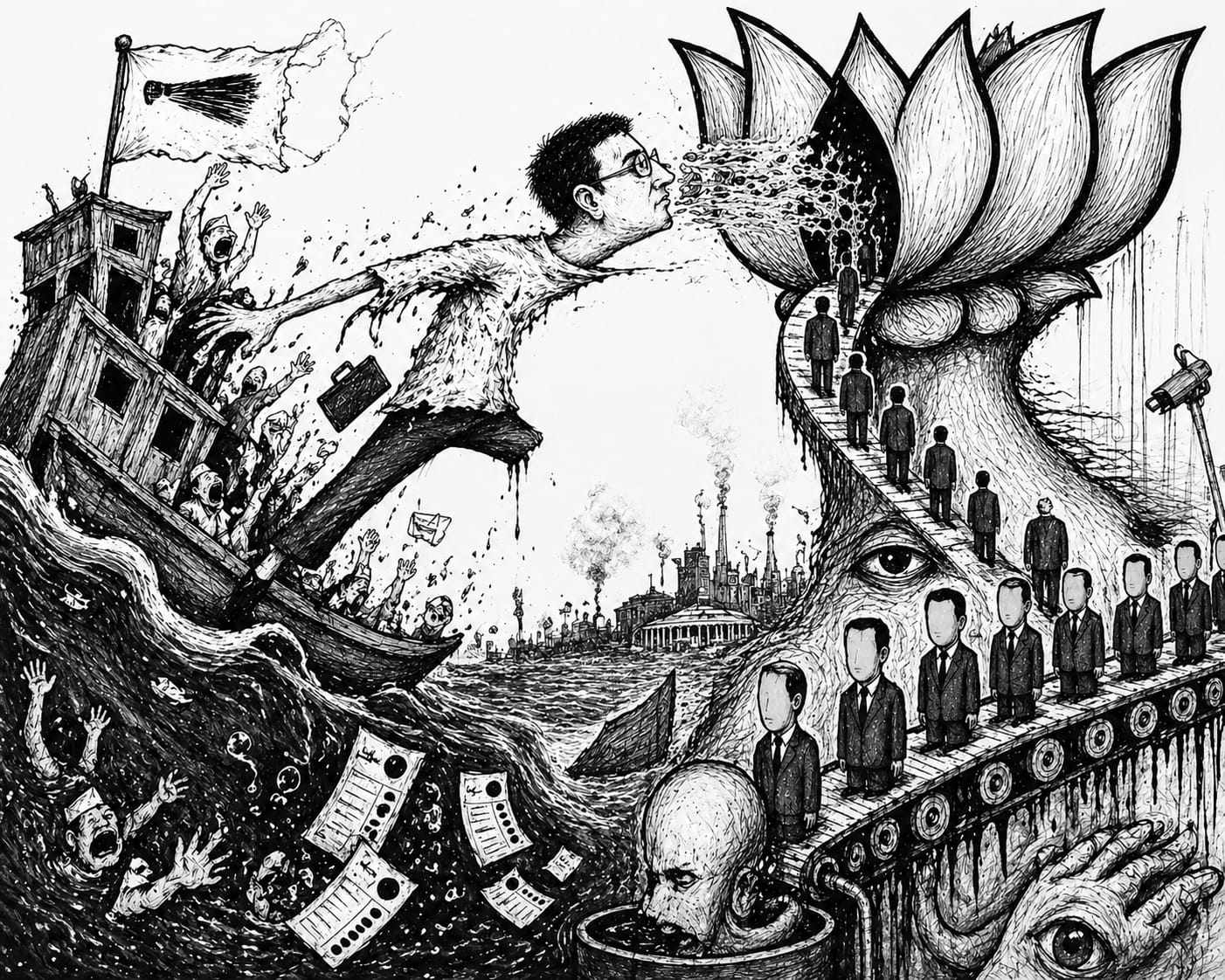
There is something particularly hollow about a government that routinely invokes "civilisational values," "Vishwaguru" status, and moral leadership, remaining silent when the world's most potent military invades a small country.
The Modi government lectures the world about yoga and ahimsa. It claims ancient Indian wisdom offers solutions to modern problems. It positions India as a voice for the Global South in international forums.
But when the Global South actually needed that voice—when a Latin American nation was attacked, its leader kidnapped, its sovereignty erased—India offered "deep concern" and a prayer for "dialogue."
This is not leadership. This is not even pragmatism. It is moral abdication dressed in diplomatic language.
What Should India Have Said?
A principled response was not difficult. India could have:
Named the United States as the perpetrator of military action
Condemned the violation of Venezuelan sovereignty and territorial integrity
Invoked the UN Charter, specifically Article 2(4) prohibiting the use of force
Called for Maduro's release and the withdrawal of US forces
Demanded accountability through UN mechanisms
Offered to mediate as a non-aligned power
This would have been consistent with India's stated principles, its historical foreign policy positions, and its claimed role in the Global South. It would not have required endorsing Maduro's authoritarian record—criticism of his governance is compatible with condemning the invasion.
Instead, India chose silence. And that silence says more about the Modi government's values than any number of speeches about ancient wisdom and global leadership.
Venezuela is 15,000 kilometres from Delhi. Its crisis may seem remote from Indian concerns. But the principle violated on 3 January 2026—that powerful countries cannot simply invade weaker ones, capture their leaders, and install compliant governments—is the foundation of the international order that India has depended on since independence.
If that principle dies, India's security dies with it. And India's silence helped kill it.
Further reading:
UN Security Council Meeting on Venezuela (5 January 2026) - UN News
Secretary-General Guterres's Statement - UN.org
International Reactions - Wikipedia compilation
CPI(M) Statement on Venezuela
The Wire Analysis - India's Venezuela Response















Write a comment ...