
Police found 1.1% of attacks were communal. Indian media claimed genocide. The gap between these numbers tells the story of a propaganda machine serving the BJP's domestic politics at the expense of actual Bangladeshi Hindus.
I know the villages where the Indian media claims genocide is happening. I have walked through them.
Between 2014 and 2018, I worked on the No Lean Season programme in Bangladesh's Rangpur Division—Lalmonirhat, Kurigram, the same districts that now feature in breathless reports about Hindu persecution. The programme, designed by Yale economist Mushfiq Mobarak and implemented by RDRS Bangladesh, provided $20 migration subsidies to help desperately poor families send a member to cities during monga. This seasonal famine affects northwestern Bangladesh every year between the planting and harvest seasons.
I remember the families we worked with. Hindu and Muslim, sitting together in the same village meetings, facing the same hunger, making the same calculations about whether a son could survive the journey to Dhaka to pull a rickshaw for three months. The poverty was not communal. The solutions were not communal. The villages were not communal—they were mixed, as Bengali villages have been for centuries, with Hindu and Muslim families living as neighbours, their children playing together, their festivals sometimes shared.
So when I see Indian news channels screaming about "Hindu genocide" in Rangpur, I do not just doubt the narrative. I know it is false. Not because violence did not happen—it did. But because I know those villages, and I know that the story the Indian media is telling bears no relationship to how those communities actually function.
Here is a number that should end every conversation about "Hindu genocide" in Bangladesh: 1.1%.
That is the percentage of attacks on minorities between August 4-20, 2024, that Bangladesh Police determined were communally motivated. Of 1,769 incidents reported by the Bangladesh Hindu Buddhist Christian Unity Council, police investigations found that 20 were communal in nature. The remaining 1,234 were political attacks on Awami League supporters who happened to be Hindu, caught up in the same wave of retribution that targeted Muslim AL members across the country.
But you wouldn't know this from Indian media. You would be familiar with "genocide." About "mass rape." About "Islamist takeover." About temples burning and Hindus fleeing, and a civilizational crisis requiring urgent intervention.
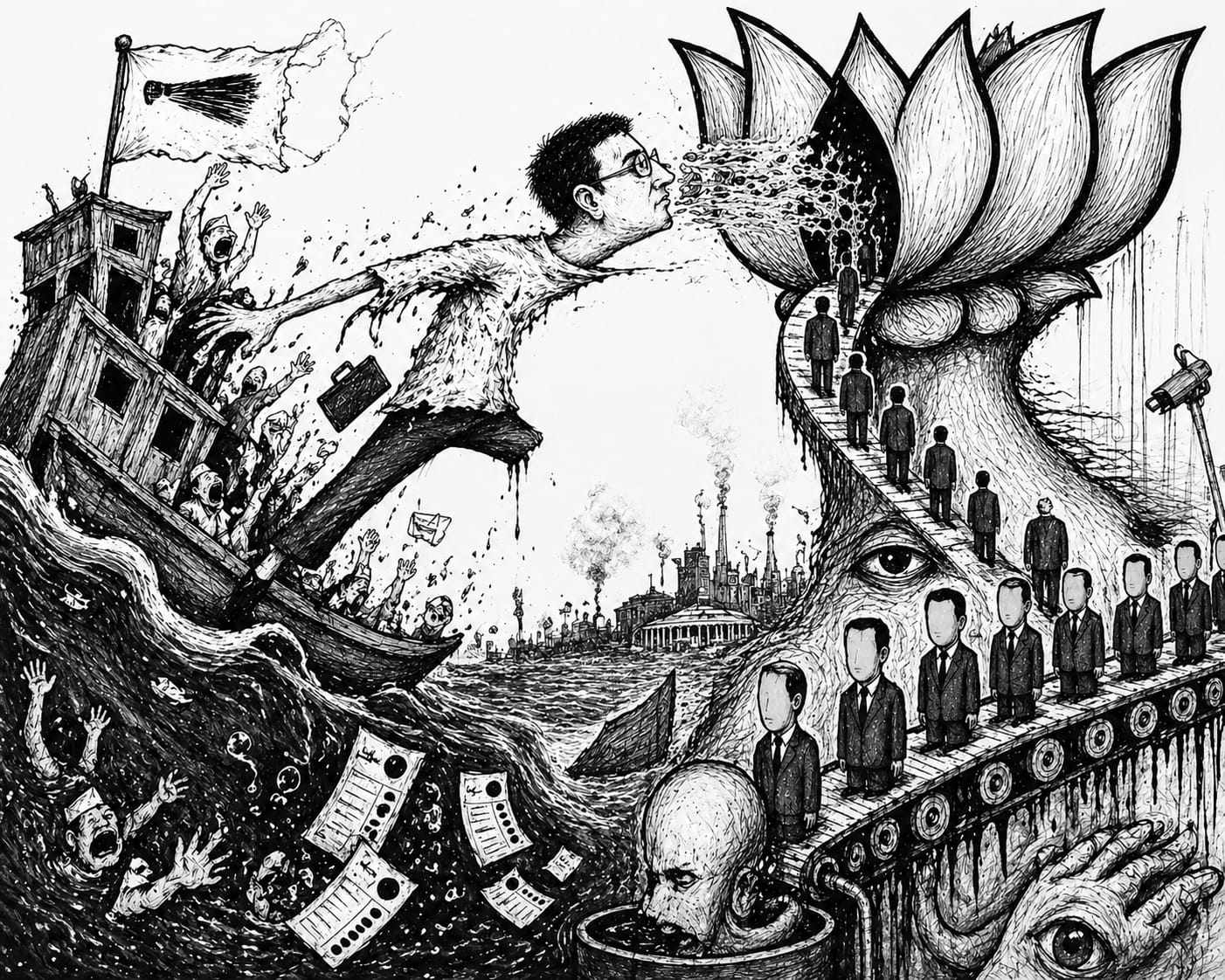
The gap between 1.1% and "genocide" is not a rounding error. It is a deliberate propaganda operation, and understanding it requires understanding who benefits from the lie.
What Actually Happened
On 5 August 2024, Sheikh Hasina fled Bangladesh after a student-led uprising ended her 15-year rule. In the ensuing power vacuum, violence erupted—as it does during every political transition in Bangladesh's history.
Prothom Alo, Bangladesh's largest newspaper, dispatched correspondents to all 64 districts. Their investigation, covering August 5-20, documented 1,068 attacks on minority communities across 49 districts.
The crucial finding: In at least 506 cases—more than half—the victims were affiliated with the Awami League.
This was not communal violence. This was political violence that affected Hindus because Hindus had disproportionately supported the AL, much as it affected Muslim AL supporters, whose homes and businesses were also attacked, looted, and burned.
The Netra News investigation examined the nine deaths that the Hindu Buddhist Christian Unity Council had claimed were "communal killings." Their finding: No death showed clear signs of a religious or communal motive. Seven were attributed to political retribution, mob violence, or criminal disputes.
When Bangladesh Police conducted their own investigation in January 2025, examining all 1,769 incidents claimed by the BHBCUC, they found:
1,234 incidents (69.8%): Politically motivated
20 incidents (1.1%): Communal
161 claims (9.1%): False or untrue
The math is unambiguous. For every genuinely communal attack, there were 62 political ones—the "Hindu persecution" narrative inverted reality.
The Misinformation Machine
Enter Indian media.
Rumour Scanner, Bangladesh's leading fact-checking organisation, tracked the disinformation flood. Their findings:
148 pieces of misinformation about Bangladesh from Indian sources in 2024
72 Indian media outlets spread false reports on 32 topics
72% of social media accounts spreading fake news were based in India
Misinformation viewed at least 200 million times on X (Twitter)
One false post alone: 10+ million views
The patterns were systematic:
Pattern 1: Misrepresenting Muslim victims as Hindu. At least 36 instances where videos of Muslim victims of political violence were relabeled as "Hindu persecution." The most viral footage is of a house burning, which was claimed to be cricketer Liton Das's home. It was the residence of Mashrafe Mortaza, a Muslim former cricket captain and an Awami League supporter.
Pattern 2: Framing political violence as communal Attacks on AL supporters—regardless of religion—were presented as anti-Hindu pogroms. The fact that Muslim AL members faced identical violence was systematically omitted.
Pattern 3: Recycling old footage. Videos from previous years, from other countries, even from India itself, were presented as current Bangladesh atrocities.
Pattern 4: Fabricating claims wholesale
"23 Hindus killed in communal violence" → Government investigation: "Not a single one related to communal violence."
"152 temples desecrated" → Exaggerated by multiples
"Pakistani weapons ship at Chittagong" → Commercial cargo vessel
"Indian TV channels banned" → Still broadcasting
"Yunus fled to France." → Never happened
The Media Outlets
Rumor Scanner's analysis named names:
Outlet False Reports Republic Bangla 10 Hindustan Times 3 Zee News 3 Live Mint 3 Republic 2 India Today 2 ABP Anand 2 Aaj Tak 2 NDTV multiple ANI multiple Indian Express multiple
These are not fringe outlets. They are mainstream Indian media—the newspapers of record, the 24-hour news channels, the wire service that feeds stories to outlets worldwide. When ANI reports something, it gets picked up globally. When Zee News runs a graphic claiming "Hindu Genocide," millions see it.
BBC Verify confirmed the pattern: "Ultra-right-wing Indian influencers took the opportunity to share misleading videos, making it seem as though Hindus in Bangladesh were under attack."
The social media monitoring app Brandwatch found that, after 4 August, false stories were spread via a hashtag used 700,000 times on X. Almost all the accounts driving these trends were located in India.
What Bangladeshi Hindus Actually Say
Here is the voice that Indian media refuses to amplify: Bangladeshi Hindus themselves.
Gobinda Pramanik, Secretary General of the Bangladesh National Hindu Grand Alliance—an organisation representing two dozen Hindu religious bodies—told VOA:
"Almost all were politically motivated attacks. In the Indian media, they falsely termed them as communal anti-Hindu attacks. In Bangladesh, we do not have any communal tension between Muslims and Hindus."
He added: "Some Hindus said that they were anxious about the safety of many Hindu temples from 5 August, for two or three days; our Muslim brothers maintained vigil in front of many Hindu temples across the country."
Meghmallar Basu, a Hindu student leader and President of Dhaka University Students' Union, told VOA:
"To call the tensions and violence in Bangladesh 'genocide against Hindus' would be a shameless lie."
"The misinformation that Hindutva activists in India are intentionally spreading on social media is worsening the relations between the two countries. The Hindu-Muslim relations in our country are also at the risk of worsening because of this propaganda."
These are not government officials defending their record. These are Hindu community leaders in Bangladesh, saying clearly: the Indian narrative is false, and it is making things worse for us.
The Historical Amnesia
Indian media's selective outrage requires historical amnesia about violence against minorities under Sheikh Hasina, the leader India sheltered after her ouster.
Ain o Salish Kendra, Bangladesh's most respected human rights organisation, documented 3,679 attacks on the Hindu community between 2013 and 2021—all under Awami League rule:
559 Hindu houses vandalised or burned
442 Hindu shops and businesses attacked
1,678 temples and places of worship vandalised or set ablaze
The worst year was 2014: 761 Hindu homes, 193 businesses, and 247 temples attacked. In October 2021, during Durga Puja under Hasina's government, 70 puja venues, 30 houses, and 50 shops were vandalised, torched, and looted in just three days. Where was the Indian media outrage at the time? Where were the "genocide" headlines when Hindus were attacked under a government India supported?
The answer is obvious: the purpose of the current campaign is not to protect Bangladeshi Hindus. It is to delegitimise the government that replaced India's ally.
The Political Purpose
The misinformation serves multiple BJP objectives:
Domestic politics: "Hindu persecution abroad" feeds the Hindutva narrative. It justifies the BJP's majoritarian project by suggesting Hindus are under threat everywhere—a claim that requires evidence, however manufactured.
Deflection: India's own record on minorities—lynchings of Muslims, attacks on Christians, demolitions of mosques—disappears when the spotlight is on Bangladesh. You cannot ask about the 2002 Gujarat or the 2020 Delhi when you're discussing Dhaka 2024.
Diplomatic leverage: The "persecution" narrative pressures the Yunus government, signals to Bangladeshi Hindus that their future lies with India's approval, and justifies potential interference in Bangladeshi affairs.
Revenge for Hasina's fall: India provided sanctuary to Hasina; India was widely seen as having propped up her authoritarian rule. Her ouster was an embarrassment. The "genocide" narrative reframes Bangladesh's democratic uprising as an Islamist takeover, vindicating India's support for the fallen autocrat.
The propagandists include BJP politicians (Suvendu Adhikari, Agnimitra Pal), RSS-affiliated handles, and even figures like Nupur Sharma—the BJP spokesperson whose remarks about Prophet Muhammad triggered global protests. These are not neutral observers concerned about minority rights. They are participants in a political project that requires Hindu victimhood as raw material.
The Real Harm
The tragedy is that this propaganda harms the people it claims to protect.
When Indian media screams "genocide," it:
Inflames actual communal tensions: As Meghmallar Basu warned, "Hindu-Muslim relations in our country are also at the risk of worsening because of this propaganda." Muslims in Bangladesh see themselves falsely accused of atrocities they didn't commit. The resentment this creates endangers real Hindus.
Undermines genuine grievances: There were attacks on Hindu homes and temples. There is fear in Hindu communities. There are legitimate concerns about law enforcement failures. But when every incident is exaggerated into "genocide," the real issues get lost in the noise. The boy who cried wolf gets eaten.
Empowers actual extremists: The BJP's narrative—that Muslims are inherently dangerous to Hindus—is precisely what Islamist extremists in Bangladesh want to confirm. Each fake "persecution" story validates their worldview and weakens secular voices.
Poisoning bilateral relations: India and Bangladesh share a 4,000-kilometre border, deep economic ties, and intertwined histories. The propaganda campaign has brought relations to their lowest point in decades, harming both countries' interests.
The Comparison India Won't Make
If Indian media genuinely cared about Hindu minorities in Muslim-majority countries, it would note that Bangladeshi Hindus (8% of the population) have:
Representation in parliament
Constitutional protections
Freedom to practice their religion
Hindu festivals as national holidays
Compare this to Indian Muslims (14% of the population) under BJP rule:
Citizenship law that explicitly excludes Muslims
Systematic demolition of Muslim properties ("bulldozer justice")
Lynchings for alleged cow slaughter
Hijab bans in educational institutions
CAA-NRC threatening millions with statelessness
The Hindu population in Bangladesh has declined from 22% in 1951 to 8% today—a genuine demographic shift driven by migration, lower fertility, and historical violence. However, this decline occurred primarily under governments that India supported, and it accelerated during periods (such as 1971 and 1990) when India was Bangladesh's ally.
Meanwhile, India's Muslim population has grown in percentage terms since independence, despite facing discrimination. By the BJP's own logic about "declining minorities = genocide," which country has the worst record?
What Should Concern Us
None of this means Bangladesh has no problems with minority protection. It does.
The arrest of Hindu priest Chinmoy Krishna Das on sedition charges is concerning. Incidents of temple vandalism, land grabbing, and intimidation are real. The Yunus government's response has been inadequate—dismissing legitimate concerns as "fake news" rather than addressing them.
But the appropriate response to these issues is:
Pressure for better law enforcement
Support for secular civil society in Bangladesh
Diplomatic engagement on specific cases
Honest reporting that distinguishes political violence from communal violence
The inappropriate response is:
Manufacturing a "genocide" narrative from 1.1% communal attacks
Spreading fabricated videos and false claims
Treating Bangladeshi Hindus as props in Indian domestic politics
Poisoning Hindu-Muslim relations in Bangladesh to score points at home
The Numbers, Again
When the propaganda gets overwhelming, return to the numbers:
1,234 politically motivated attacks
20 communal attacks
161 false claims
1.1% genuinely communal
72 Indian media outlets spreading misinformation
148 false reports in 2024
200 million views of misinformation on X
72% of fake news accounts based in India
These numbers tell a story, but not the one the Indian media wants to tell. They tell the story of a propaganda machine that has learned to manufacture crises, to transform political violence into civilisational conflict, to weaponise minority suffering for majoritarian politics.
The real victims are Bangladeshi Hindus themselves—first targeted by political violence during a chaotic transition, then exploited by a foreign media ecosystem that cares nothing for their actual welfare, only for the political utility of their suffering.
One final number: 3,679. That's how many attacks on Hindus occurred under Sheikh Hasina between 2013 and 2021. Where were the genocide headlines then?
The silence answers every question about what this campaign is really about.
Further reading:
Rumor Scanner: India's Disinformation Flood on Bangladesh
Rumor Scanner: 72 Indian Media Outlets Spread Misinformation
Prothom Alo: Communal Violence Investigation
The Daily Star: Politics of Indian Propaganda
UK Home Office: Bangladesh Country Policy Information Note (June 2025)
Netra News: Claims of Communal Atrocities Falter Under Scrutiny















Write a comment ...